 Add to Chrome
 Add to Firefox
 Add to Edge
Parkinson Speech Dataset
Papers and Code
Phonological Subspace Collapse Is Aetiology-Specific and Cross-Lingually Stable: Evidence from 3,374 Speakers
Apr 23, 2026
We previously introduced a training-free method for dysarthria severity assessment based on d-prime separability of phonological feature subspaces in frozen self-supervised speech representations, validated on 890 speakers across 5 languages with HuBERT-base. Here, we scale the analysis to 3,374 speakers from 25 datasets spanning 12 languages and 5 aetiologies (Parkinson's disease, cerebral palsy, ALS, Down syndrome, and stroke), plus healthy controls, using 6 SSL backbones. We report three findings. First, aetiology-specific degradation profiles are distinguishable at the group level: 10 of 13 features yield large effect sizes (epsilon-squared > 0.14, Holm-corrected p < 0.001), with Parkinson's disease separable from the articulatory execution group at Cohen's d = 0.83; individual-level classification remains limited (22.6% macro F1). Second, profiles show cross-lingual profile-shape stability: cosine similarity of 5-dimensional consonant d-prime profiles exceeds 0.95 across the languages available for each aetiology. Absolute d-prime magnitudes are not cross-lingually calibrated, so the method supports language-independent phenotyping of degradation patterns but requires within-corpus calibration for absolute severity interpretation. Third, the method is architecture-independent: all 6 backbones produce monotonic severity gradients with inter-model agreement exceeding rho = 0.77. Fixed-token d-prime estimation preserves the severity correlation (rho = -0.733 at 200 tokens per class), confirming that the signal is not a token-count artefact. These results support phonological subspace analysis as a robust, training-free framework for aetiology-aware dysarthria characterisation, with evidence of cross-lingual profile-shape stability and cross-backbone robustness in the represented sample.

Adapting Self-Supervised Speech Representations for Cross-lingual Dysarthria Detection in Parkinson's Disease
Mar 23, 2026The limited availability of dysarthric speech data makes cross-lingual detection an important but challenging problem. A key difficulty is that speech representations often encode language-dependent structure that can confound dysarthria detection. We propose a representation-level language shift (LS) that aligns source-language self-supervised speech representations with the target-language distribution using centroid-based vector adaptation estimated from healthy-control speech. We evaluate the approach on oral DDK recordings from Parkinson's disease speech datasets in Czech, German, and Spanish under both cross-lingual and multilingual settings. LS substantially improves sensitivity and F1 in cross-lingual settings, while yielding smaller but consistent gains in multilingual settings. Representation analysis further shows that LS reduces language identity in the embedding space, supporting the interpretation that LS removes language-dependent structure.
Benchmarking Video Foundation Models for Remote Parkinson's Disease Screening
Feb 13, 2026Remote, video-based assessments offer a scalable pathway for Parkinson's disease (PD) screening. While traditional approaches rely on handcrafted features mimicking clinical scales, recent advances in video foundation models (VFMs) enable representation learning without task-specific customization. However, the comparative effectiveness of different VFM architectures across diverse clinical tasks remains poorly understood. We present a large-scale systematic study using a novel video dataset from 1,888 participants (727 with PD), comprising 32,847 videos across 16 standardized clinical tasks. We evaluate seven state-of-the-art VFMs -- including VideoPrism, V-JEPA, ViViT, and VideoMAE -- to determine their robustness in clinical screening. By evaluating frozen embeddings with a linear classification head, we demonstrate that task saliency is highly model-dependent: VideoPrism excels in capturing visual speech kinematics (no audio) and facial expressivity, while V-JEPA proves superior for upper-limb motor tasks. Notably, TimeSformer remains highly competitive for rhythmic tasks like finger tapping. Our experiments yield AUCs of 76.4-85.3% and accuracies of 71.5-80.6%. While high specificity (up to 90.3%) suggests strong potential for ruling out healthy individuals, the lower sensitivity (43.2-57.3%) highlights the need for task-aware calibration and integration of multiple tasks and modalities. Overall, this work establishes a rigorous baseline for VFM-based PD screening and provides a roadmap for selecting suitable tasks and architectures in remote neurological monitoring. Code and anonymized structured data are publicly available: https://anonymous.4open.science/r/parkinson\_video\_benchmarking-A2C5
Evaluating the Usefulness of Non-Diagnostic Speech Data for Developing Parkinson's Disease Classifiers
May 24, 2025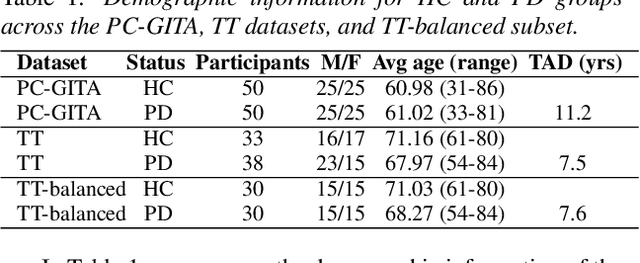
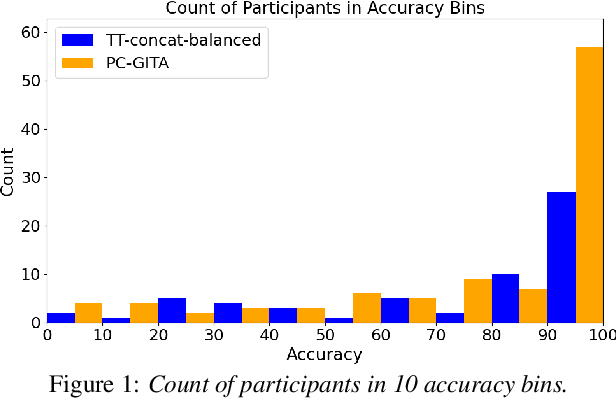
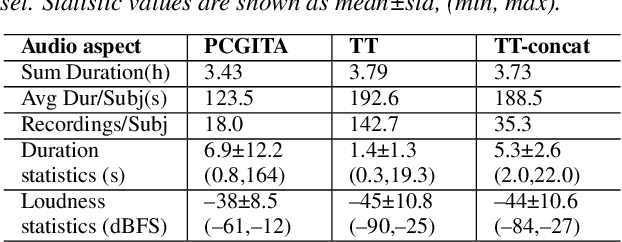
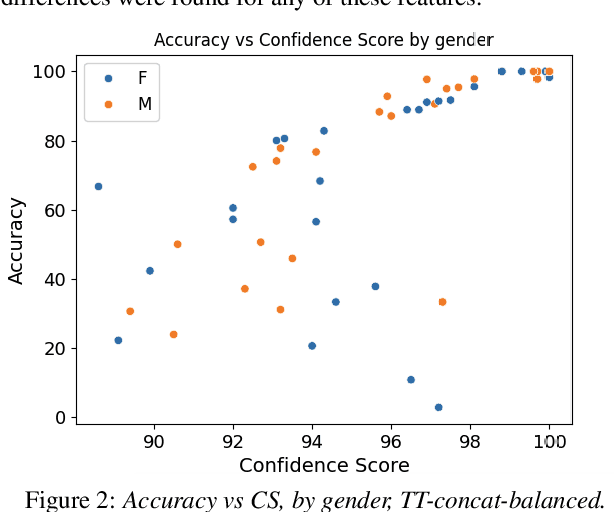
Speech-based Parkinson's disease (PD) detection has gained attention for its automated, cost-effective, and non-intrusive nature. As research studies usually rely on data from diagnostic-oriented speech tasks, this work explores the feasibility of diagnosing PD on the basis of speech data not originally intended for diagnostic purposes, using the Turn-Taking (TT) dataset. Our findings indicate that TT can be as useful as diagnostic-oriented PD datasets like PC-GITA. We also investigate which specific dataset characteristics impact PD classification performance. The results show that concatenating audio recordings and balancing participants' gender and status distributions can be beneficial. Cross-dataset evaluation reveals that models trained on PC-GITA generalize poorly to TT, whereas models trained on TT perform better on PC-GITA. Furthermore, we provide insights into the high variability across folds, which is mainly due to large differences in individual speaker performance.
BenSParX: A Robust Explainable Machine Learning Framework for Parkinson's Disease Detection from Bengali Conversational Speech
May 18, 2025Parkinson's disease (PD) poses a growing global health challenge, with Bangladesh experiencing a notable rise in PD-related mortality. Early detection of PD remains particularly challenging in resource-constrained settings, where voice-based analysis has emerged as a promising non-invasive and cost-effective alternative. However, existing studies predominantly focus on English or other major languages; notably, no voice dataset for PD exists for Bengali - posing a significant barrier to culturally inclusive and accessible healthcare solutions. Moreover, most prior studies employed only a narrow set of acoustic features, with limited or no hyperparameter tuning and feature selection strategies, and little attention to model explainability. This restricts the development of a robust and generalizable machine learning model. To address this gap, we present BenSparX, the first Bengali conversational speech dataset for PD detection, along with a robust and explainable machine learning framework tailored for early diagnosis. The proposed framework incorporates diverse acoustic feature categories, systematic feature selection methods, and state-of-the-art machine learning algorithms with extensive hyperparameter optimization. Furthermore, to enhance interpretability and trust in model predictions, the framework incorporates SHAP (SHapley Additive exPlanations) analysis to quantify the contribution of individual acoustic features toward PD detection. Our framework achieves state-of-the-art performance, yielding an accuracy of 95.77%, F1 score of 95.57%, and AUC-ROC of 0.982. We further externally validated our approach by applying the framework to existing PD datasets in other languages, where it consistently outperforms state-of-the-art approaches. To facilitate further research and reproducibility, the dataset has been made publicly available at https://github.com/Riad071/BenSParX.
Variational Autoencoder for Personalized Pathological Speech Enhancement
Mar 18, 2025

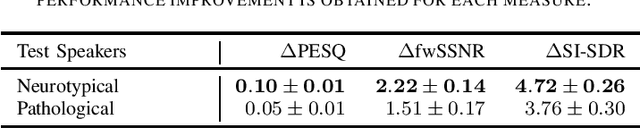
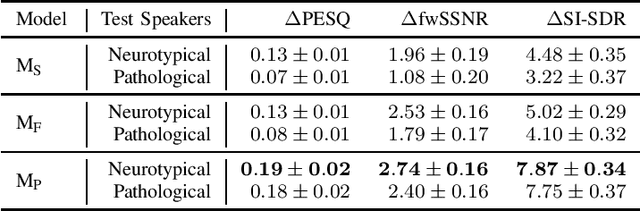
The generalizability of speech enhancement (SE) models across speaker conditions remains largely unexplored, despite its critical importance for broader applicability. This paper investigates the performance of the hybrid variational autoencoder (VAE)-non-negative matrix factorization (NMF) model for SE, focusing primarily on its generalizability to pathological speakers with Parkinson's disease. We show that VAE models trained on large neurotypical datasets perform poorly on pathological speech. While fine-tuning these pre-trained models with pathological speech improves performance, a performance gap remains between neurotypical and pathological speakers. To address this gap, we propose using personalized SE models derived from fine-tuning pre-trained models with only a few seconds of clean data from each speaker. Our results demonstrate that personalized models considerably enhance performance for all speakers, achieving comparable results for both neurotypical and pathological speakers.
Robust Cross-Etiology and Speaker-Independent Dysarthric Speech Recognition
Jan 25, 2025


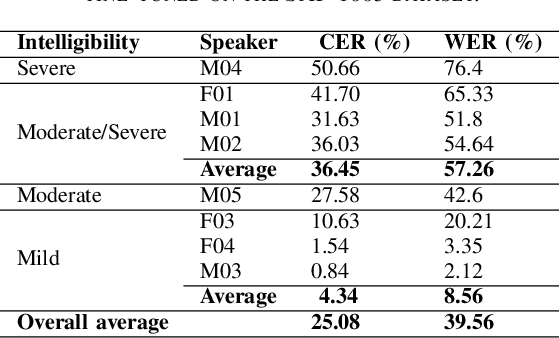
In this paper, we present a speaker-independent dysarthric speech recognition system, with a focus on evaluating the recently released Speech Accessibility Project (SAP-1005) dataset, which includes speech data from individuals with Parkinson's disease (PD). Despite the growing body of research in dysarthric speech recognition, many existing systems are speaker-dependent and adaptive, limiting their generalizability across different speakers and etiologies. Our primary objective is to develop a robust speaker-independent model capable of accurately recognizing dysarthric speech, irrespective of the speaker. Additionally, as a secondary objective, we aim to test the cross-etiology performance of our model by evaluating it on the TORGO dataset, which contains speech samples from individuals with cerebral palsy (CP) and amyotrophic lateral sclerosis (ALS). By leveraging the Whisper model, our speaker-independent system achieved a CER of 6.99% and a WER of 10.71% on the SAP-1005 dataset. Further, in cross-etiology settings, we achieved a CER of 25.08% and a WER of 39.56% on the TORGO dataset. These results highlight the potential of our approach to generalize across unseen speakers and different etiologies of dysarthria.
Bilingual Dual-Head Deep Model for Parkinson's Disease Detection from Speech
Mar 13, 2025
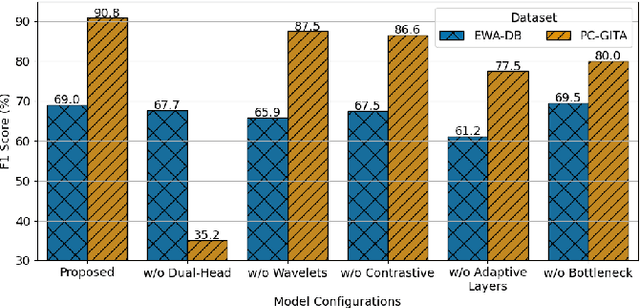
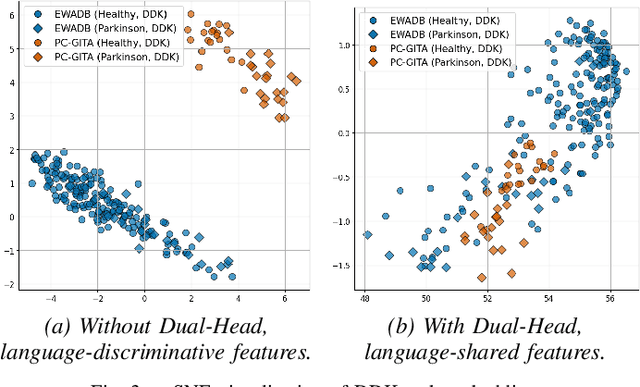
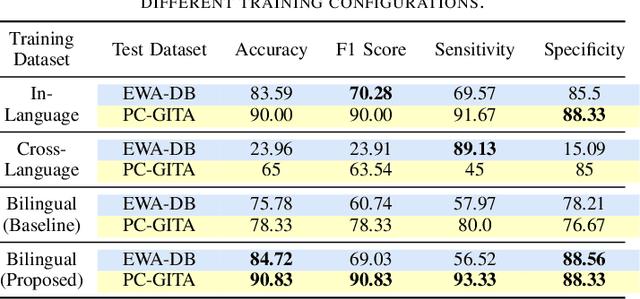
This work aims to tackle the Parkinson's disease (PD) detection problem from the speech signal in a bilingual setting by proposing an ad-hoc dual-head deep neural architecture for type-based binary classification. One head is specialized for diadochokinetic patterns. The other head looks for natural speech patterns present in continuous spoken utterances. Only one of the two heads is operative accordingly to the nature of the input. Speech representations are extracted from self-supervised learning (SSL) models and wavelet transforms. Adaptive layers, convolutional bottlenecks, and contrastive learning are exploited to reduce variations across languages. Our solution is assessed against two distinct datasets, EWA-DB, and PC-GITA, which cover Slovak and Spanish languages, respectively. Results indicate that conventional models trained on a single language dataset struggle with cross-linguistic generalization, and naive combinations of datasets are suboptimal. In contrast, our model improves generalization on both languages, simultaneously.
Distinguishing Parkinson's Patients Using Voice-Based Feature Extraction and Classification
Jan 24, 2025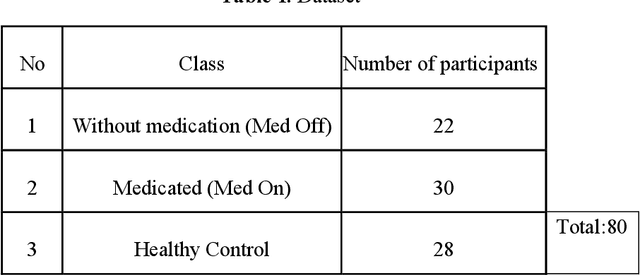
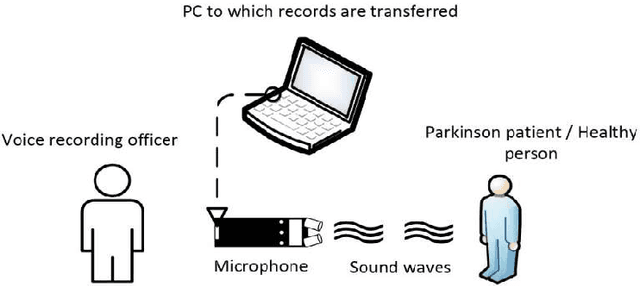

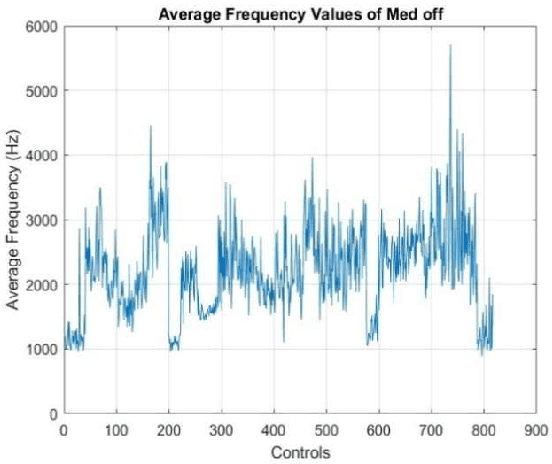
Parkinson's disease (PD) is a progressive neurodegenerative disorder that impacts motor functions and speech characteristics This study focuses on differentiating individuals with Parkinson's disease from healthy controls through the extraction and classification of speech features. Patients were further divided into 2 groups. Med On represents the patient with medication, while Med Off represents the patient without medication. The dataset consisted of patients and healthy individuals who read a predefined text using the H1N Zoom microphone in a suitable recording environment at F{\i}rat University Neurology Department. Speech recordings from PD patients and healthy controls were analyzed, and 19 key features were extracted, including jitter, luminance, zero-crossing rate (ZCR), root mean square (RMS) energy, entropy, skewness, and kurtosis.These features were visualized in graphs and statistically evaluated to identify distinctive patterns in PD patients. Using MATLAB's Classification Learner toolbox, several machine learning classification algorithm models were applied to classify groups and significant accuracy rates were achieved. The accuracy of our 3-layer artificial neural network architecture was also compared with classical machine learning algorithms. This study highlights the potential of noninvasive voice analysis combined with machine learning for early detection and monitoring of PD patients. Future research can improve diagnostic accuracy by optimizing feature selection and exploring advanced classification techniques.
Towards a Generalizable Speech Marker for Parkinson's Disease Diagnosis
Jan 07, 2025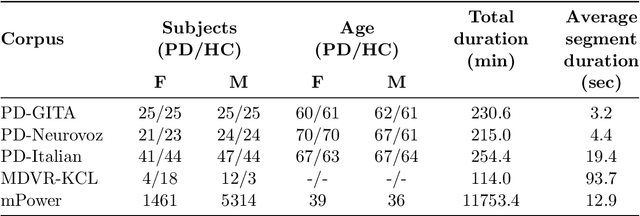

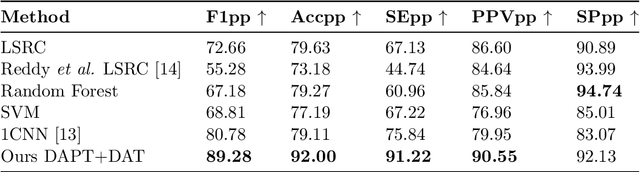
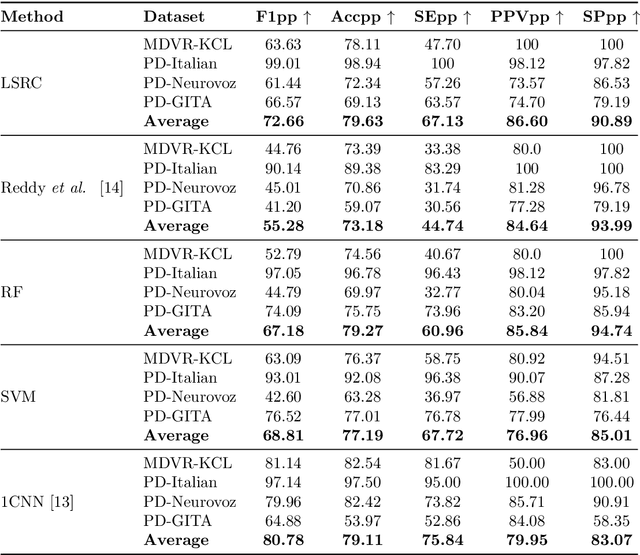
Parkinson's Disease (PD) is a neurodegenerative disorder characterized by motor symptoms, including altered voice production in the early stages. Early diagnosis is crucial not only to improve PD patients' quality of life but also to enhance the efficacy of potential disease-modifying therapies during early neurodegeneration, a window often missed by current diagnostic tools. In this paper, we propose a more generalizable approach to PD recognition through domain adaptation and self-supervised learning. We demonstrate the generalization capabilities of the proposed approach across diverse datasets in different languages. Our approach leverages HuBERT, a large deep neural network originally trained for speech recognition and further trains it on unlabeled speech data from a population that is similar to the target group, i.e., the elderly, in a self-supervised manner. The model is then fine-tuned and adapted for use across different datasets in multiple languages, including English, Italian, and Spanish. Evaluations on four publicly available PD datasets demonstrate the model's efficacy, achieving an average specificity of 92.1% and an average sensitivity of 91.2%. This method offers objective and consistent evaluations across large populations, addressing the variability inherent in human assessments and providing a non-invasive, cost-effective and accessible diagnostic option.