 Add to Chrome
 Add to Firefox
 Add to Edge
A Benchmark for Early-stage Parkinson's Disease Detection from Speech
May 13, 2026
Early-stage Parkinson's disease (EarlyPD) detection from speech is clinically meaningful yet underexplored, and published results are hard to compare because studies differ in datasets, languages, tasks, evaluation protocols, and EarlyPD definitions. To address this issue, we propose the first benchmark for speech-based EarlyPD detection, with a speaker-independent split designed for fair and replicable cross-method evaluation on researcher-accessible datasets. The benchmark covers three common speech tasks and evaluates methods under different training-resource settings. We also present multi-dimensional evaluation breakdowns by dataset, aggregation level, gender, and disease stage to support fine-grained comparisons and clinical adoption. Our results provide a replicable reference and actionable insights, encouraging the adoption of this publicly available benchmark to advance robust and clinically meaningful EarlyPD detection from speech.

Evaluating the Usefulness of Non-Diagnostic Speech Data for Developing Parkinson's Disease Classifiers
May 24, 2025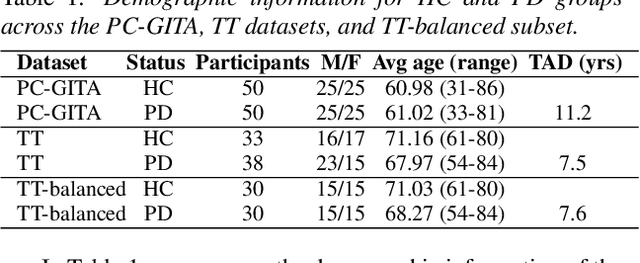
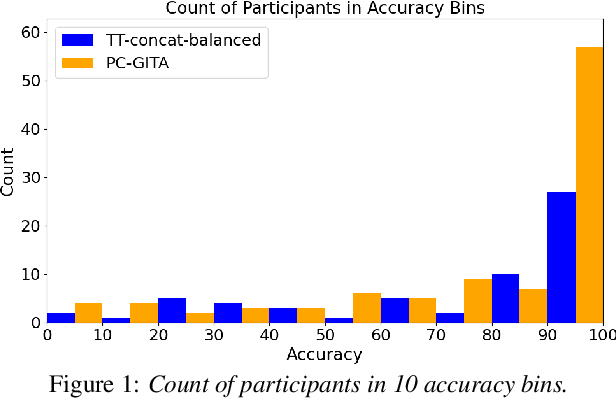
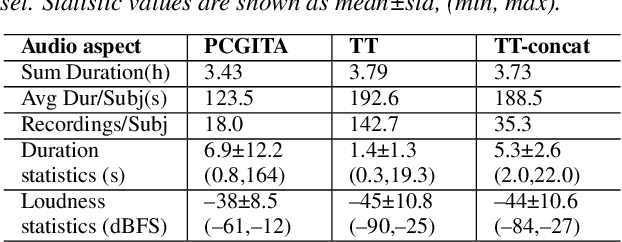
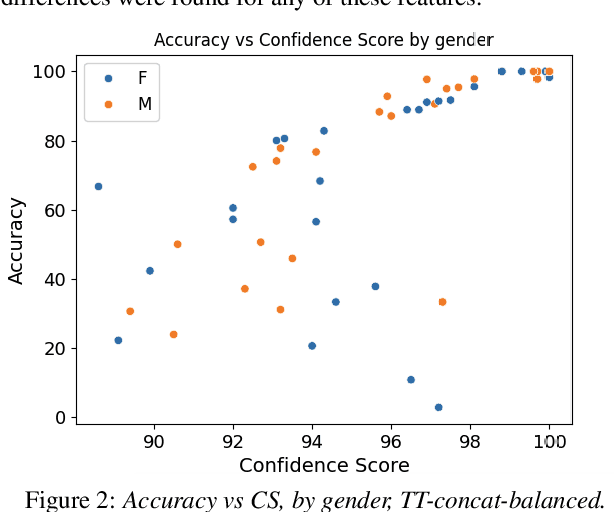
Speech-based Parkinson's disease (PD) detection has gained attention for its automated, cost-effective, and non-intrusive nature. As research studies usually rely on data from diagnostic-oriented speech tasks, this work explores the feasibility of diagnosing PD on the basis of speech data not originally intended for diagnostic purposes, using the Turn-Taking (TT) dataset. Our findings indicate that TT can be as useful as diagnostic-oriented PD datasets like PC-GITA. We also investigate which specific dataset characteristics impact PD classification performance. The results show that concatenating audio recordings and balancing participants' gender and status distributions can be beneficial. Cross-dataset evaluation reveals that models trained on PC-GITA generalize poorly to TT, whereas models trained on TT perform better on PC-GITA. Furthermore, we provide insights into the high variability across folds, which is mainly due to large differences in individual speaker performance.