 Add to Chrome
 Add to Firefox
 Add to Edge
Low-Burden Data Augmentation for Dysarthric ASR via Zero-Shot Voice Cloning
Jun 18, 2026
Automatic speech recognition remains unreliable for dysarthric speech due to data scarcity and high inter-speaker variability. While synthetic data can address these gaps, traditional methods often require extensive speaker-specific data, reintroducing the collection bottleneck. We investigate zero-shot voice cloning as a low-burden augmentation strategy, using Higgs Audio V2 to clone speakers in the TORGO dataset. We fine-tune (FT) Whisper-medium on cloned, real, and hybrid data and evaluate on held-out real speech. Compared to the zero-shot (31.62%), Clone FT achieved a competitive 26.00% WER, nearly matching the 24.44% and 25.12% seen with Real and Hybrid FT, respectively. Notably, Clone and Hybrid FT outperform Real FT for moderate-severe speakers. Clone FT achieves the best results (11.45% relative) in cross-corpus evaluation on the SAP-1102. These results suggest that zero-shot cloning provides scalable training data that circumvents the costly data collection bottleneck.

Robust Cross-Etiology and Speaker-Independent Dysarthric Speech Recognition
Jan 25, 2025


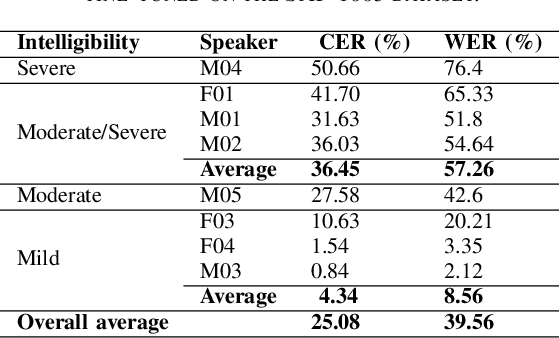
In this paper, we present a speaker-independent dysarthric speech recognition system, with a focus on evaluating the recently released Speech Accessibility Project (SAP-1005) dataset, which includes speech data from individuals with Parkinson's disease (PD). Despite the growing body of research in dysarthric speech recognition, many existing systems are speaker-dependent and adaptive, limiting their generalizability across different speakers and etiologies. Our primary objective is to develop a robust speaker-independent model capable of accurately recognizing dysarthric speech, irrespective of the speaker. Additionally, as a secondary objective, we aim to test the cross-etiology performance of our model by evaluating it on the TORGO dataset, which contains speech samples from individuals with cerebral palsy (CP) and amyotrophic lateral sclerosis (ALS). By leveraging the Whisper model, our speaker-independent system achieved a CER of 6.99% and a WER of 10.71% on the SAP-1005 dataset. Further, in cross-etiology settings, we achieved a CER of 25.08% and a WER of 39.56% on the TORGO dataset. These results highlight the potential of our approach to generalize across unseen speakers and different etiologies of dysarthria.