 Add to Chrome
 Add to Firefox
 Add to Edge
Ecommerce
Papers and Code
GenFacet: End-to-End Generative Faceted Search via Multi-Task Preference Alignment in E-Commerce
Mar 20, 2026
Faceted search acts as a critical bridge for navigating massive ecommerce catalogs, yet traditional systems rely on static rule-based extraction or statistical ranking, struggling with emerging vocabulary, semantic gaps, and a disconnect between facet selection and underlying retrieval. In this paper, we introduce GenFacet, an industrial-grade, end-to-end generative framework deployed at JD.com. GenFacet reframes faceted search as two coupled generative tasks within a unified Large Language Model: Context-Aware Facet Generation, which dynamically synthesizes trend-responsive navigation options, and Intent-Driven Query Rewriting, which translates user interactions into precise search queries to close the retrieval loop. To bridge the gap between generative capabilities and search utility, we propose a novel multi-task training pipeline combining teacher-student distillation with GRPO. This aligns the model with complex user preferences by directly optimizing for downstream search satisfaction. Validated on China's largest selfoperated e-commerce platform via rigorous offline evaluations and online A/B tests, GenFacet demonstrated substantial improvements. Specifically, online results reveal a relative increase of 42.0% in facet Click-Through Rate (CTR) and 2.0% in User Conversion Rate (UCVR). These outcomes provide strong evidence of the benefits of generative methods for improving query understanding and user engagement in large-scale information retrieval systems.

Trackly: A Unified SaaS Platform for User Behavior Analytics and Real Time Rule Based Anomaly Detection
Jan 30, 2026Understanding user behavior is essential for improving digital experiences, optimizing business conversions, and mitigating threats like account takeovers, fraud, and bot attacks. Most platforms separate product analytics and security, creating fragmented visibility and delayed threat detection. Trackly, a scalable SaaS platform, unifies comprehensive user behavior analytics with real time, rule based anomaly detection. It tracks sessions, IP based geo location, device browser fingerprints, and granular events such as page views, add to cart, and checkouts. Suspicious activities logins from new devices or locations, impossible travel (Haversine formula), rapid bot like actions, VPN proxy usage, or multiple accounts per IP are flagged via configurable rules with weighted risk scoring, enabling transparent, explainable decisions. A real time dashboard provides global session maps, DAU MAU, bounce rates, and session durations. Integration is simplified with a lightweight JavaScript SDK and secure REST APIs. Implemented on a multi tenant microservices stack (ASP.NET Core, MongoDB, RabbitMQ, Next.js), Trackly achieved 98.1% accuracy, 97.7% precision, and 2.25% false positives on synthetic datasets, proving its efficiency for SMEs and ecommerce.
STARS: Semantic Tokens with Augmented Representations for Recommendation at Scale
Dec 13, 2025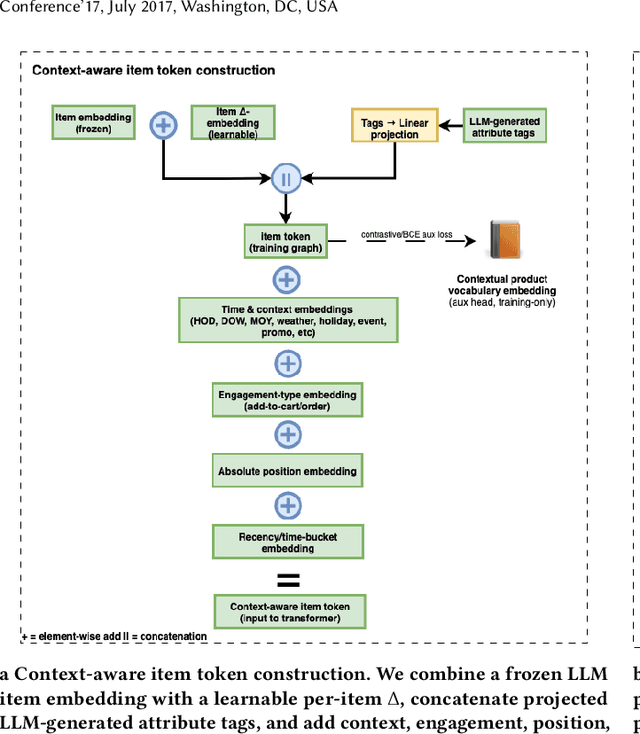
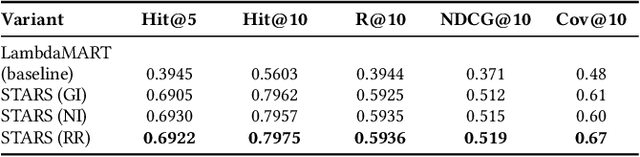
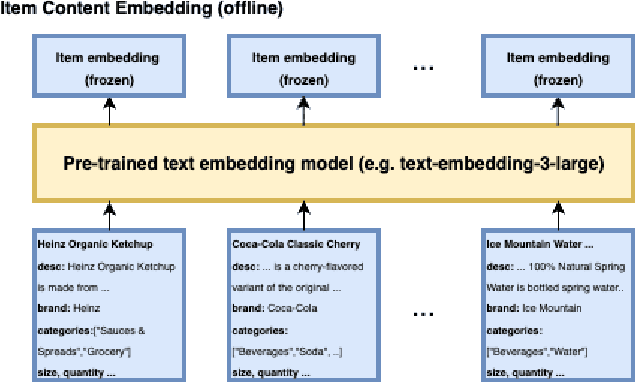
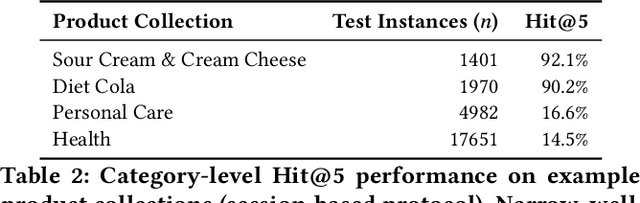
Real-world ecommerce recommender systems must deliver relevant items under strict tens-of-milliseconds latency constraints despite challenges such as cold-start products, rapidly shifting user intent, and dynamic context including seasonality, holidays, and promotions. We introduce STARS, a transformer-based sequential recommendation framework built for large-scale, low-latency ecommerce settings. STARS combines several innovations: dual-memory user embeddings that separate long-term preferences from short-term session intent; semantic item tokens that fuse pretrained text embeddings, learnable deltas, and LLM-derived attribute tags, strengthening content-based matching, long-tail coverage, and cold-start performance; context-aware scoring with learned calendar and event offsets; and a latency-conscious two-stage retrieval pipeline that performs offline embedding generation and online maximum inner-product search with filtering, enabling tens-of-milliseconds response times. In offline evaluations on production-scale data, STARS improves Hit@5 by more than 75 percent relative to our existing LambdaMART system. A large-scale A/B test on 6 million visits shows statistically significant lifts, including Total Orders +0.8%, Add-to-Cart on Home +2.0%, and Visits per User +0.5%. These results demonstrate that combining semantic enrichment, multi-intent modeling, and deployment-oriented design can yield state-of-the-art recommendation quality in real-world environments without sacrificing serving efficiency.
AdaRec: Adaptive Recommendation with LLMs via Narrative Profiling and Dual-Channel Reasoning
Nov 10, 2025We propose AdaRec, a few-shot in-context learning framework that leverages large language models for an adaptive personalized recommendation. AdaRec introduces narrative profiling, transforming user-item interactions into natural language representations to enable unified task handling and enhance human readability. Centered on a bivariate reasoning paradigm, AdaRec employs a dual-channel architecture that integrates horizontal behavioral alignment, discovering peer-driven patterns, with vertical causal attribution, highlighting decisive factors behind user preferences. Unlike existing LLM-based approaches, AdaRec eliminates manual feature engineering through semantic representations and supports rapid cross-task adaptation with minimal supervision. Experiments on real ecommerce datasets demonstrate that AdaRec outperforms both machine learning models and LLM-based baselines by up to eight percent in few-shot settings. In zero-shot scenarios, it achieves up to a nineteen percent improvement over expert-crafted profiling, showing effectiveness for long-tail personalization with minimal interaction data. Furthermore, lightweight fine-tuning on synthetic data generated by AdaRec matches the performance of fully fine-tuned models, highlighting its efficiency and generalization across diverse tasks.
AI Agents and the Law
Aug 12, 2025As AI becomes more "agentic," it faces technical and socio-legal issues it must address if it is to fulfill its promise of increased economic productivity and efficiency. This paper uses technical and legal perspectives to explain how things change when AI systems start being able to directly execute tasks on behalf of a user. We show how technical conceptions of agents track some, but not all, socio-legal conceptions of agency. That is, both computer science and the law recognize the problems of under-specification for an agent, and both disciplines have robust conceptions of how to address ensuring an agent does what the programmer, or in the law, the principal desires and no more. However, to date, computer science has under-theorized issues related to questions of loyalty and to third parties that interact with an agent, both of which are central parts of the law of agency. First, we examine the correlations between implied authority in agency law and the principle of value-alignment in AI, wherein AI systems must operate under imperfect objective specification. Second, we reveal gaps in the current computer science view of agents pertaining to the legal concepts of disclosure and loyalty, and how failure to account for them can result in unintended effects in AI ecommerce agents. In surfacing these gaps, we show a path forward for responsible AI agent development and deployment.
Embedding based retrieval for long tail search queries in ecommerce
May 03, 2025
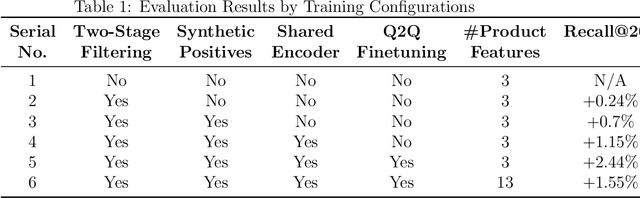
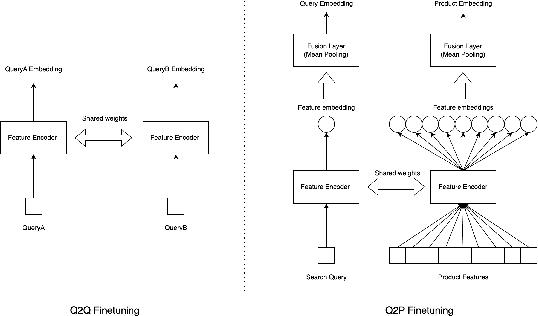
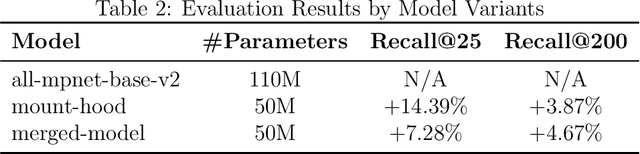
In this abstract we present a series of optimizations we performed on the two-tower model architecture [14], training and evaluation datasets to implement semantic product search at Best Buy. Search queries on bestbuy.com follow the pareto distribution whereby a minority of them account for most searches. This leaves us with a long tail of search queries that have low frequency of issuance. The queries in the long tail suffer from very spare interaction signals. Our current work focuses on building a model to serve the long tail queries. We present a series of optimizations we have done to this model to maximize conversion for the purpose of retrieval from the catalog. The first optimization we present is using a large language model to improve the sparsity of conversion signals. The second optimization is pretraining an off-the-shelf transformer-based model on the Best Buy catalog data. The third optimization we present is on the finetuning front. We use query-to-query pairs in addition to query-to-product pairs and combining the above strategies for finetuning the model. We also demonstrate how merging the weights of these finetuned models improves the evaluation metrics. Finally, we provide a recipe for curating an evaluation dataset for continuous monitoring of model performance with human-in-the-loop evaluation. We found that adding this recall mechanism to our current term match-based recall improved conversion by 3% in an online A/B test.
* Published at RecSys '24: Proceedings of the 18th ACM Conference on Recommender Systems
Widening the Role of Group Recommender Systems with CAJO
Apr 08, 2025Group Recommender Systems (GRSs) have been studied and developed for more than twenty years. However, their application and usage has not grown. They can even be labeled as failures, if compared to the very successful and common recommender systems (RSs) used on all the major ecommerce and social platforms. As a result, the RSs that we all use now, are only targeted for individual users, aiming at choosing an item exclusively for themselves; no choice support is provided to groups trying to select a service, a product, an experience, a person, serving equally well all the group members. In this opinion article we discuss why the success of group recommender systems is lagging and we propose a research program unfolding on the analysis and development of new forms of collaboration between humans and intelligent systems. We define a set of roles, named CAJO, that GRSs should play in order to become more useful tools for group decision making.
Hidden Darkness in LLM-Generated Designs: Exploring Dark Patterns in Ecommerce Web Components Generated by LLMs
Feb 19, 2025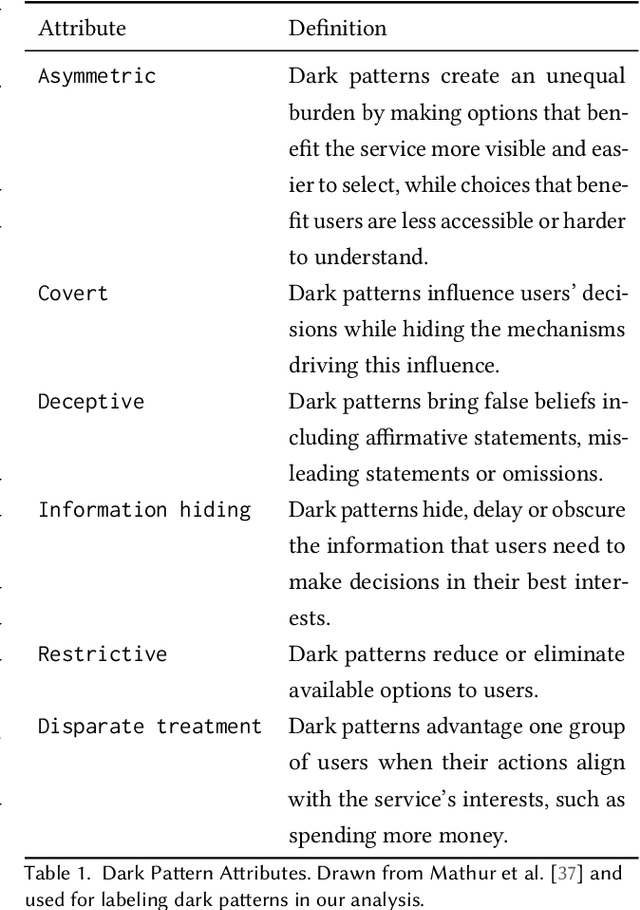

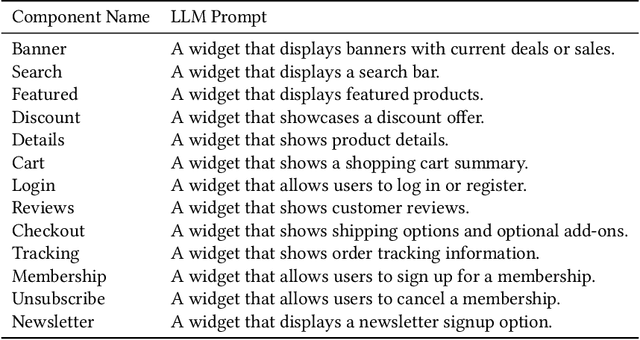
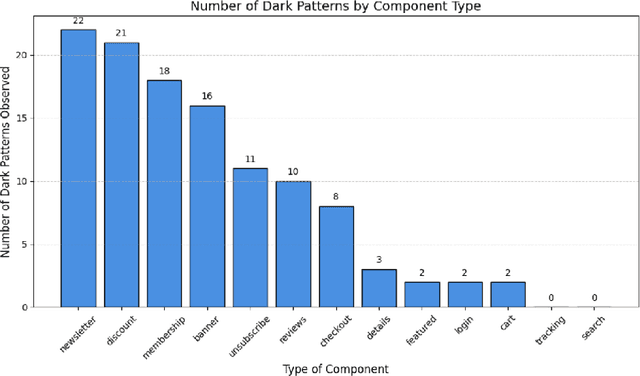
Recent work has highlighted the risks of LLM-generated content for a wide range of harmful behaviors, including incorrect and harmful code. In this work, we extend this by studying whether LLM-generated web design contains dark patterns. This work evaluated designs of ecommerce web components generated by four popular LLMs: Claude, GPT, Gemini, and Llama. We tested 13 commonly used ecommerce components (e.g., search, product reviews) and used them as prompts to generate a total of 312 components across all models. Over one-third of generated components contain at least one dark pattern. The majority of dark pattern strategies involve hiding crucial information, limiting users' actions, and manipulating them into making decisions through a sense of urgency. Dark patterns are also more frequently produced in components that are related to company interests. These findings highlight the need for interventions to prevent dark patterns during front-end code generation with LLMs and emphasize the importance of expanding ethical design education to a broader audience.
Semantic Ads Retrieval at Walmart eCommerce with Language Models Progressively Trained on Multiple Knowledge Domains
Feb 13, 2025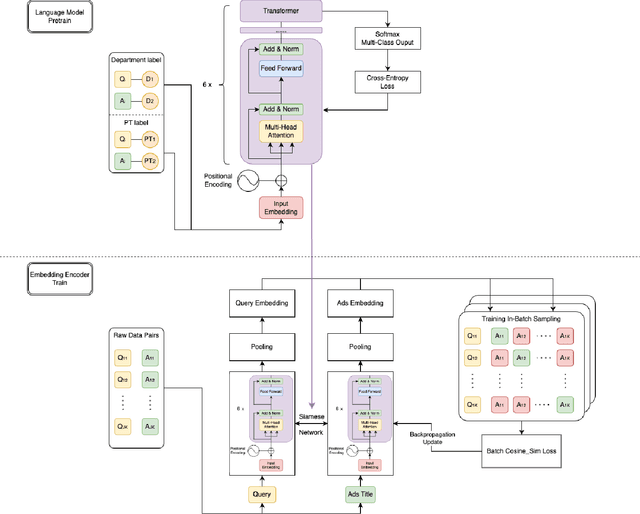
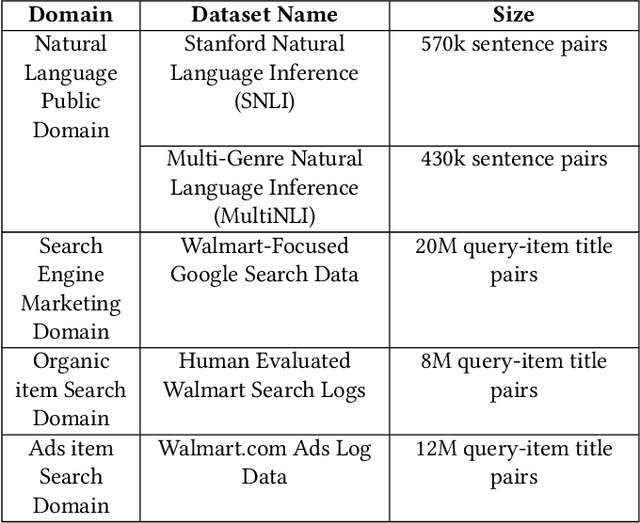
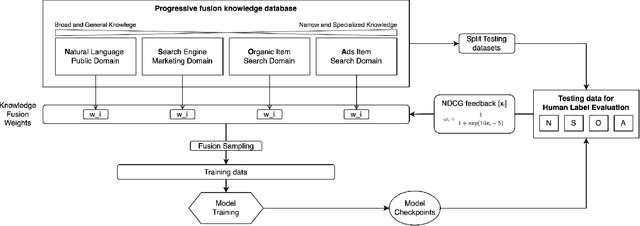
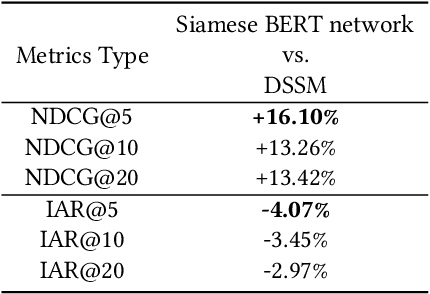
Sponsored search in e-commerce poses several unique and complex challenges. These challenges stem from factors such as the asymmetric language structure between search queries and product names, the inherent ambiguity in user search intent, and the vast volume of sparse and imbalanced search corpus data. The role of the retrieval component within a sponsored search system is pivotal, serving as the initial step that directly affects the subsequent ranking and bidding systems. In this paper, we present an end-to-end solution tailored to optimize the ads retrieval system on Walmart.com. Our approach is to pretrain the BERT-like classification model with product category information, enhancing the model's understanding of Walmart product semantics. Second, we design a two-tower Siamese Network structure for embedding structures to augment training efficiency. Third, we introduce a Human-in-the-loop Progressive Fusion Training method to ensure robust model performance. Our results demonstrate the effectiveness of this pipeline. It enhances the search relevance metric by up to 16% compared to a baseline DSSM-based model. Moreover, our large-scale online A/B testing demonstrates that our approach surpasses the ad revenue of the existing production model.
1-2-1: Renaissance of Single-Network Paradigm for Virtual Try-On
Jan 09, 2025
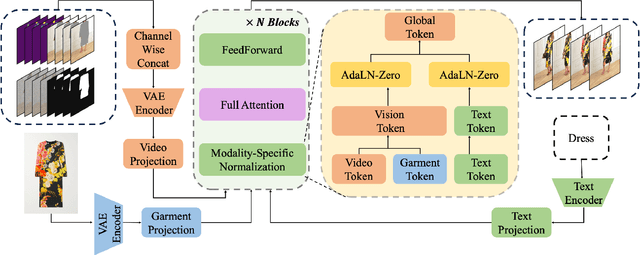


Virtual Try-On (VTON) has become a crucial tool in ecommerce, enabling the realistic simulation of garments on individuals while preserving their original appearance and pose. Early VTON methods relied on single generative networks, but challenges remain in preserving fine-grained garment details due to limitations in feature extraction and fusion. To address these issues, recent approaches have adopted a dual-network paradigm, incorporating a complementary "ReferenceNet" to enhance garment feature extraction and fusion. While effective, this dual-network approach introduces significant computational overhead, limiting its scalability for high-resolution and long-duration image/video VTON applications. In this paper, we challenge the dual-network paradigm by proposing a novel single-network VTON method that overcomes the limitations of existing techniques. Our method, namely MNVTON, introduces a Modality-specific Normalization strategy that separately processes text, image and video inputs, enabling them to share the same attention layers in a VTON network. Extensive experimental results demonstrate the effectiveness of our approach, showing that it consistently achieves higher-quality, more detailed results for both image and video VTON tasks. Our results suggest that the single-network paradigm can rival the performance of dualnetwork approaches, offering a more efficient alternative for high-quality, scalable VTON applications.