 Add to Chrome
 Add to Firefox
 Add to Edge
Cross Lingual Asr
Papers and Code
BBPE16: UTF-16-based byte-level byte-pair encoding for improved multilingual speech recognition
Feb 02, 2026
Multilingual automatic speech recognition (ASR) requires tokenization that efficiently covers many writing systems. Byte-level BPE (BBPE) using UTF-8 is widely adopted for its language-agnostic design and full Unicode coverage, but its variable-length encoding inflates token sequences for non-Latin scripts, such as Chinese, Japanese, and Korean (CJK). Longer sequences increase computational load and memory use. We propose BBPE16, a UTF-16-based BBPE tokenizer that represents most modern scripts with a uniform 2-byte code unit. BBPE16 preserves BBPE's language-agnostic properties while substantially improving cross-lingual token sharing. Across monolingual, bilingual, and trilingual ASR, and in a multilingual continual-learning setup, BBPE16 attains comparable or better accuracy; for Chinese, it reduces token counts by up to 10.4% and lowers decoding iterations by up to 10.3%. These reductions speed up fine-tuning and inference and decrease memory usage, making BBPE16 a practical tokenization choice for multilingual ASR.

Dynamic Multi-Expert Projectors with Stabilized Routing for Multilingual Speech Recognition
Jan 27, 2026Recent advances in LLM-based ASR connect frozen speech encoders with Large Language Models (LLMs) via lightweight projectors. While effective in monolingual settings, a single projector struggles to capture the diverse acoustic-to-semantic mappings required for multilingual ASR. To address this, we propose SMEAR-MoE, a stabilized Mixture-of-Experts projector that ensures dense gradient flow to all experts, preventing expert collapse while enabling cross-lingual sharing. We systematically compare monolithic, static multi-projector, and dynamic MoE designs across four Indic languages (Hindi, Marathi, Tamil, Telugu). Our SMEAR-MoE achieves strong performance, delivering upto a 7.6% relative WER reduction over the single-projector baseline, while maintaining comparable runtime efficiency. Analysis of expert routing further shows linguistically meaningful specialization, with related languages sharing experts. These results demonstrate that stable multi-expert projectors are key to scalable and robust multilingual ASR.
Dialect Matters: Cross-Lingual ASR Transfer for Low-Resource Indic Language Varieties
Jan 07, 2026We conduct an empirical study of cross-lingual transfer using spontaneous, noisy, and code-mixed speech across a wide range of Indic dialects and language varieties. Our results indicate that although ASR performance is generally improved with reduced phylogenetic distance between languages, this factor alone does not fully explain performance in dialectal settings. Often, fine-tuning on smaller amounts of dialectal data yields performance comparable to fine-tuning on larger amounts of phylogenetically-related, high-resource standardized languages. We also present a case study on Garhwali, a low-resource Pahari language variety, and evaluate multiple contemporary ASR models. Finally, we analyze transcription errors to examine bias toward pre-training languages, providing additional insight into challenges faced by ASR systems on dialectal and non-standardized speech.
Multimodal In-context Learning for ASR of Low-resource Languages
Jan 09, 2026Automatic speech recognition (ASR) still covers only a small fraction of the world's languages, mainly due to supervised data scarcity. In-context learning (ICL) with large language models (LLMs) addresses this problem, but prior work largely focuses on high-resource languages covered during training and text-only settings. This paper investigates whether speech LLMs can learn unseen languages with multimodal ICL (MICL), and how this learning can be used to improve ASR. We conduct experiments with two speech LLMs, Phi-4 and Qwen3-Omni, on three diverse endangered languages. Firstly, we find that MICL is effective for unseen languages, leveraging both speech and text modalities. We further show that cross-lingual transfer learning improves MICL efficiency on target languages without training on them. Moreover, we analyze attention patterns to interpret MICL mechanisms, and we observe layer-dependent preferences between audio and text context, with an overall bias towards text. Finally, we show that prompt-based ASR with speech LLMs performs poorly on unseen languages, motivating a simple ASR system that combines a stronger acoustic model with a speech LLM via MICL-based selection of acoustic hypotheses. Results show that MICL consistently improves ASR performance, and that cross-lingual transfer learning matches or outperforms corpus-trained language models without using target-language data. Our code is publicly available.
Corpus of Cross-lingual Dialogues with Minutes and Detection of Misunderstandings
Dec 23, 2025Speech processing and translation technology have the potential to facilitate meetings of individuals who do not share any common language. To evaluate automatic systems for such a task, a versatile and realistic evaluation corpus is needed. Therefore, we create and present a corpus of cross-lingual dialogues between individuals without a common language who were facilitated by automatic simultaneous speech translation. The corpus consists of 5 hours of speech recordings with ASR and gold transcripts in 12 original languages and automatic and corrected translations into English. For the purposes of research into cross-lingual summarization, our corpus also includes written summaries (minutes) of the meetings. Moreover, we propose automatic detection of misunderstandings. For an overview of this task and its complexity, we attempt to quantify misunderstandings in cross-lingual meetings. We annotate misunderstandings manually and also test the ability of current large language models to detect them automatically. The results show that the Gemini model is able to identify text spans with misunderstandings with recall of 77% and precision of 47%.
* 12 pages, 2 figures, 6 tables, published as a conference paper in Text, Speech, and Dialogue 28th International Conference, TSD 2025, Erlangen, Germany, August 25-28, 2025, Proceedings, Part II. This version published here on arXiv.org is before review comments and seedings of the TSD conference staff
Efficient ASR for Low-Resource Languages: Leveraging Cross-Lingual Unlabeled Data
Dec 08, 2025Automatic speech recognition for low-resource languages remains fundamentally constrained by the scarcity of labeled data and computational resources required by state-of-the-art models. We present a systematic investigation into cross-lingual continuous pretraining for low-resource languages, using Perso-Arabic languages (Persian, Arabic, and Urdu) as our primary case study. Our approach demonstrates that strategic utilization of unlabeled speech data can effectively bridge the resource gap without sacrificing recognition accuracy. We construct a 3,000-hour multilingual corpus through a scalable unlabeled data collection pipeline and employ targeted continual pretraining combined with morphologically-aware tokenization to develop a 300M parameter model that achieves performance comparable to systems 5 times larger. Our model outperforms Whisper Large v3 (1.5B parameters) on Persian and achieves competitive results on Arabic and Urdu despite using significantly fewer parameters and substantially less labeled data. These findings challenge the prevailing assumption that ASR quality scales primarily with model size, revealing instead that data relevance and strategic pretraining are more critical factors for low-resource scenarios. This work provides a practical pathway toward inclusive speech technology, enabling effective ASR for underrepresented languages without dependence on massive computational infrastructure or proprietary datasets.
CLiFT-ASR: A Cross-Lingual Fine-Tuning Framework for Low-Resource Taiwanese Hokkien Speech Recognition
Nov 10, 2025Automatic speech recognition (ASR) for low-resource languages such as Taiwanese Hokkien is difficult due to the scarcity of annotated data. However, direct fine-tuning on Han-character transcriptions often fails to capture detailed phonetic and tonal cues, while training only on romanization lacks lexical and syntactic coverage. In addition, prior studies have rarely explored staged strategies that integrate both annotation types. To address this gap, we present CLiFT-ASR, a cross-lingual fine-tuning framework that builds on Mandarin HuBERT models and progressively adapts them to Taiwanese Hokkien. The framework employs a two-stage process in which it first learns acoustic and tonal representations from phonetic Tai-lo annotations and then captures vocabulary and syntax from Han-character transcriptions. This progressive adaptation enables effective alignment between speech sounds and orthographic structures. Experiments on the TAT-MOE corpus demonstrate that CLiFT-ASR achieves a 24.88\% relative reduction in character error rate (CER) compared with strong baselines. The results indicate that CLiFT-ASR provides an effective and parameter-efficient solution for Taiwanese Hokkien ASR and that it has potential to benefit other low-resource language scenarios.
TTA: Transcribe, Translate and Alignment for Cross-lingual Speech Representation
Nov 18, 2025Speech-LLM models have demonstrated great performance in multi-modal and multi-task speech understanding. A typical speech-LLM paradigm is integrating speech modality with a large language model (LLM). While the Whisper encoder was frequently adopted in previous studies for speech input, it shows limitations regarding input format, model scale, and semantic performance. To this end, we propose a lightweight TTA model specialized in speech semantics for more effective LLM integration. With large-scale training of 358k hours of speech data on multilingual speech recognition (ASR), speech translation (ST) and speech-text alignment tasks, TTA is capable of producing robust cross-lingual speech representations. Extensive evaluations across diverse benchmarks, including ASR/ST, speech retrieval, and ASR-LLM performance assessments, demonstrate TTA's superiority over Whisper. Furthermore, we rigorously validate the interplay between cross-lingual capabilities and ASR/ST performance. The model weights and training recipes of TTA will be released as part of an audio understanding toolkit Auden.
The Limits of Data Scaling: Sub-token Utilization and Acoustic Saturation in Multilingual ASR
Oct 26, 2025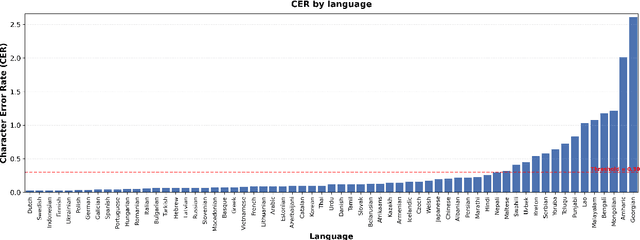
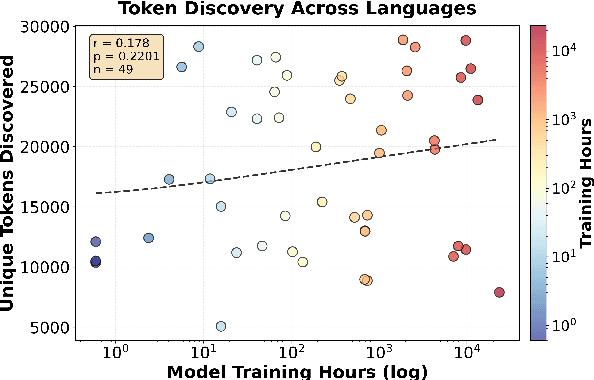
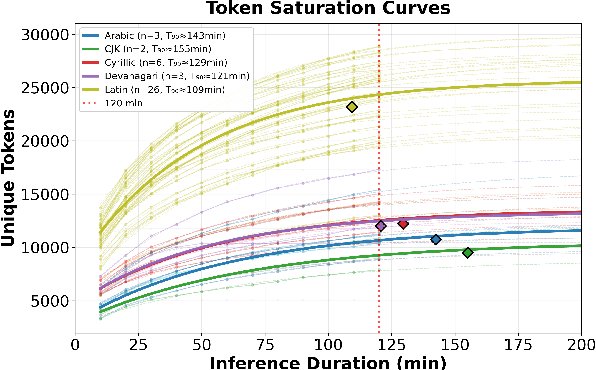
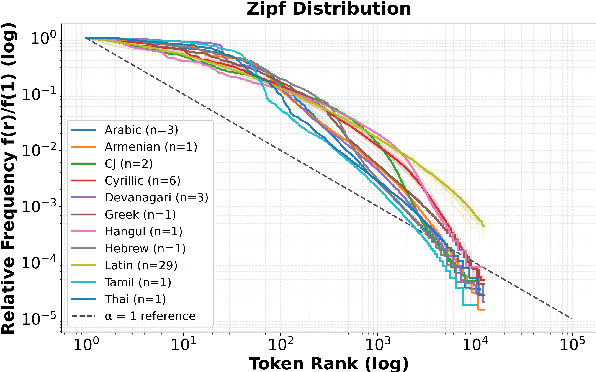
How much audio is needed to fully observe a multilingual ASR model's learned sub-token inventory across languages, and does data disparity in multilingual pre-training affect how these tokens are utilized during inference? We address this question by analyzing Whisper's decoding behavior during inference across 49 languages. By logging decoding candidate sub-tokens and tracking their cumulative discovery over time, we study the utilization pattern of the model's sub-token space. Results show that the total number of discovered tokens remains largely independent of a language's pre-training hours, indicating that data disparity does not strongly influence lexical diversity in the model's hypothesis space. Sub-token discovery rates follow a consistent exponential saturation pattern across languages, suggesting a stable time window after which additional audio yields minimal new sub-token activation. We refer to this convergence threshold as acoustic saturation time (AST). Further analyses of rank-frequency distributions reveal Zipf-like patterns better modeled by a Zipf-Mandelbrot law, and mean sub-token length shows a positive correlation with resource level. Additionally, those metrics show more favorable patterns for languages in the Latin script than those in scripts such as Cyrillic, CJK, and Semitic. Together, our study suggests that sub-token utilization during multilingual ASR inference is constrained more by the statistical, typological, and orthographic structure of the speech than by training data scale, providing an empirical basis for more equitable corpus construction and cross-lingual evaluation.
LRW-Persian: Lip-reading in the Wild Dataset for Persian Language
Oct 26, 2025Lipreading has emerged as an increasingly important research area for developing robust speech recognition systems and assistive technologies for the hearing-impaired. However, non-English resources for visual speech recognition remain limited. We introduce LRW-Persian, the largest in-the-wild Persian word-level lipreading dataset, comprising $743$ target words and over $414{,}000$ video samples extracted from more than $1{,}900$ hours of footage across $67$ television programs. Designed as a benchmark-ready resource, LRW-Persian provides speaker-disjoint training and test splits, wide regional and dialectal coverage, and rich per-clip metadata including head pose, age, and gender. To ensure large-scale data quality, we establish a fully automated end-to-end curation pipeline encompassing transcription based on Automatic Speech Recognition(ASR), active-speaker localization, quality filtering, and pose/mask screening. We further fine-tune two widely used lipreading architectures on LRW-Persian, establishing reference performance and demonstrating the difficulty of Persian visual speech recognition. By filling a critical gap in low-resource languages, LRW-Persian enables rigorous benchmarking, supports cross-lingual transfer, and provides a foundation for advancing multimodal speech research in underrepresented linguistic contexts. The dataset is publicly available at: https://lrw-persian.vercel.app.