 Add to Chrome
 Add to Firefox
 Add to Edge
Biwi
Papers and Code
Skeletons Speak Louder than Text: A Motion-Aware Pretraining Paradigm for Video-Based Person Re-Identification
Nov 17, 2025
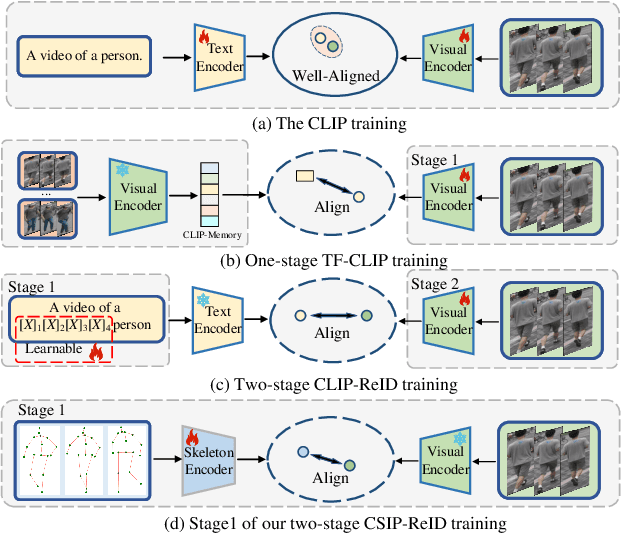
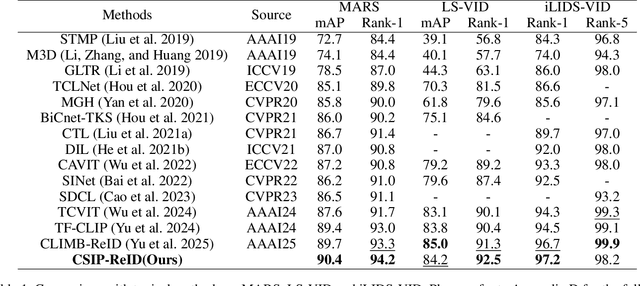
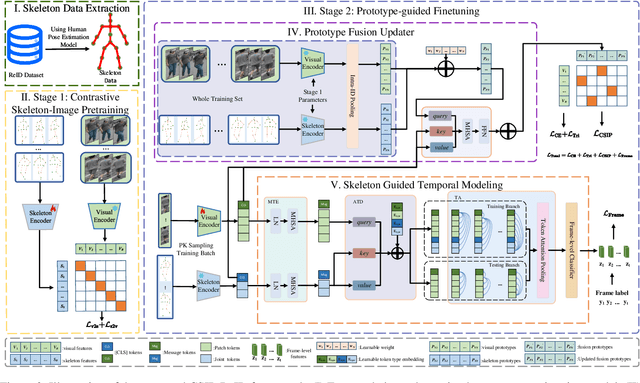

Multimodal pretraining has revolutionized visual understanding, but its impact on video-based person re-identification (ReID) remains underexplored. Existing approaches often rely on video-text pairs, yet suffer from two fundamental limitations: (1) lack of genuine multimodal pretraining, and (2) text poorly captures fine-grained temporal motion-an essential cue for distinguishing identities in video. In this work, we take a bold departure from text-based paradigms by introducing the first skeleton-driven pretraining framework for ReID. To achieve this, we propose Contrastive Skeleton-Image Pretraining for ReID (CSIP-ReID), a novel two-stage method that leverages skeleton sequences as a spatiotemporally informative modality aligned with video frames. In the first stage, we employ contrastive learning to align skeleton and visual features at sequence level. In the second stage, we introduce a dynamic Prototype Fusion Updater (PFU) to refine multimodal identity prototypes, fusing motion and appearance cues. Moreover, we propose a Skeleton Guided Temporal Modeling (SGTM) module that distills temporal cues from skeleton data and integrates them into visual features. Extensive experiments demonstrate that CSIP-ReID achieves new state-of-the-art results on standard video ReID benchmarks (MARS, LS-VID, iLIDS-VID). Moreover, it exhibits strong generalization to skeleton-only ReID tasks (BIWI, IAS), significantly outperforming previous methods. CSIP-ReID pioneers an annotation-free and motion-aware pretraining paradigm for ReID, opening a new frontier in multimodal representation learning.

GADS: A Super Lightweight Model for Head Pose Estimation
Apr 22, 2025In human-computer interaction, head pose estimation profoundly influences application functionality. Although utilizing facial landmarks is valuable for this purpose, existing landmark-based methods prioritize precision over simplicity and model size, limiting their deployment on edge devices and in compute-poor environments. To bridge this gap, we propose \textbf{Grouped Attention Deep Sets (GADS)}, a novel architecture based on the Deep Set framework. By grouping landmarks into regions and employing small Deep Set layers, we reduce computational complexity. Our multihead attention mechanism extracts and combines inter-group information, resulting in a model that is $7.5\times$ smaller and executes $25\times$ faster than the current lightest state-of-the-art model. Notably, our method achieves an impressive reduction, being $4321\times$ smaller than the best-performing model. We introduce vanilla GADS and Hybrid-GADS (landmarks + RGB) and evaluate our models on three benchmark datasets -- AFLW2000, BIWI, and 300W-LP. We envision our architecture as a robust baseline for resource-constrained head pose estimation methods.
UniTalker: Scaling up Audio-Driven 3D Facial Animation through A Unified Model
Aug 01, 2024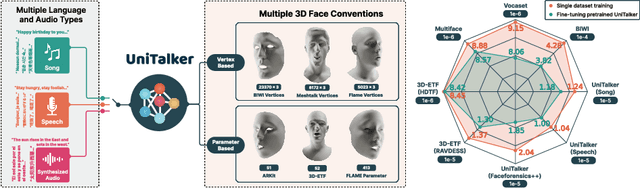
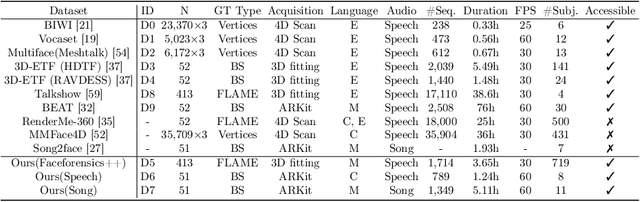

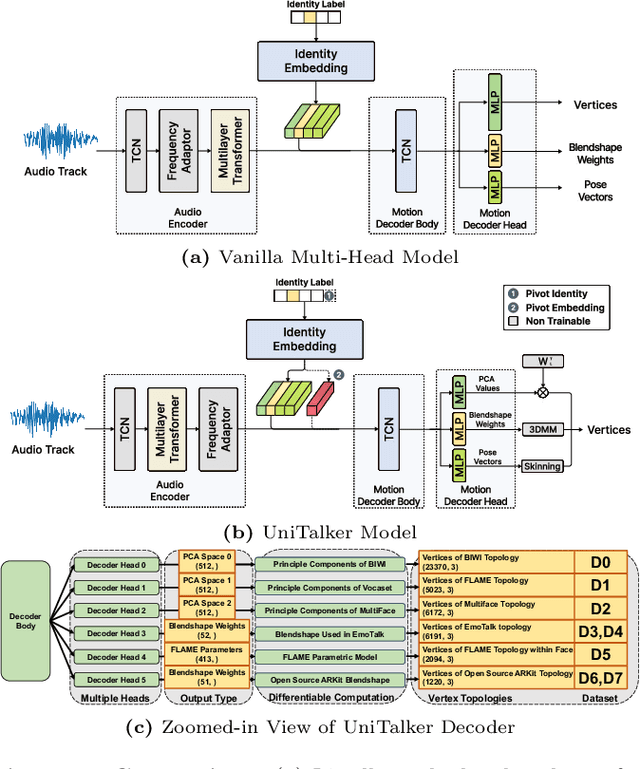
Audio-driven 3D facial animation aims to map input audio to realistic facial motion. Despite significant progress, limitations arise from inconsistent 3D annotations, restricting previous models to training on specific annotations and thereby constraining the training scale. In this work, we present UniTalker, a unified model featuring a multi-head architecture designed to effectively leverage datasets with varied annotations. To enhance training stability and ensure consistency among multi-head outputs, we employ three training strategies, namely, PCA, model warm-up, and pivot identity embedding. To expand the training scale and diversity, we assemble A2F-Bench, comprising five publicly available datasets and three newly curated datasets. These datasets contain a wide range of audio domains, covering multilingual speech voices and songs, thereby scaling the training data from commonly employed datasets, typically less than 1 hour, to 18.5 hours. With a single trained UniTalker model, we achieve substantial lip vertex error reductions of 9.2% for BIWI dataset and 13.7% for Vocaset. Additionally, the pre-trained UniTalker exhibits promise as the foundation model for audio-driven facial animation tasks. Fine-tuning the pre-trained UniTalker on seen datasets further enhances performance on each dataset, with an average error reduction of 6.3% on A2F-Bench. Moreover, fine-tuning UniTalker on an unseen dataset with only half the data surpasses prior state-of-the-art models trained on the full dataset. The code and dataset are available at the project page https://github.com/X-niper/UniTalker.
6DoF Head Pose Estimation through Explicit Bidirectional Interaction with Face Geometry
Jul 19, 2024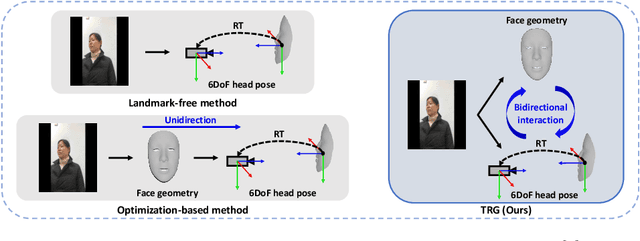
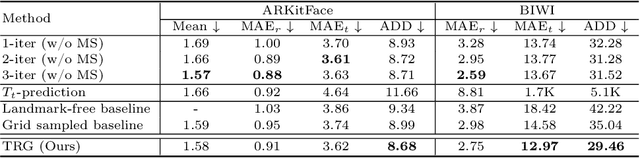
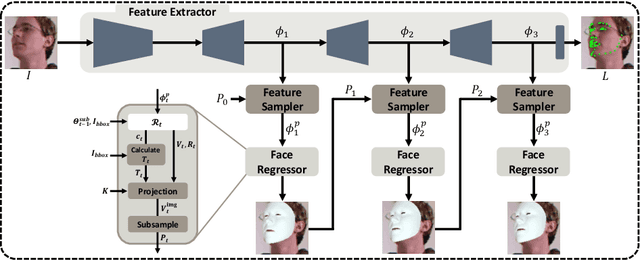
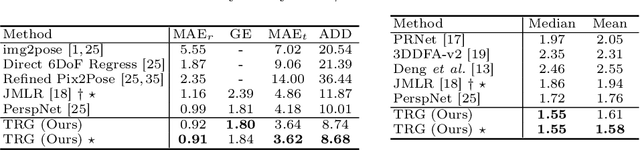
This study addresses the nuanced challenge of estimating head translations within the context of six-degrees-of-freedom (6DoF) head pose estimation, placing emphasis on this aspect over the more commonly studied head rotations. Identifying a gap in existing methodologies, we recognized the underutilized potential synergy between facial geometry and head translation. To bridge this gap, we propose a novel approach called the head Translation, Rotation, and face Geometry network (TRG), which stands out for its explicit bidirectional interaction structure. This structure has been carefully designed to leverage the complementary relationship between face geometry and head translation, marking a significant advancement in the field of head pose estimation. Our contributions also include the development of a strategy for estimating bounding box correction parameters and a technique for aligning landmarks to image. Both of these innovations demonstrate superior performance in 6DoF head pose estimation tasks. Extensive experiments conducted on ARKitFace and BIWI datasets confirm that the proposed method outperforms current state-of-the-art techniques. Codes are released at https://github.com/asw91666/TRG-Release.
Location-guided Head Pose Estimation for Fisheye Image
Feb 28, 2024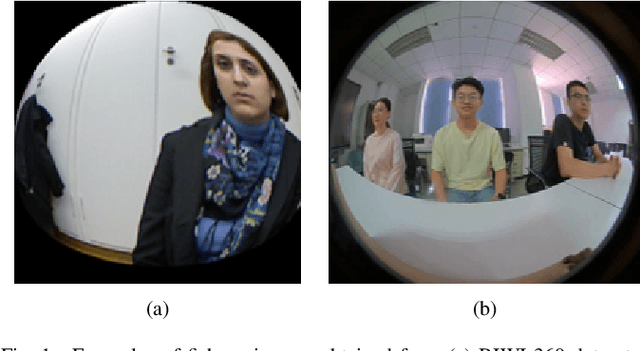
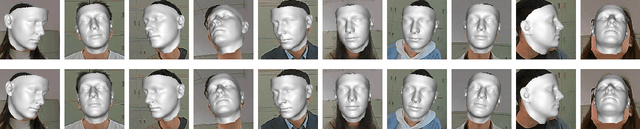
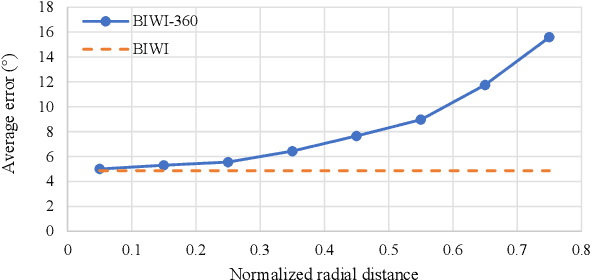

Camera with a fisheye or ultra-wide lens covers a wide field of view that cannot be modeled by the perspective projection. Serious fisheye \textcolor{blue}{lens} distortion in the peripheral region of the image leads to degraded performance of the \textcolor{blue}{existing} head pose estimation models trained on undistorted images. This paper presents a new approach for head pose estimation that uses the knowledge of head location in the image to reduce the negative effect of fisheye distortion. We develop an end-to-end convolutional neural network to estimate the head pose with the multi-task learning of head pose and head location. Our proposed network estimates the head pose directly from the fisheye image without the operation of rectification or calibration. We also created \textcolor{blue}{a} fisheye-\textcolor{blue}{distorted} version of the three popular head pose estimation datasets, BIWI, 300W-LP, and AFLW2000 for our experiments. Experiments results show that our network remarkably improves the accuracy of head pose estimation compared with other state-of-the-art one-stage and two-stage methods.
On the representation and methodology for wide and short range head pose estimation
Jan 11, 2024Head pose estimation (HPE) is a problem of interest in computer vision to improve the performance of face processing tasks in semi-frontal or profile settings. Recent applications require the analysis of faces in the full 360{\deg} rotation range. Traditional approaches to solve the semi-frontal and profile cases are not directly amenable for the full rotation case. In this paper we analyze the methodology for short- and wide-range HPE and discuss which representations and metrics are adequate for each case. We show that the popular Euler angles representation is a good choice for short-range HPE, but not at extreme rotations. However, the Euler angles' gimbal lock problem prevents them from being used as a valid metric in any setting. We also revisit the current cross-data set evaluation methodology and note that the lack of alignment between the reference systems of the training and test data sets negatively biases the results of all articles in the literature. We introduce a procedure to quantify this misalignment and a new methodology for cross-data set HPE that establishes new, more accurate, SOTA for the 300W-LP|Biwi benchmark. We also propose a generalization of the geodesic angular distance metric that enables the construction of a loss that controls the contribution of each training sample to the optimization of the model. Finally, we introduce a wide range HPE benchmark based on the CMU Panoptic data set.
Human motion trajectory prediction using the Social Force Model for real-time and low computational cost applications
Nov 17, 2023Human motion trajectory prediction is a very important functionality for human-robot collaboration, specifically in accompanying, guiding, or approaching tasks, but also in social robotics, self-driving vehicles, or security systems. In this paper, a novel trajectory prediction model, Social Force Generative Adversarial Network (SoFGAN), is proposed. SoFGAN uses a Generative Adversarial Network (GAN) and Social Force Model (SFM) to generate different plausible people trajectories reducing collisions in a scene. Furthermore, a Conditional Variational Autoencoder (CVAE) module is added to emphasize the destination learning. We show that our method is more accurate in making predictions in UCY or BIWI datasets than most of the current state-of-the-art models and also reduces collisions in comparison to other approaches. Through real-life experiments, we demonstrate that the model can be used in real-time without GPU's to perform good quality predictions with a low computational cost.
DualTalker: A Cross-Modal Dual Learning Approach for Speech-Driven 3D Facial Animation
Nov 13, 2023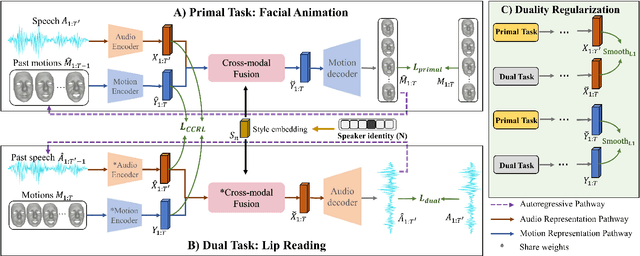

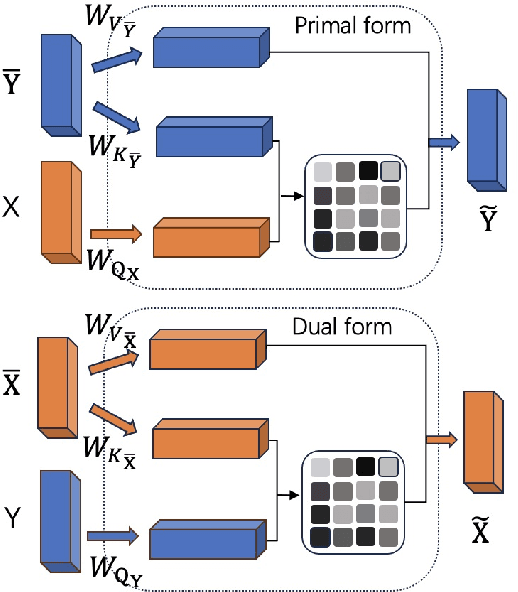

In recent years, audio-driven 3D facial animation has gained significant attention, particularly in applications such as virtual reality, gaming, and video conferencing. However, accurately modeling the intricate and subtle dynamics of facial expressions remains a challenge. Most existing studies approach the facial animation task as a single regression problem, which often fail to capture the intrinsic inter-modal relationship between speech signals and 3D facial animation and overlook their inherent consistency. Moreover, due to the limited availability of 3D-audio-visual datasets, approaches learning with small-size samples have poor generalizability that decreases the performance. To address these issues, in this study, we propose a cross-modal dual-learning framework, termed DualTalker, aiming at improving data usage efficiency as well as relating cross-modal dependencies. The framework is trained jointly with the primary task (audio-driven facial animation) and its dual task (lip reading) and shares common audio/motion encoder components. Our joint training framework facilitates more efficient data usage by leveraging information from both tasks and explicitly capitalizing on the complementary relationship between facial motion and audio to improve performance. Furthermore, we introduce an auxiliary cross-modal consistency loss to mitigate the potential over-smoothing underlying the cross-modal complementary representations, enhancing the mapping of subtle facial expression dynamics. Through extensive experiments and a perceptual user study conducted on the VOCA and BIWI datasets, we demonstrate that our approach outperforms current state-of-the-art methods both qualitatively and quantitatively. We have made our code and video demonstrations available at https://github.com/sabrina-su/iadf.git.
2D Image head pose estimation via latent space regression under occlusion settings
Nov 10, 2023Head orientation is a challenging Computer Vision problem that has been extensively researched having a wide variety of applications. However, current state-of-the-art systems still underperform in the presence of occlusions and are unreliable for many task applications in such scenarios. This work proposes a novel deep learning approach for the problem of head pose estimation under occlusions. The strategy is based on latent space regression as a fundamental key to better structure the problem for occluded scenarios. Our model surpasses several state-of-the-art methodologies for occluded HPE, and achieves similar accuracy for non-occluded scenarios. We demonstrate the usefulness of the proposed approach with: (i) two synthetically occluded versions of the BIWI and AFLW2000 datasets, (ii) real-life occlusions of the Pandora dataset, and (iii) a real-life application to human-robot interaction scenarios where face occlusions often occur. Specifically, the autonomous feeding from a robotic arm.
3D Face Alignment Through Fusion of Head Pose Information and Features
Aug 25, 2023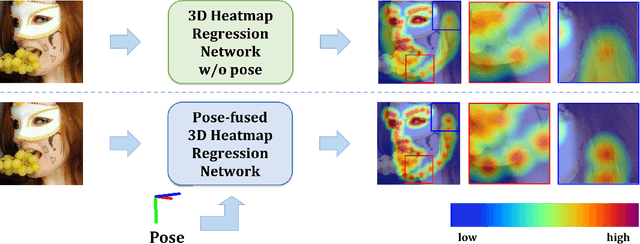
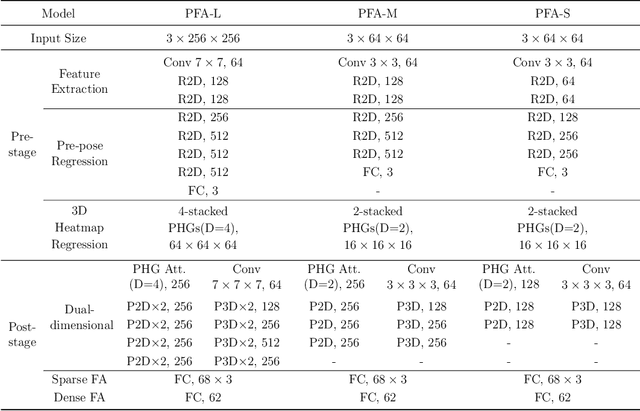
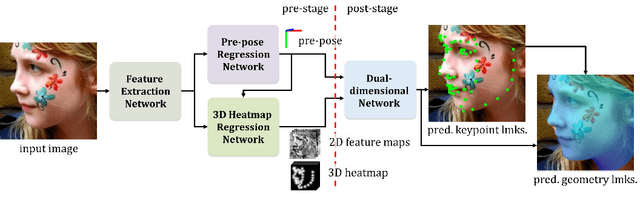
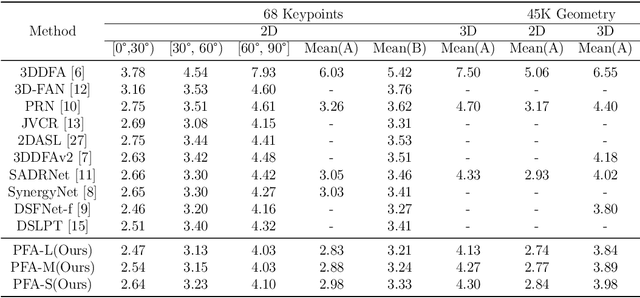
The ability of humans to infer head poses from face shapes, and vice versa, indicates a strong correlation between the two. Accordingly, recent studies on face alignment have employed head pose information to predict facial landmarks in computer vision tasks. In this study, we propose a novel method that employs head pose information to improve face alignment performance by fusing said information with the feature maps of a face alignment network, rather than simply using it to initialize facial landmarks. Furthermore, the proposed network structure performs robust face alignment through a dual-dimensional network using multidimensional features represented by 2D feature maps and a 3D heatmap. For effective dense face alignment, we also propose a prediction method for facial geometric landmarks through training based on knowledge distillation using predicted keypoints. We experimentally assessed the correlation between the predicted facial landmarks and head pose information, as well as variations in the accuracy of facial landmarks with respect to the quality of head pose information. In addition, we demonstrated the effectiveness of the proposed method through a competitive performance comparison with state-of-the-art methods on the AFLW2000-3D, AFLW, and BIWI datasets.