 Add to Chrome
 Add to Firefox
 Add to Edge
Asvspoof 2019
Papers and Code
Lightweight Resolution-Aware Audio Deepfake Detection via Cross-Scale Attention and Consistency Learning
Jan 10, 2026
Audio deepfake detection has become increasingly challenging due to rapid advances in speech synthesis and voice conversion technologies, particularly under channel distortions, replay attacks, and real-world recording conditions. This paper proposes a resolution-aware audio deepfake detection framework that explicitly models and aligns multi-resolution spectral representations through cross-scale attention and consistency learning. Unlike conventional single-resolution or implicit feature-fusion approaches, the proposed method enforces agreement across complementary time--frequency scales. The proposed framework is evaluated on three representative benchmarks: ASVspoof 2019 (LA and PA), the Fake-or-Real (FoR) dataset, and the In-the-Wild Audio Deepfake dataset under a speaker-disjoint protocol. The method achieves near-perfect performance on ASVspoof LA (EER 0.16%), strong robustness on ASVspoof PA (EER 5.09%), FoR rerecorded audio (EER 4.54%), and in-the-wild deepfakes (AUC 0.98, EER 4.81%), significantly outperforming single-resolution and non-attention baselines under challenging conditions. The proposed model remains lightweight and efficient, requiring only 159k parameters and less than 1~GFLOP per inference, making it suitable for practical deployment. Comprehensive ablation studies confirm the critical contributions of cross-scale attention and consistency learning, while gradient-based interpretability analysis reveals that the model learns resolution-consistent and semantically meaningful spectral cues across diverse spoofing conditions. These results demonstrate that explicit cross-resolution modeling provides a principled, robust, and scalable foundation for next-generation audio deepfake detection systems.

Reliable Audio Deepfake Detection in Variable Conditions via Quantum-Kernel SVMs
Dec 21, 2025Detecting synthetic speech is challenging when labeled data are scarce and recording conditions vary. Existing end-to-end deep models often overfit or fail to generalize, and while kernel methods can remain competitive, their performance heavily depends on the chosen kernel. Here, we show that using a quantum kernel in audio deepfake detection reduces falsepositive rates without increasing model size. Quantum feature maps embed data into high-dimensional Hilbert spaces, enabling the use of expressive similarity measures and compact classifiers. Building on this motivation, we compare quantum-kernel SVMs (QSVMs) with classical SVMs using identical mel-spectrogram preprocessing and stratified 5-fold cross-validation across four corpora (ASVspoof 2019 LA, ASVspoof 5 (2024), ADD23, and an In-the-Wild set). QSVMs achieve consistently lower equalerror rates (EER): 0.183 vs. 0.299 on ASVspoof 5 (2024), 0.081 vs. 0.188 on ADD23, 0.346 vs. 0.399 on ASVspoof 2019, and 0.355 vs. 0.413 In-the-Wild. At the EER operating point (where FPR equals FNR), these correspond to absolute false-positiverate reductions of 0.116 (38.8%), 0.107 (56.9%), 0.053 (13.3%), and 0.058 (14.0%), respectively. We also report how consistent the results are across cross-validation folds and margin-based measures of class separation, using identical settings for both models. The only modification is the kernel; the features and SVM remain unchanged, no additional trainable parameters are introduced, and the quantum kernel is computed on a conventional computer.
DIN-CTS: Low-Complexity Depthwise-Inception Neural Network with Contrastive Training Strategy for Deepfake Speech Detection
Feb 27, 2025In this paper, we propose a deep neural network approach for deepfake speech detection (DSD) based on a lowcomplexity Depthwise-Inception Network (DIN) trained with a contrastive training strategy (CTS). In this framework, input audio recordings are first transformed into spectrograms using Short-Time Fourier Transform (STFT) and Linear Filter (LF), which are then used to train the DIN. Once trained, the DIN processes bonafide utterances to extract audio embeddings, which are used to construct a Gaussian distribution representing genuine speech. Deepfake detection is then performed by computing the distance between a test utterance and this distribution to determine whether the utterance is fake or bonafide. To evaluate our proposed systems, we conducted extensive experiments on the benchmark dataset of ASVspoof 2019 LA. The experimental results demonstrate the effectiveness of combining the Depthwise-Inception Network with the contrastive learning strategy in distinguishing between fake and bonafide utterances. We achieved Equal Error Rate (EER), Accuracy (Acc.), F1, AUC scores of 4.6%, 95.4%, 97.3%, and 98.9% respectively using a single, low-complexity DIN with just 1.77 M parameters and 985 M FLOPS on short audio segments (4 seconds). Furthermore, our proposed system outperforms the single-system submissions in the ASVspoof 2019 LA challenge, showcasing its potential for real-time applications.
Generalizable Audio Deepfake Detection via Latent Space Refinement and Augmentation
Jan 24, 2025Advances in speech synthesis technologies, like text-to-speech (TTS) and voice conversion (VC), have made detecting deepfake speech increasingly challenging. Spoofing countermeasures often struggle to generalize effectively, particularly when faced with unseen attacks. To address this, we propose a novel strategy that integrates Latent Space Refinement (LSR) and Latent Space Augmentation (LSA) to improve the generalization of deepfake detection systems. LSR introduces multiple learnable prototypes for the spoof class, refining the latent space to better capture the intricate variations within spoofed data. LSA further diversifies spoofed data representations by applying augmentation techniques directly in the latent space, enabling the model to learn a broader range of spoofing patterns. We evaluated our approach on four representative datasets, i.e. ASVspoof 2019 LA, ASVspoof 2021 LA and DF, and In-The-Wild. The results show that LSR and LSA perform well individually, and their integration achieves competitive results, matching or surpassing current state-of-the-art methods.
Explaining Speaker and Spoof Embeddings via Probing
Dec 24, 2024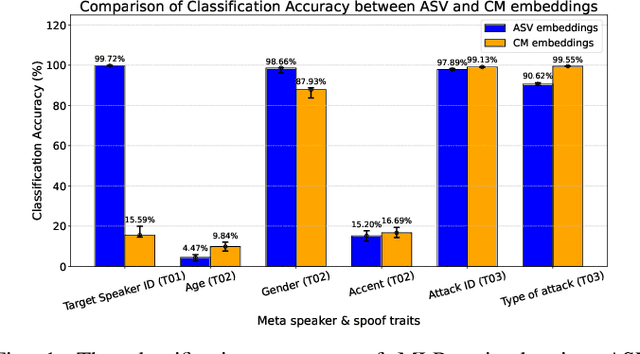
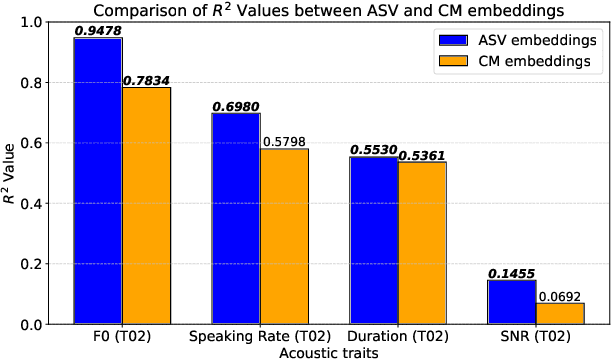
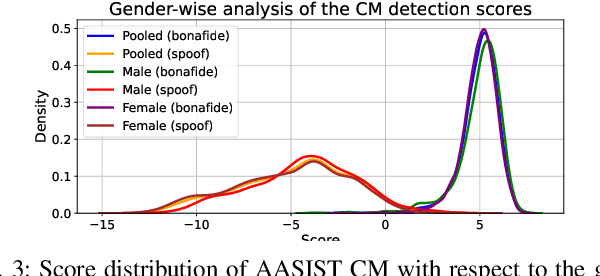
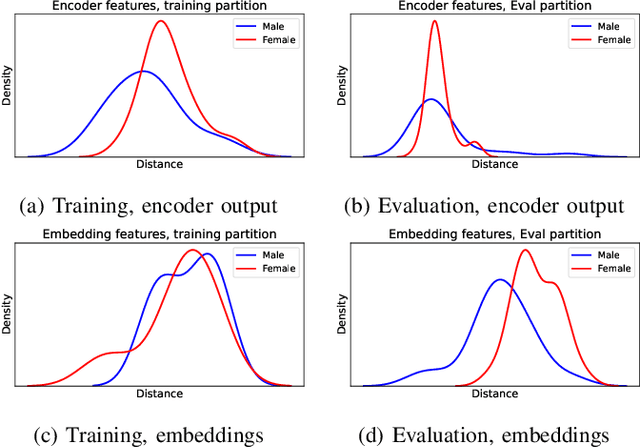
This study investigates the explainability of embedding representations, specifically those used in modern audio spoofing detection systems based on deep neural networks, known as spoof embeddings. Building on established work in speaker embedding explainability, we examine how well these spoof embeddings capture speaker-related information. We train simple neural classifiers using either speaker or spoof embeddings as input, with speaker-related attributes as target labels. These attributes are categorized into two groups: metadata-based traits (e.g., gender, age) and acoustic traits (e.g., fundamental frequency, speaking rate). Our experiments on the ASVspoof 2019 LA evaluation set demonstrate that spoof embeddings preserve several key traits, including gender, speaking rate, F0, and duration. Further analysis of gender and speaking rate indicates that the spoofing detector partially preserves these traits, potentially to ensure the decision process remains robust against them.
Investigating Prosodic Signatures via Speech Pre-Trained Models for Audio Deepfake Source Attribution
Dec 23, 2024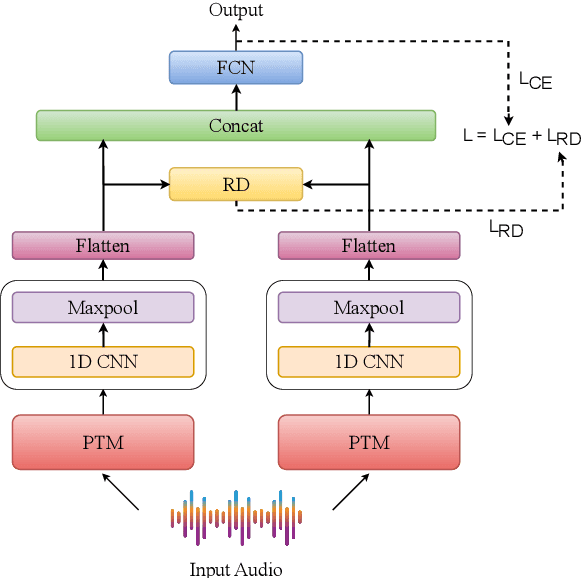
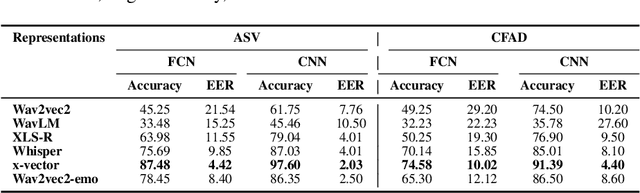
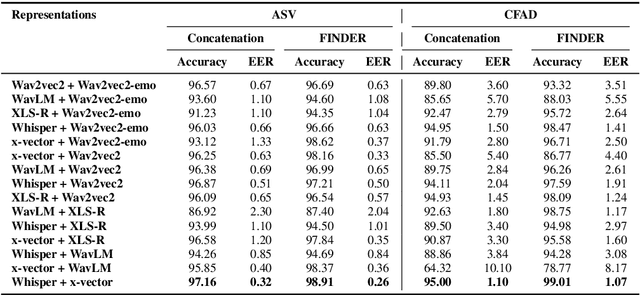
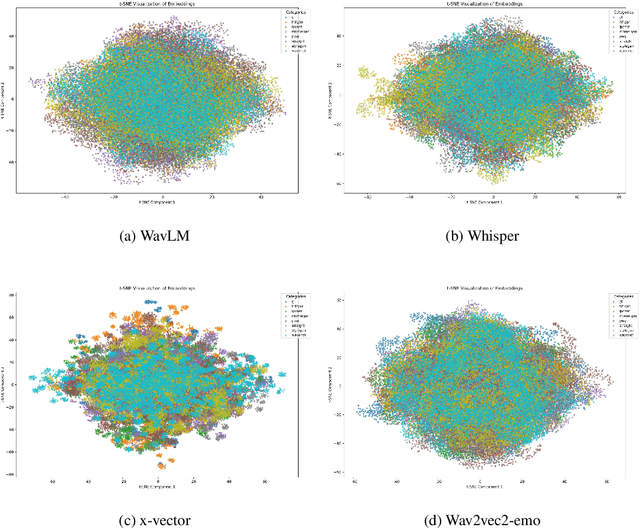
In this work, we investigate various state-of-the-art (SOTA) speech pre-trained models (PTMs) for their capability to capture prosodic signatures of the generative sources for audio deepfake source attribution (ADSD). These prosodic characteristics can be considered one of major signatures for ADSD, which is unique to each source. So better is the PTM at capturing prosodic signs better the ADSD performance. We consider various SOTA PTMs that have shown top performance in different prosodic tasks for our experiments on benchmark datasets, ASVSpoof 2019 and CFAD. x-vector (speaker recognition PTM) attains the highest performance in comparison to all the PTMs considered despite consisting lowest model parameters. This higher performance can be due to its speaker recognition pre-training that enables it for capturing unique prosodic characteristics of the sources in a better way. Further, motivated from tasks such as audio deepfake detection and speech recognition, where fusion of PTMs representations lead to improved performance, we explore the same and propose FINDER for effective fusion of such representations. With fusion of Whisper and x-vector representations through FINDER, we achieved the topmost performance in comparison to all the individual PTMs as well as baseline fusion techniques and attaining SOTA performance.
Is Audio Spoof Detection Robust to Laundering Attacks?
Aug 27, 2024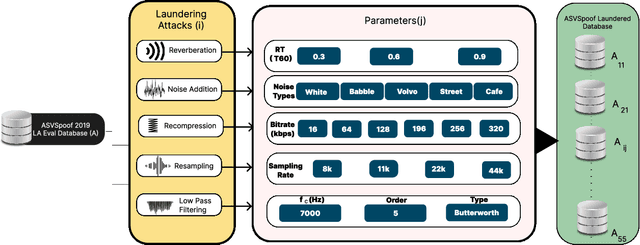
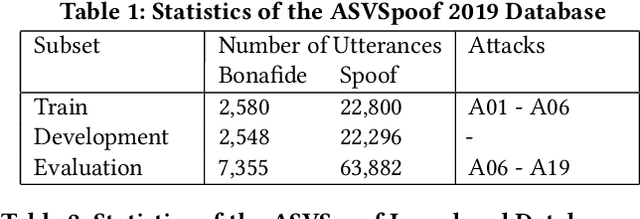

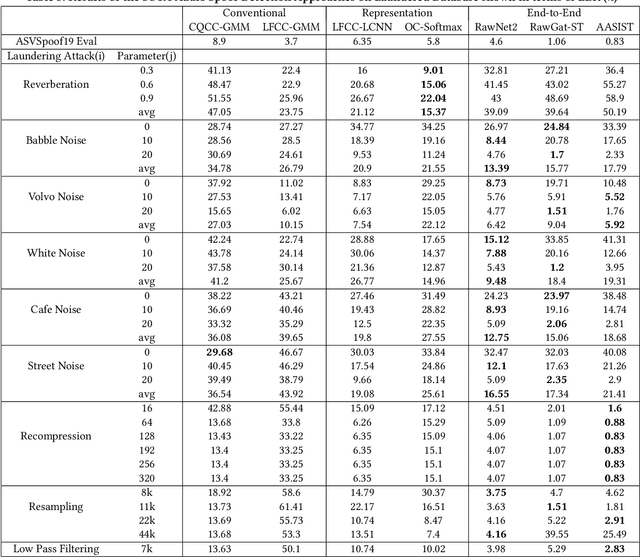
Voice-cloning (VC) systems have seen an exceptional increase in the realism of synthesized speech in recent years. The high quality of synthesized speech and the availability of low-cost VC services have given rise to many potential abuses of this technology. Several detection methodologies have been proposed over the years that can detect voice spoofs with reasonably good accuracy. However, these methodologies are mostly evaluated on clean audio databases, such as ASVSpoof 2019. This paper evaluates SOTA Audio Spoof Detection approaches in the presence of laundering attacks. In that regard, a new laundering attack database, called the ASVSpoof Laundering Database, is created. This database is based on the ASVSpoof 2019 (LA) eval database comprising a total of 1388.22 hours of audio recordings. Seven SOTA audio spoof detection approaches are evaluated on this laundered database. The results indicate that SOTA systems perform poorly in the presence of aggressive laundering attacks, especially reverberation and additive noise attacks. This suggests the need for robust audio spoof detection.
Malacopula: adversarial automatic speaker verification attacks using a neural-based generalised Hammerstein model
Aug 17, 2024We present Malacopula, a neural-based generalised Hammerstein model designed to introduce adversarial perturbations to spoofed speech utterances so that they better deceive automatic speaker verification (ASV) systems. Using non-linear processes to modify speech utterances, Malacopula enhances the effectiveness of spoofing attacks. The model comprises parallel branches of polynomial functions followed by linear time-invariant filters. The adversarial optimisation procedure acts to minimise the cosine distance between speaker embeddings extracted from spoofed and bona fide utterances. Experiments, performed using three recent ASV systems and the ASVspoof 2019 dataset, show that Malacopula increases vulnerabilities by a substantial margin. However, speech quality is reduced and attacks can be detected effectively under controlled conditions. The findings emphasise the need to identify new vulnerabilities and design defences to protect ASV systems from adversarial attacks in the wild.
Toward Improving Synthetic Audio Spoofing Detection Robustness via Meta-Learning and Disentangled Training With Adversarial Examples
Aug 23, 2024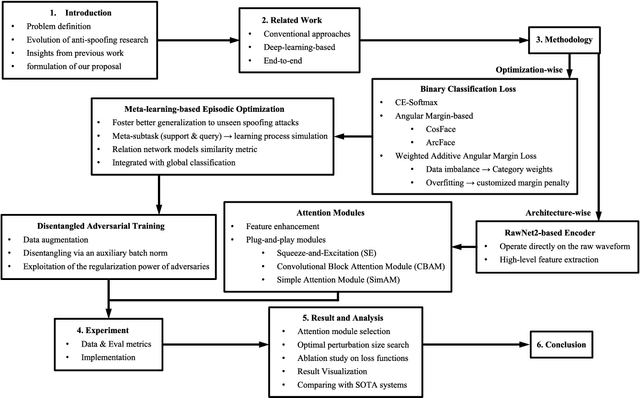
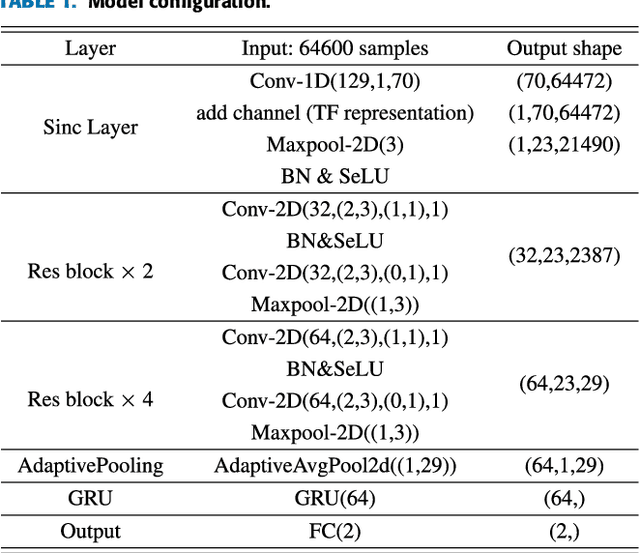
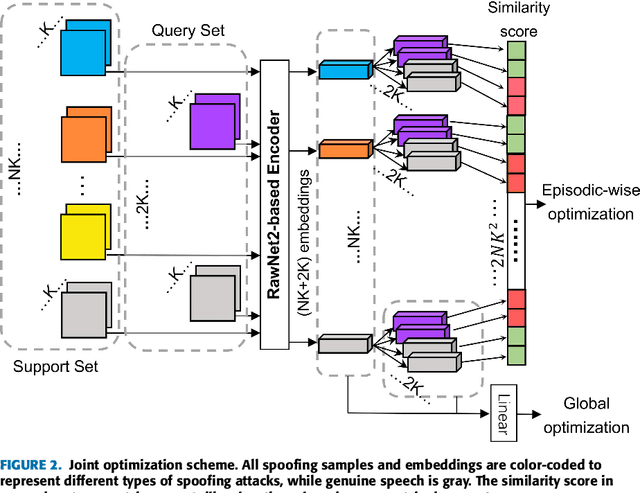
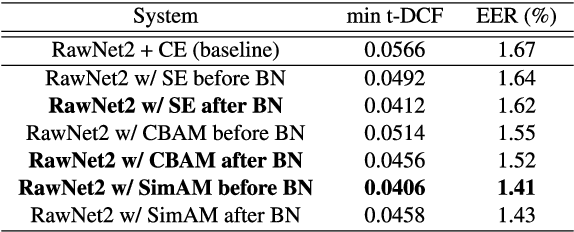
Advances in automatic speaker verification (ASV) promote research into the formulation of spoofing detection systems for real-world applications. The performance of ASV systems can be degraded severely by multiple types of spoofing attacks, namely, synthetic speech (SS), voice conversion (VC), replay, twins and impersonation, especially in the case of unseen synthetic spoofing attacks. A reliable and robust spoofing detection system can act as a security gate to filter out spoofing attacks instead of having them reach the ASV system. A weighted additive angular margin loss is proposed to address the data imbalance issue, and different margins has been assigned to improve generalization to unseen spoofing attacks in this study. Meanwhile, we incorporate a meta-learning loss function to optimize differences between the embeddings of support versus query set in order to learn a spoofing-category-independent embedding space for utterances. Furthermore, we craft adversarial examples by adding imperceptible perturbations to spoofing speech as a data augmentation strategy, then we use an auxiliary batch normalization (BN) to guarantee that corresponding normalization statistics are performed exclusively on the adversarial examples. Additionally, A simple attention module is integrated into the residual block to refine the feature extraction process. Evaluation results on the Logical Access (LA) track of the ASVspoof 2019 corpus provides confirmation of our proposed approaches' effectiveness in terms of a pooled EER of 0.87%, and a min t-DCF of 0.0277. These advancements offer effective options to reduce the impact of spoofing attacks on voice recognition/authentication systems.
* IEEE ACCESS 2024
Source Tracing of Audio Deepfake Systems
Jul 10, 2024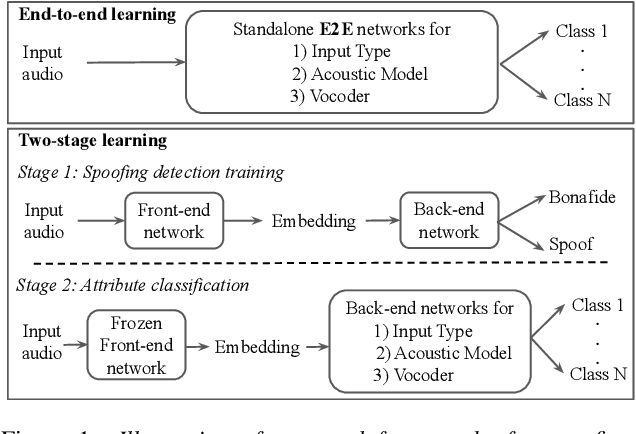
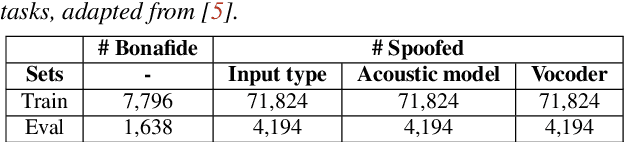

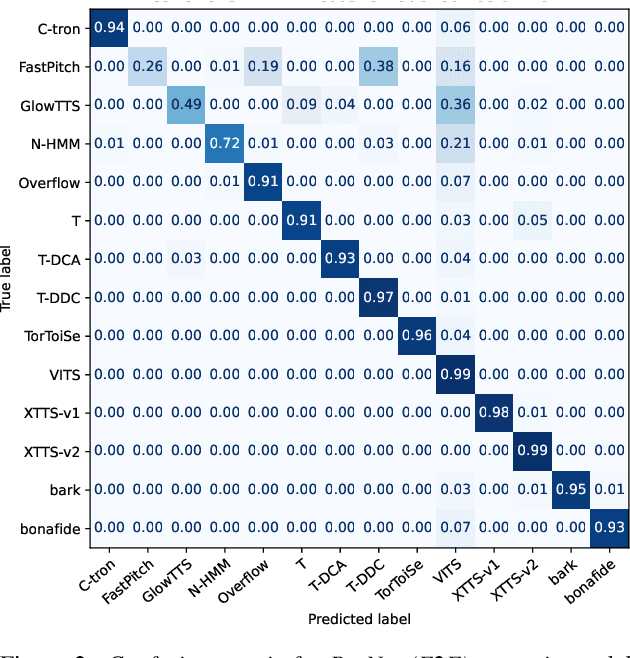
Recent progress in generative AI technology has made audio deepfakes remarkably more realistic. While current research on anti-spoofing systems primarily focuses on assessing whether a given audio sample is fake or genuine, there has been limited attention on discerning the specific techniques to create the audio deepfakes. Algorithms commonly used in audio deepfake generation, like text-to-speech (TTS) and voice conversion (VC), undergo distinct stages including input processing, acoustic modeling, and waveform generation. In this work, we introduce a system designed to classify various spoofing attributes, capturing the distinctive features of individual modules throughout the entire generation pipeline. We evaluate our system on two datasets: the ASVspoof 2019 Logical Access and the Multi-Language Audio Anti-Spoofing Dataset (MLAAD). Results from both experiments demonstrate the robustness of the system to identify the different spoofing attributes of deepfake generation systems.