 Add to Chrome
 Add to Firefox
 Add to Edge
Albert
Papers and Code
Greedy-Gnorm: A Gradient Matrix Norm-Based Alternative to Attention Entropy for Head Pruning
Feb 04, 2026
Attention head pruning has emerged as an effective technique for transformer model compression, an increasingly important goal in the era of Green AI. However, existing pruning methods often rely on static importance scores, which fail to capture the evolving role of attention heads during iterative removal. We propose Greedy-Gradient norm (Greedy-Gnorm), a novel head pruning algorithm that dynamically recalculates head importance after each pruning step. Specifically, each head is scored by the elementwise product of the l2-norms of its Q/K/V gradient blocks, as estimated from a hold-out validation set and updated at every greedy iteration. This dynamic approach to scoring mitigates against stale rankings and better reflects gradient-informed importance as pruning progresses. Extensive experiments on BERT, ALBERT, RoBERTa, and XLM-RoBERTa demonstrate that Greedy-Gnorm consistently preserves accuracy under substantial head removal, outperforming attention entropy. By effectively reducing model size while maintaining task performance, Greedy-Gnorm offers a promising step toward more energy-efficient transformer model deployment.

On the origin of neural scaling laws: from random graphs to natural language
Jan 15, 2026Scaling laws have played a major role in the modern AI revolution, providing practitioners predictive power over how the model performance will improve with increasing data, compute, and number of model parameters. This has spurred an intense interest in the origin of neural scaling laws, with a common suggestion being that they arise from power law structure already present in the data. In this paper we study scaling laws for transformers trained to predict random walks (bigrams) on graphs with tunable complexity. We demonstrate that this simplified setting already gives rise to neural scaling laws even in the absence of power law structure in the data correlations. We further consider dialing down the complexity of natural language systematically, by training on sequences sampled from increasingly simplified generative language models, from 4,2,1-layer transformer language models down to language bigrams, revealing a monotonic evolution of the scaling exponents. Our results also include scaling laws obtained from training on random walks on random graphs drawn from Erdös-Renyi and scale-free Barabási-Albert ensembles. Finally, we revisit conventional scaling laws for language modeling, demonstrating that several essential results can be reproduced using 2 layer transformers with context length of 50, provide a critical analysis of various fits used in prior literature, demonstrate an alternative method for obtaining compute optimal curves as compared with current practice in published literature, and provide preliminary evidence that maximal update parameterization may be more parameter efficient than standard parameterization.
Handcrafted Feature-Assisted One-Class Learning for Artist Authentication in Historical Drawings
Jan 13, 2026Authentication and attribution of works on paper remain persistent challenges in cultural heritage, particularly when the available reference corpus is small and stylistic cues are primarily expressed through line and limited tonal variation. We present a verification-based computational framework for historical drawing authentication using one-class autoencoders trained on a compact set of interpretable handcrafted features. Ten artist-specific verifiers are trained using authenticated sketches from the Metropolitan Museum of Art open-access collection, the Ashmolean Collections Catalogue, the Morgan Library and Museum, the Royal Collection Trust (UK), the Victoria and Albert Museum Collections, and an online catalogue of the Casa Buonarroti collection and evaluated under a biometric-style protocol with genuine and impostor trials. Feature vectors comprise Fourier-domain energy, Shannon entropy, global contrast, GLCM-based homogeneity, and a box-counting estimate of fractal complexity. Across 900 verification decisions (90 genuine and 810 impostor trials), the pooled system achieves a True Acceptance Rate of 83.3% with a False Acceptance Rate of 9.5% at the chosen operating point. Performance varies substantially by artist, with near-zero false acceptance for some verifiers and elevated confusability for others. A pairwise attribution of false accepts indicates structured error pathways consistent with stylistic proximity and shared drawing conventions, whilst also motivating tighter control of digitisation artefacts and threshold calibration. The proposed methodology is designed to complement, rather than replace, connoisseurship by providing reproducible, quantitative evidence suitable for data-scarce settings common in historical sketch attribution.
A Platform for Interactive AI Character Experiences
Jan 03, 2026From movie characters to modern science fiction - bringing characters into interactive, story-driven conversations has captured imaginations across generations. Achieving this vision is highly challenging and requires much more than just language modeling. It involves numerous complex AI challenges, such as conversational AI, maintaining character integrity, managing personality and emotions, handling knowledge and memory, synthesizing voice, generating animations, enabling real-world interactions, and integration with physical environments. Recent advancements in the development of foundation models, prompt engineering, and fine-tuning for downstream tasks have enabled researchers to address these individual challenges. However, combining these technologies for interactive characters remains an open problem. We present a system and platform for conveniently designing believable digital characters, enabling a conversational and story-driven experience while providing solutions to all of the technical challenges. As a proof-of-concept, we introduce Digital Einstein, which allows users to engage in conversations with a digital representation of Albert Einstein about his life, research, and persona. While Digital Einstein exemplifies our methods for a specific character, our system is flexible and generalizes to any story-driven or conversational character. By unifying these diverse AI components into a single, easy-to-adapt platform, our work paves the way for immersive character experiences, turning the dream of lifelike, story-based interactions into a reality.
Comparative Efficiency Analysis of Lightweight Transformer Models: A Multi-Domain Empirical Benchmark for Enterprise NLP Deployment
Jan 01, 2026In the rapidly evolving landscape of enterprise natural language processing (NLP), the demand for efficient, lightweight models capable of handling multi-domain text automation tasks has intensified. This study conducts a comparative analysis of three prominent lightweight Transformer models - DistilBERT, MiniLM, and ALBERT - across three distinct domains: customer sentiment classification, news topic classification, and toxicity and hate speech detection. Utilizing datasets from IMDB, AG News, and the Measuring Hate Speech corpus, we evaluated performance using accuracy-based metrics including accuracy, precision, recall, and F1-score, as well as efficiency metrics such as model size, inference time, throughput, and memory usage. Key findings reveal that no single model dominates all performance dimensions. ALBERT achieves the highest task-specific accuracy in multiple domains, MiniLM excels in inference speed and throughput, and DistilBERT demonstrates the most consistent accuracy across tasks while maintaining competitive efficiency. All results reflect controlled fine-tuning under fixed enterprise-oriented constraints rather than exhaustive hyperparameter optimization. These results highlight trade-offs between accuracy and efficiency, recommending MiniLM for latency-sensitive enterprise applications, DistilBERT for balanced performance, and ALBERT for resource-constrained environments.
Feature-Enhanced Graph Neural Networks for Classification of Synthetic Graph Generative Models: A Benchmarking Study
Dec 20, 2025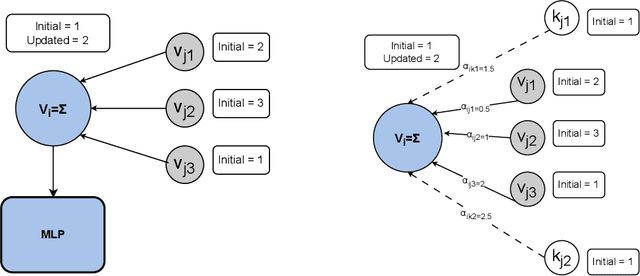

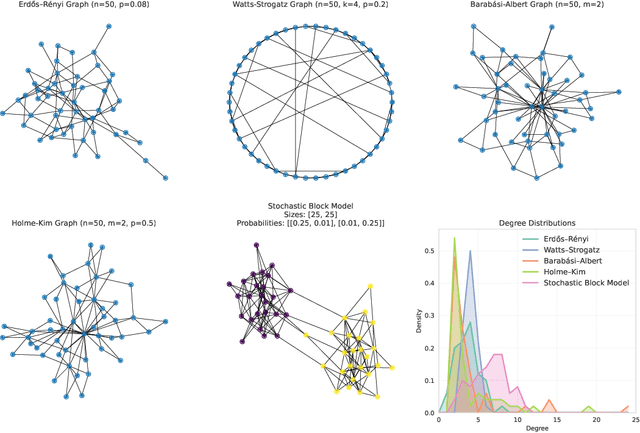
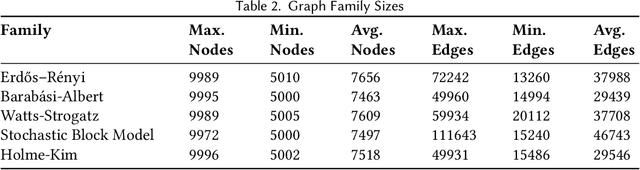
The ability to discriminate between generative graph models is critical to understanding complex structural patterns in both synthetic graphs and the real-world structures that they emulate. While Graph Neural Networks (GNNs) have seen increasing use to great effect in graph classification tasks, few studies explore their integration with interpretable graph theoretic features. This paper investigates the classification of synthetic graph families using a hybrid approach that combines GNNs with engineered graph-theoretic features. We generate a large and structurally diverse synthetic dataset comprising graphs from five representative generative families, Erdos-Renyi, Watts-Strogatz, Barab'asi-Albert, Holme-Kim, and Stochastic Block Model. These graphs range in size up to 1x10^4 nodes, containing up to 1.1x10^5 edges. A comprehensive range of node and graph level features is extracted for each graph and pruned using a Random Forest based feature selection pipeline. The features are integrated into six GNN architectures: GCN, GAT, GATv2, GIN, GraphSAGE and GTN. Each architecture is optimised for hyperparameter selection using Optuna. Finally, models were compared against a baseline Support Vector Machine (SVM) trained solely on the handcrafted features. Our evaluation demonstrates that GraphSAGE and GTN achieve the highest classification performance, with 98.5% accuracy, and strong class separation evidenced by t-SNE and UMAP visualisations. GCN and GIN also performed well, while GAT-based models lagged due to limitations in their ability to capture global structures. The SVM baseline confirmed the importance of the message passing functionality for performance gains and meaningful class separation.
On the false election between regulation and innovation. Ideas for regulation through the responsible use of artificial intelligence in research and education.[Spanish version]
Oct 08, 2025This short essay is a reworking of the answers offered by the author at the Debate Session of the AIHUB (CSIC) and EduCaixa Summer School, organized by Marta Garcia-Matos and Lissette Lemus, and coordinated by Albert Sabater (OEIAC, UG), with the participation of Vanina Martinez-Posse (IIIA-CSIC), Eulalia Soler (Eurecat) and Pompeu Casanovas (IIIA-CSIC) on July 4th 2025. Albert Sabater posed three questions: (1) How can regulatory frameworks priori-tise the protection of fundamental rights (privacy, non-discrimination, autonomy, etc.) in the development of AI, without falling into the false dichotomy between regulation and innova-tion? (2) Given the risks of AI (bias, mass surveillance, manipulation), what examples of regu-lations or policies have demonstrated that it is possible to foster responsible innovation, putting the public interest before profitability, without giving in to competitive pressure from actors such as China or the US? (3) In a scenario where the US prioritizes flexibility, what mecha-nisms could ensure that international cooperation in AI does not become a race to the bottom in rights, but rather a global standard of accountability? The article attempts to answer these three questions and concludes with some reflections on the relevance of the answers for education and research.
Deep learning framework for predicting stochastic take-off and die-out of early spreading
Oct 06, 2025Large-scale outbreaks of epidemics, misinformation, or other harmful contagions pose significant threats to human society, yet the fundamental question of whether an emerging outbreak will escalate into a major epidemic or naturally die out remains largely unaddressed. This problem is challenging, partially due to inadequate data during the early stages of outbreaks and also because established models focus on average behaviors of large epidemics rather than the stochastic nature of small transmission chains. Here, we introduce the first systematic framework for forecasting whether initial transmission events will amplify into major outbreaks or fade into extinction during early stages, when intervention strategies can still be effectively implemented. Using extensive data from stochastic spreading models, we developed a deep learning framework that predicts early-stage spreading outcomes in real-time. Validation across Erd\H{o}s-R\'enyi and Barab\'asi-Albert networks with varying infectivity levels shows our method accurately forecasts stochastic spreading events well before potential outbreaks, demonstrating robust performance across different network structures and infectivity scenarios.To address the challenge of sparse data during early outbreak stages, we further propose a pretrain-finetune framework that leverages diverse simulation data for pretraining and adapts to specific scenarios through targeted fine-tuning. The pretrain-finetune framework consistently outperforms baseline models, achieving superior performance even when trained on limited scenario-specific data. To our knowledge, this work presents the first framework for predicting stochastic take-off versus die-out. This framework provides valuable insights for epidemic preparedness and public health decision-making, enabling more informed early intervention strategies.
ALBERT: Advanced Localization and Bidirectional Encoder Representations from Transformers for Automotive Damage Evaluation
Jun 12, 2025This paper introduces ALBERT, an instance segmentation model specifically designed for comprehensive car damage and part segmentation. Leveraging the power of Bidirectional Encoder Representations, ALBERT incorporates advanced localization mechanisms to accurately identify and differentiate between real and fake damages, as well as segment individual car parts. The model is trained on a large-scale, richly annotated automotive dataset that categorizes damage into 26 types, identifies 7 fake damage variants, and segments 61 distinct car parts. Our approach demonstrates strong performance in both segmentation accuracy and damage classification, paving the way for intelligent automotive inspection and assessment applications.
Learning to Diagnose Privately: DP-Powered LLMs for Radiology Report Classification
Jun 04, 2025Purpose: This study proposes a framework for fine-tuning large language models (LLMs) with differential privacy (DP) to perform multi-abnormality classification on radiology report text. By injecting calibrated noise during fine-tuning, the framework seeks to mitigate the privacy risks associated with sensitive patient data and protect against data leakage while maintaining classification performance. Materials and Methods: We used 50,232 radiology reports from the publicly available MIMIC-CXR chest radiography and CT-RATE computed tomography datasets, collected between 2011 and 2019. Fine-tuning of LLMs was conducted to classify 14 labels from MIMIC-CXR dataset, and 18 labels from CT-RATE dataset using Differentially Private Low-Rank Adaptation (DP-LoRA) in high and moderate privacy regimes (across a range of privacy budgets = {0.01, 0.1, 1.0, 10.0}). Model performance was evaluated using weighted F1 score across three model architectures: BERT-medium, BERT-small, and ALBERT-base. Statistical analyses compared model performance across different privacy levels to quantify the privacy-utility trade-off. Results: We observe a clear privacy-utility trade-off through our experiments on 2 different datasets and 3 different models. Under moderate privacy guarantees the DP fine-tuned models achieved comparable weighted F1 scores of 0.88 on MIMIC-CXR and 0.59 on CT-RATE, compared to non-private LoRA baselines of 0.90 and 0.78, respectively. Conclusion: Differentially private fine-tuning using LoRA enables effective and privacy-preserving multi-abnormality classification from radiology reports, addressing a key challenge in fine-tuning LLMs on sensitive medical data.