 Add to Chrome
 Add to Firefox
 Add to Edge
Learning Engagement Assistant (LEA): Cross-Course Scalability and Classroom Evaluation of an Agentic AI Tutoring System
Jul 15, 2026
This paper is an extension of a paper presented at the ICAART 2026 conference, which introduced LEA (Learning Engagement Assistant), an adaptive AI tutoring agent combining course-specific Retrieval-Augmented Generation (RAG) with structured Knowledge Component (KC) models across integrated Chat, Tutor, and Quiz modes. That prior work validated LEA on a single STEM course (CMP511) exclusively through simulation, using synthetic learner agents. This paper extends that work by reporting the first classroom deployment of LEA with real students (n = 8, CMP511) and the first empirical test of its cross-course scalability, deploying the system across three courses spanning two academic levels and two disciplinary domains. The study reveals a divergence from simulation predictions across modes, showing that synthetic evaluation alone cannot anticipate all aspects of real deployment. A RAGAS-based cross-course scalability evaluation (660 questions) finds Answer Relevancy and Context Precision broadly stable across courses (0.88-0.94 and 0.88-0.90 respectively), while Faithfulness declines with curriculum distance from the system's original course (0.69 to 0.50), a preliminary finding that may reflect generation logic tuned to the system's original subject rather than a scalability limitation. These findings suggest that while the orchestration layer requires no modification, full course-agnosticism of all downstream components requires further investigation.

Feature-Enhanced Graph Neural Networks for Classification of Synthetic Graph Generative Models: A Benchmarking Study
Dec 20, 2025

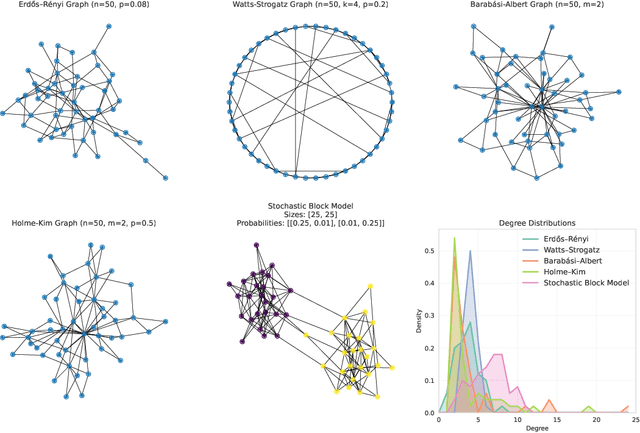
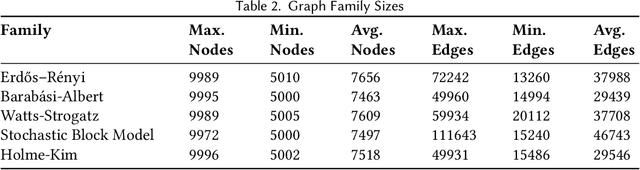
The ability to discriminate between generative graph models is critical to understanding complex structural patterns in both synthetic graphs and the real-world structures that they emulate. While Graph Neural Networks (GNNs) have seen increasing use to great effect in graph classification tasks, few studies explore their integration with interpretable graph theoretic features. This paper investigates the classification of synthetic graph families using a hybrid approach that combines GNNs with engineered graph-theoretic features. We generate a large and structurally diverse synthetic dataset comprising graphs from five representative generative families, Erdos-Renyi, Watts-Strogatz, Barab'asi-Albert, Holme-Kim, and Stochastic Block Model. These graphs range in size up to 1x10^4 nodes, containing up to 1.1x10^5 edges. A comprehensive range of node and graph level features is extracted for each graph and pruned using a Random Forest based feature selection pipeline. The features are integrated into six GNN architectures: GCN, GAT, GATv2, GIN, GraphSAGE and GTN. Each architecture is optimised for hyperparameter selection using Optuna. Finally, models were compared against a baseline Support Vector Machine (SVM) trained solely on the handcrafted features. Our evaluation demonstrates that GraphSAGE and GTN achieve the highest classification performance, with 98.5% accuracy, and strong class separation evidenced by t-SNE and UMAP visualisations. GCN and GIN also performed well, while GAT-based models lagged due to limitations in their ability to capture global structures. The SVM baseline confirmed the importance of the message passing functionality for performance gains and meaningful class separation.
Enhancing Road Safety through Accurate Detection of Hazardous Driving Behaviors with Graph Convolutional Recurrent Networks
May 08, 2023
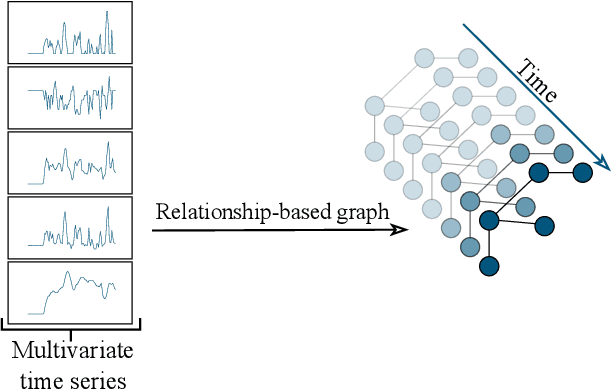
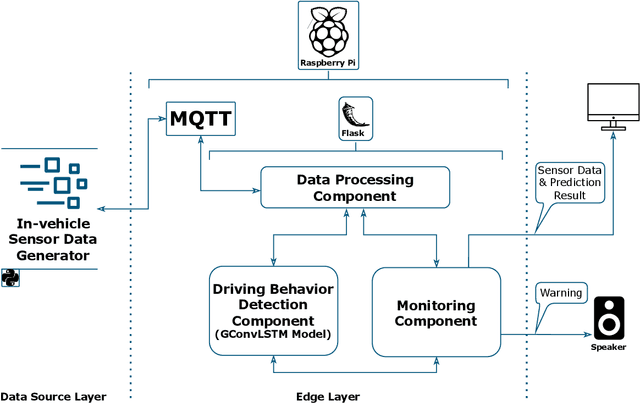
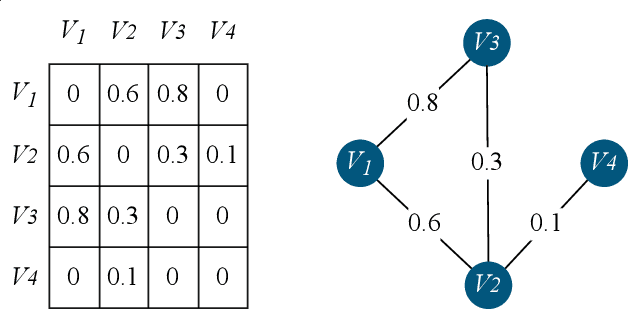
Car accidents remain a significant public safety issue worldwide, with the majority of them attributed to driver errors stemming from inadequate driving knowledge, non-compliance with regulations, and poor driving habits. To improve road safety, Driving Behavior Detection (DBD) systems have been proposed in several studies to identify safe and unsafe driving behavior. Many of these studies have utilized sensor data obtained from the Controller Area Network (CAN) bus to construct their models. However, the use of publicly available sensors is known to reduce the accuracy of detection models, while incorporating vendor-specific sensors into the dataset increases accuracy. To address the limitations of existing approaches, we present a reliable DBD system based on Graph Convolutional Long Short-Term Memory Networks (GConvLSTM) that enhances the precision and practicality of DBD models using public sensors. Additionally, we incorporate non-public sensors to evaluate the model's effectiveness. Our proposed model achieved a high accuracy of 97.5\% for public sensors and an average accuracy of 98.1\% for non-public sensors, indicating its consistency and accuracy in both settings. To enable local driver behavior analysis, we deployed our DBD system on a Raspberry Pi at the network edge, with drivers able to access daily driving condition reports, sensor data, and prediction results through a monitoring dashboard. Furthermore, the dashboard issues voice warnings to alert drivers of hazardous driving conditions. Our findings demonstrate that the proposed system can effectively detect hazardous and unsafe driving behavior, with potential applications in improving road safety and reducing the number of accidents caused by driver errors.