 Add to Chrome
 Add to Firefox
 Add to Edge
Symmetry-Structured Neural Completion of Islamic Geometric Patterns from Sparse Control Geometry
Jun 30, 2026
Islamic geometric patterns are governed by exact rotational symmetry and strict construction rules. This paper treats these rules as formal geometric knowledge and embeds them in a neural completion framework, rather than leaving them to be learned statistically from data. Given sparse control geometry and a target symmetry order, the system completes the pattern as a vector graph by predicting edges and refinements of bounded curves over a candidate lattice whose edges are organised into rotational orbits under the cyclic group. Symmetry is enforced either by constraining predictions within these orbits or by projecting them onto them during inference. The orbit-tied variant provides a constructive guarantee: for any input and any orbit-level selection rule, it produces exact N-fold symmetry, preserves anchor points, and keeps all refinements within prescribed bounds. These properties are verified numerically. The study focuses on rotational symmetry, and all quantitative results are obtained from procedurally generated graphs inspired by Islamic geometric design rather than from a historical corpus. On clean inputs, enforcing exact validity produces no measurable loss in fidelity. When control geometry is missing, an unstructured decoder loses fidelity and breaks symmetry; retraining on corrupted inputs recovers much of the fidelity but not exact validity. Symmetry-structured inference, by contrast, keeps violations at zero throughout. The results show that augmentation and symmetry structure address distinct failure modes: augmentation improves fidelity under corruption, while symmetry structure guarantees validity. The framework therefore provides a knowledge-constrained, guarantee-backed approach to neural completion for scalable vector ornaments whose validity depends on exact geometric structure.

A Coherence Law for Trainability in Noisy Equivariant Quantum Neural Networks
Jun 28, 2026Symmetry provides a quantum neural network structure, but on its own it does not keep the network trainable once noise is present. We ask which physical quantity decides whether the gradients of an equivariant circuit survive decoherence, and we answer with a compact training law. Working with U(1)-equivariant brickwork circuits that conserve a charge, we find that two distinct effects govern a trainable gradient. Causality fixes where the gradient can live, confining it to the backward light cone of the readout inside the active charge sector. Coherence then determines how fast it decays through the contraction of the off-diagonal sector modes that the projected readout can actually observe. We prove a light-cone reduction that pins the noiseless gradient to the sector-restricted cone with a lower bound independent of the total qubit number, and we define a readout-visible aligned coherence rate as a Rayleigh quotient of the noise generator along the gradient-carrying mode. A perturbative open-system analysis turns this rate into a leading-order training law. Density-matrix simulations then confirm that the finite-noise degradation follows a single accumulated variable built from noise depth and coherence contraction, with a coefficient of determination of 0.979. The sharpest test comes from a correlated-dephasing channel that has a large worst-case rate but a near-zero aligned rate. The law predicts no gradient loss for this channel, and none is seen. Sector coherence outperforms every standard channel diagnostic we compare it against, and the analysis identifies readout-visible sector coherence as the quantity that links equivariant architecture, open-system dynamics and noisy trainability.
Training Deep Visual Networks Beyond Loss and Accuracy Through a Dynamical Systems Approach
Apr 08, 2026Deep visual recognition models are usually trained and evaluated using metrics such as loss and accuracy. While these measures show whether a model is improving, they reveal very little about how its internal representations change during training. This paper introduces a complementary way to study that process by examining training through the lens of dynamical systems. Drawing on ideas from signal analysis originally used to study biological neural activity, we define three measures from layer activations collected across training epochs: an integration score that reflects long-range coordination across layers, a metastability score that captures how flexibly the network shifts between more and less synchronised states, and a combined dynamical stability index. We apply this framework to nine combinations of model architecture and dataset, including several ResNet variants, DenseNet-121, MobileNetV2, VGG-16, and a pretrained Vision Transformer on CIFAR-10 and CIFAR-100. The results suggest three main patterns. First, the integration measure consistently distinguishes the easier CIFAR-10 setting from the more difficult CIFAR-100 setting. Second, changes in the volatility of the stability index may provide an early sign of convergence before accuracy fully plateaus. Third, the relationship between integration and metastability appears to reflect different styles of training behaviour. Overall, this study offers an exploratory but promising new way to understand deep visual training beyond loss and accuracy.
A Neural Tension Operator for Curve Subdivision across Constant Curvature Geometries
Mar 30, 2026Interpolatory subdivision schemes generate smooth curves from piecewise-linear control polygons by repeatedly inserting new vertices. Classical schemes rely on a single global tension parameter and typically require separate formulations in Euclidean, spherical, and hyperbolic geometries. We introduce a shared learned tension predictor that replaces the global parameter with per-edge insertion angles predicted by a single 140K-parameter network. The network takes local intrinsic features and a trainable geometry embedding as input, and the predicted angles drive geometry-specific insertion operators across all three spaces without architectural modification. A constrained sigmoid output head enforces a structural safety bound, guaranteeing that every inserted vertex lies within a valid angular range for any finite weight configuration. Three theoretical results accompany the method: a structural guarantee of tangent-safe insertions; a heuristic motivation for per-edge adaptivity; and a conditional convergence certificate for continuously differentiable limit curves, subject to an explicit Lipschitz constraint verified post hoc. On 240 held-out validation curves, the learned predictor occupies a distinct position on the fidelity--smoothness Pareto frontier, achieving markedly lower bending energy and angular roughness than all fixed-tension and manifold-lift baselines. Riemannian manifold lifts retain a pointwise-fidelity advantage, which this study quantifies directly. On the out-of-distribution ISS orbital ground-track example, bending energy falls by 41% and angular roughness by 68% with only a modest increase in Hausdorff distance, suggesting that the predictor generalises beyond its synthetic training distribution.
Handcrafted Feature-Assisted One-Class Learning for Artist Authentication in Historical Drawings
Jan 13, 2026Authentication and attribution of works on paper remain persistent challenges in cultural heritage, particularly when the available reference corpus is small and stylistic cues are primarily expressed through line and limited tonal variation. We present a verification-based computational framework for historical drawing authentication using one-class autoencoders trained on a compact set of interpretable handcrafted features. Ten artist-specific verifiers are trained using authenticated sketches from the Metropolitan Museum of Art open-access collection, the Ashmolean Collections Catalogue, the Morgan Library and Museum, the Royal Collection Trust (UK), the Victoria and Albert Museum Collections, and an online catalogue of the Casa Buonarroti collection and evaluated under a biometric-style protocol with genuine and impostor trials. Feature vectors comprise Fourier-domain energy, Shannon entropy, global contrast, GLCM-based homogeneity, and a box-counting estimate of fractal complexity. Across 900 verification decisions (90 genuine and 810 impostor trials), the pooled system achieves a True Acceptance Rate of 83.3% with a False Acceptance Rate of 9.5% at the chosen operating point. Performance varies substantially by artist, with near-zero false acceptance for some verifiers and elevated confusability for others. A pairwise attribution of false accepts indicates structured error pathways consistent with stylistic proximity and shared drawing conventions, whilst also motivating tighter control of digitisation artefacts and threshold calibration. The proposed methodology is designed to complement, rather than replace, connoisseurship by providing reproducible, quantitative evidence suitable for data-scarce settings common in historical sketch attribution.
Dynamical Systems Analysis Reveals Functional Regimes in Large Language Models
Jan 11, 2026Large language models perform text generation through high-dimensional internal dynamics, yet the temporal organisation of these dynamics remains poorly understood. Most interpretability approaches emphasise static representations or causal interventions, leaving temporal structure largely unexplored. Drawing on neuroscience, where temporal integration and metastability are core markers of neural organisation, we adapt these concepts to transformer models and discuss a composite dynamical metric, computed from activation time-series during autoregressive generation. We evaluate this metric in GPT-2-medium across five conditions: structured reasoning, forced repetition, high-temperature noisy sampling, attention-head pruning, and weight-noise injection. Structured reasoning consistently exhibits elevated metric relative to repetitive, noisy, and perturbed regimes, with statistically significant differences confirmed by one-way ANOVA and large effect sizes in key comparisons. These results are robust to layer selection, channel subsampling, and random seeds. Our findings demonstrate that neuroscience-inspired dynamical metrics can reliably characterise differences in computational organisation across functional regimes in large language models. We stress that the proposed metric captures formal dynamical properties and does not imply subjective experience.
DFA-CON: A Contrastive Learning Approach for Detecting Copyright Infringement in DeepFake Art
May 13, 2025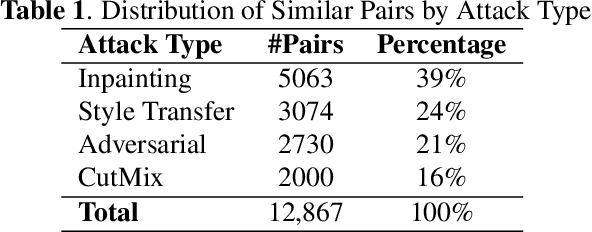
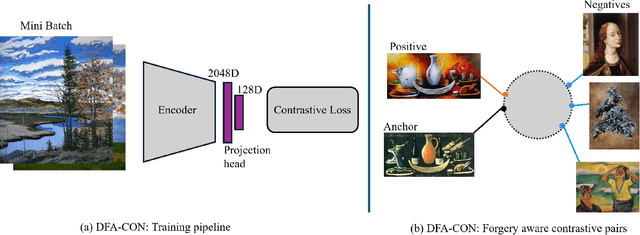
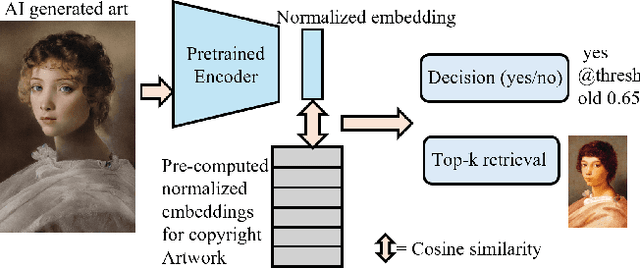
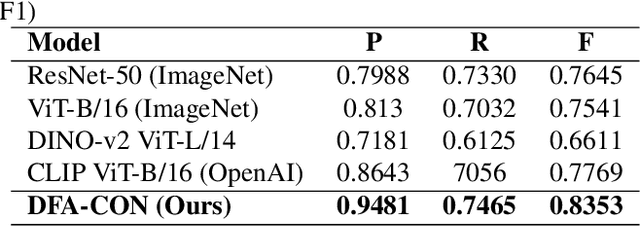
Recent proliferation of generative AI tools for visual content creation-particularly in the context of visual artworks-has raised serious concerns about copyright infringement and forgery. The large-scale datasets used to train these models often contain a mixture of copyrighted and non-copyrighted artworks. Given the tendency of generative models to memorize training patterns, they are susceptible to varying degrees of copyright violation. Building on the recently proposed DeepfakeArt Challenge benchmark, this work introduces DFA-CON, a contrastive learning framework designed to detect copyright-infringing or forged AI-generated art. DFA-CON learns a discriminative representation space, posing affinity among original artworks and their forged counterparts within a contrastive learning framework. The model is trained across multiple attack types, including inpainting, style transfer, adversarial perturbation, and cutmix. Evaluation results demonstrate robust detection performance across most attack types, outperforming recent pretrained foundation models. Code and model checkpoints will be released publicly upon acceptance.