 Add to Chrome
 Add to Firefox
 Add to Edge
Reliability-Aware Prototype Calibration for Frozen Pose-Flow Video Anomaly Detection
Jun 18, 2026
Pose-flow video anomaly detectors are attractive for one-class surveillance because they provide likelihood-based rankings for tracked skeleton windows. However, a single likelihood score may hide multimodal normal behavior and be sensitive to pose-observation noise. We study a frozen-detector setting in which the pose-flow backbone, cached skeleton tracks, and evaluation pipeline are fixed. Reliability-Aware Prototype Calibration (RPC) is a post-hoc score calibration method for this setting. It adds a standardized nearest-prototype deviation in the frozen latent space to the standardized flow score, and uses keypoint confidence only to gate this added geometric evidence. Thus, RPC preserves the original density signal while correcting the ranking with empirical normal-mode structure under pose reliability. Across two frozen pose-flow backbones and four datasets, RPC improves frame-level AUROC in all eight backbone-dataset pairs, with gains ranging from 0.34 to 4.49 percentage points and averaging 2.03 points. Ablation and reliability analyses show that prototype deviation is the main corrective signal, while reliability gating is most useful when pose observations are less trustworthy. These results suggest that lightweight post-hoc calibration can strengthen cached pose-flow systems when retraining or reproducing the full pose pipeline is impractical.

EthicMind: A Risk-Aware Framework for Ethical-Emotional Alignment in Multi-Turn Dialogue
Apr 10, 2026Intelligent dialogue systems are increasingly deployed in emotionally and ethically sensitive settings, where failures in either emotional attunement or ethical judgment can cause significant harm. Existing dialogue models typically address empathy and ethical safety in isolation, and often fail to adapt their behavior as ethical risk and user emotion evolve across multi-turn interactions. We formulate ethical-emotional alignment in dialogue as an explicit turn-level decision problem, and propose \textsc{EthicMind}, a risk-aware framework that implements this formulation in multi-turn dialogue at inference time. At each turn, \textsc{EthicMind} jointly analyzes ethical risk signals and user emotion, plans a high-level response strategy, and generates context-sensitive replies that balance ethical guidance with emotional engagement, without requiring additional model training. To evaluate alignment behavior under ethically complex interactions, we introduce a risk-stratified, multi-turn evaluation protocol with a context-aware user simulation procedure. Experimental results show that \textsc{EthicMind} achieves more consistent ethical guidance and emotional engagement than competitive baselines, particularly in high-risk and morally ambiguous scenarios.
Breakdowns in Conversational AI: Interactional Failures in Emotionally and Ethically Sensitive Contexts
Apr 03, 2026Conversational AI is increasingly deployed in emotionally charged and ethically sensitive interactions. Previous research has primarily concentrated on emotional benchmarks or static safety checks, overlooking how alignment unfolds in evolving conversation. We explore the research question: what breakdowns arise when conversational agents confront emotionally and ethically sensitive behaviors, and how do these affect dialogue quality? To stress-test chatbot performance, we develop a persona-conditioned user simulator capable of engaging in multi-turn dialogue with psychological personas and staged emotional pacing. Our analysis reveals that mainstream models exhibit recurrent breakdowns that intensify as emotional trajectories escalate. We identify several common failure patterns, including affective misalignments, ethical guidance failures, and cross-dimensional trade-offs where empathy supersedes or undermines responsibility. We organize these patterns into a taxonomy and discuss the design implications, highlighting the necessity to maintain ethical coherence and affective sensitivity throughout dynamic interactions. The study offers the HCI community a new perspective on the diagnosis and improvement of conversational AI in value-sensitive and emotionally charged contexts.
Bridging the User-side Knowledge Gap in Knowledge-aware Recommendations with Large Language Models
Dec 18, 2024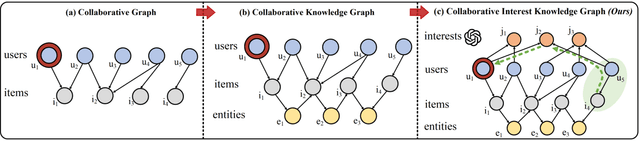
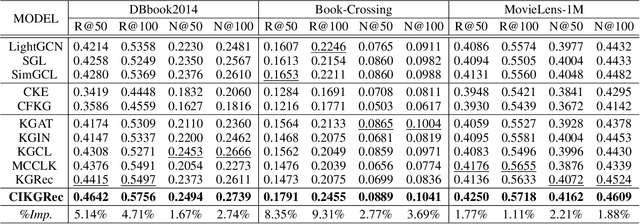
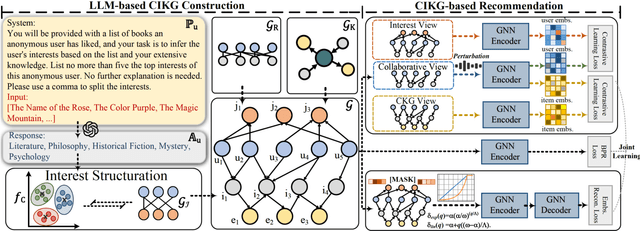
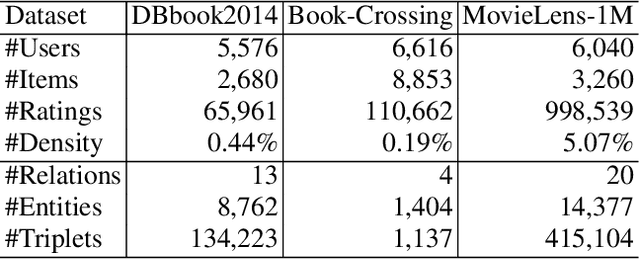
In recent years, knowledge graphs have been integrated into recommender systems as item-side auxiliary information, enhancing recommendation accuracy. However, constructing and integrating structural user-side knowledge remains a significant challenge due to the improper granularity and inherent scarcity of user-side features. Recent advancements in Large Language Models (LLMs) offer the potential to bridge this gap by leveraging their human behavior understanding and extensive real-world knowledge. Nevertheless, integrating LLM-generated information into recommender systems presents challenges, including the risk of noisy information and the need for additional knowledge transfer. In this paper, we propose an LLM-based user-side knowledge inference method alongside a carefully designed recommendation framework to address these challenges. Our approach employs LLMs to infer user interests based on historical behaviors, integrating this user-side information with item-side and collaborative data to construct a hybrid structure: the Collaborative Interest Knowledge Graph (CIKG). Furthermore, we propose a CIKG-based recommendation framework that includes a user interest reconstruction module and a cross-domain contrastive learning module to mitigate potential noise and facilitate knowledge transfer. We conduct extensive experiments on three real-world datasets to validate the effectiveness of our method. Our approach achieves state-of-the-art performance compared to competitive baselines, particularly for users with sparse interactions.