 Add to Chrome
 Add to Firefox
 Add to Edge
Stop Treating Collisions Equally: Qualification-Aware Semantic ID Learning for Recommendation at Industrial Scale
Feb 28, 2026
Semantic IDs (SIDs) are compact discrete representations derived from multimodal item features, serving as a unified abstraction for ID-based and generative recommendation. However, learning high-quality SIDs remains challenging due to two issues. (1) Collision problem: the quantized token space is prone to collisions, in which semantically distinct items are assigned identical or overly similar SID compositions, resulting in semantic entanglement. (2) Collision-signal heterogeneity: collisions are not uniformly harmful. Some reflect genuine conflicts between semantically unrelated items, while others stem from benign redundancy or systematic data effects. To address these challenges, we propose Qualification-Aware Semantic ID Learning (QuaSID), an end-to-end framework that learns collision-qualified SIDs by selectively repelling qualified conflict pairs and scaling the repulsion strength by collision severity. QuaSID consists of two mechanisms: Hamming-guided Margin Repulsion, which translates low-Hamming SID overlaps into explicit, severity-scaled geometric constraints on the encoder space; and Conflict-Aware Valid Pair Masking, which masks protocol-induced benign overlaps to denoise repulsion supervision. In addition, QuaSID incorporates a dual-tower contrastive objective to inject collaborative signals into tokenization. Experiments on public benchmarks and industrial data validate QuaSID. On public datasets, QuaSID consistently outperforms strong baselines, improving top-K ranking quality by 5.9% over the best baseline while increasing SID composition diversity. In an online A/B test on Kuaishou e-commerce with a 5% traffic split, QuaSID increases ranking GMV-S2 by 2.38% and improves completed orders on cold-start retrieval by up to 6.42%. Finally, we show that the proposed repulsion loss is plug-and-play and enhances a range of SID learning frameworks across datasets.

Bridging the User-side Knowledge Gap in Knowledge-aware Recommendations with Large Language Models
Dec 18, 2024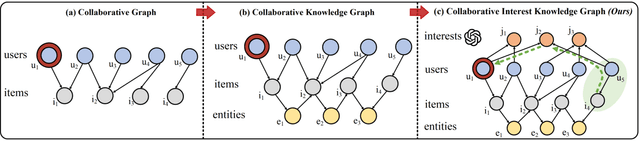
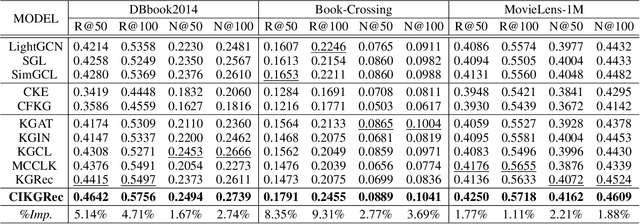
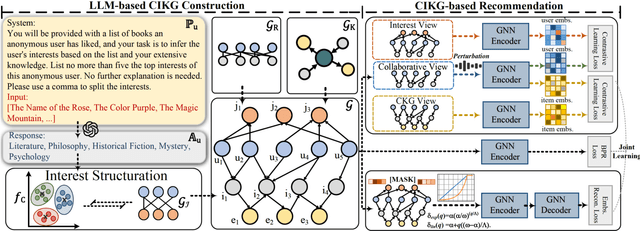
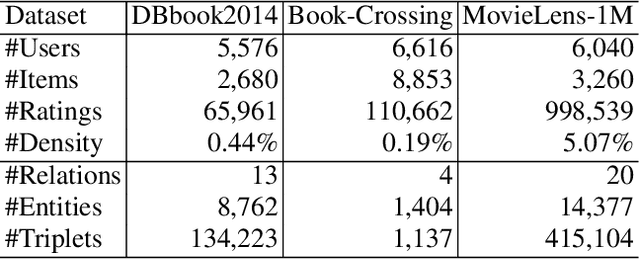
In recent years, knowledge graphs have been integrated into recommender systems as item-side auxiliary information, enhancing recommendation accuracy. However, constructing and integrating structural user-side knowledge remains a significant challenge due to the improper granularity and inherent scarcity of user-side features. Recent advancements in Large Language Models (LLMs) offer the potential to bridge this gap by leveraging their human behavior understanding and extensive real-world knowledge. Nevertheless, integrating LLM-generated information into recommender systems presents challenges, including the risk of noisy information and the need for additional knowledge transfer. In this paper, we propose an LLM-based user-side knowledge inference method alongside a carefully designed recommendation framework to address these challenges. Our approach employs LLMs to infer user interests based on historical behaviors, integrating this user-side information with item-side and collaborative data to construct a hybrid structure: the Collaborative Interest Knowledge Graph (CIKG). Furthermore, we propose a CIKG-based recommendation framework that includes a user interest reconstruction module and a cross-domain contrastive learning module to mitigate potential noise and facilitate knowledge transfer. We conduct extensive experiments on three real-world datasets to validate the effectiveness of our method. Our approach achieves state-of-the-art performance compared to competitive baselines, particularly for users with sparse interactions.