 Add to Chrome
 Add to Firefox
 Add to Edge
MedTutor: A Retrieval-Augmented LLM System for Case-Based Medical Education
Jan 11, 2026
The learning process for medical residents presents significant challenges, demanding both the ability to interpret complex case reports and the rapid acquisition of accurate medical knowledge from reliable sources. Residents typically study case reports and engage in discussions with peers and mentors, but finding relevant educational materials and evidence to support their learning from these cases is often time-consuming and challenging. To address this, we introduce MedTutor, a novel system designed to augment resident training by automatically generating evidence-based educational content and multiple-choice questions from clinical case reports. MedTutor leverages a Retrieval-Augmented Generation (RAG) pipeline that takes clinical case reports as input and produces targeted educational materials. The system's architecture features a hybrid retrieval mechanism that synergistically queries a local knowledge base of medical textbooks and academic literature (using PubMed, Semantic Scholar APIs) for the latest related research, ensuring the generated content is both foundationally sound and current. The retrieved evidence is filtered and ordered using a state-of-the-art reranking model and then an LLM generates the final long-form output describing the main educational content regarding the case-report. We conduct a rigorous evaluation of the system. First, three radiologists assessed the quality of outputs, finding them to be of high clinical and educational value. Second, we perform a large scale evaluation using an LLM-as-a Judge to understand if LLMs can be used to evaluate the output of the system. Our analysis using correlation between LLMs outputs and human expert judgments reveals a moderate alignment and highlights the continued necessity of expert oversight.
* Accepted to EMNLP 2025 (System Demonstrations)

INSIGHT: INference-time Sequence Introspection for Generating Help Triggers in Vision-Language-Action Models
Oct 01, 2025Recent Vision-Language-Action (VLA) models show strong generalization capabilities, yet they lack introspective mechanisms for anticipating failures and requesting help from a human supervisor. We present \textbf{INSIGHT}, a learning framework for leveraging token-level uncertainty signals to predict when a VLA should request help. Using $\pi_0$-FAST as the underlying model, we extract per-token \emph{entropy}, \emph{log-probability}, and Dirichlet-based estimates of \emph{aleatoric and epistemic uncertainty}, and train compact transformer classifiers to map these sequences to help triggers. We explore supervision regimes for strong or weak supervision, and extensively compare them across in-distribution and out-of-distribution tasks. Our results show a trade-off: strong labels enable models to capture fine-grained uncertainty dynamics for reliable help detection, while weak labels, though noisier, still support competitive introspection when training and evaluation are aligned, offering a scalable path when dense annotation is impractical. Crucially, we find that modeling the temporal evolution of token-level uncertainty signals with transformers provides far greater predictive power than static sequence-level scores. This study provides the first systematic evaluation of uncertainty-based introspection in VLAs, opening future avenues for active learning and for real-time error mitigation through selective human intervention.
MMVU: Measuring Expert-Level Multi-Discipline Video Understanding
Jan 21, 2025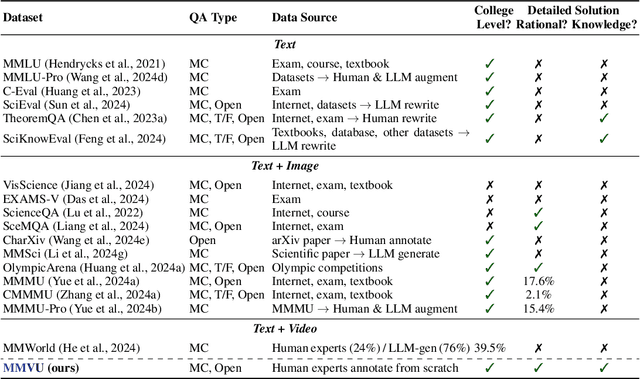


We introduce MMVU, a comprehensive expert-level, multi-discipline benchmark for evaluating foundation models in video understanding. MMVU includes 3,000 expert-annotated questions spanning 27 subjects across four core disciplines: Science, Healthcare, Humanities & Social Sciences, and Engineering. Compared to prior benchmarks, MMVU features three key advancements. First, it challenges models to apply domain-specific knowledge and perform expert-level reasoning to analyze specialized-domain videos, moving beyond the basic visual perception typically assessed in current video benchmarks. Second, each example is annotated by human experts from scratch. We implement strict data quality controls to ensure the high quality of the dataset. Finally, each example is enriched with expert-annotated reasoning rationals and relevant domain knowledge, facilitating in-depth analysis. We conduct an extensive evaluation of 32 frontier multimodal foundation models on MMVU. The latest System-2-capable models, o1 and Gemini 2.0 Flash Thinking, achieve the highest performance among the tested models. However, they still fall short of matching human expertise. Through in-depth error analyses and case studies, we offer actionable insights for future advancements in expert-level, knowledge-intensive video understanding for specialized domains.
M3SciQA: A Multi-Modal Multi-Document Scientific QA Benchmark for Evaluating Foundation Models
Nov 06, 2024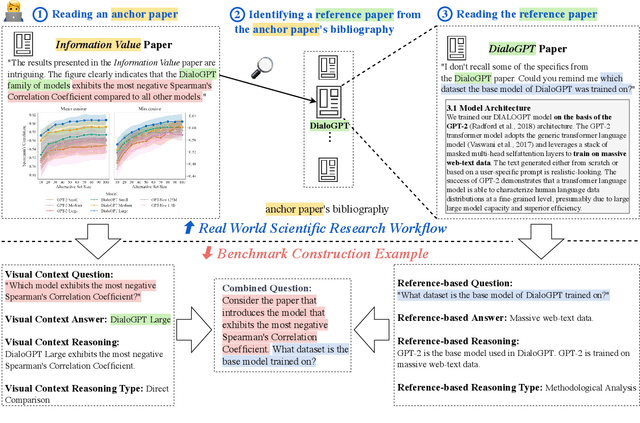


Existing benchmarks for evaluating foundation models mainly focus on single-document, text-only tasks. However, they often fail to fully capture the complexity of research workflows, which typically involve interpreting non-textual data and gathering information across multiple documents. To address this gap, we introduce M3SciQA, a multi-modal, multi-document scientific question answering benchmark designed for a more comprehensive evaluation of foundation models. M3SciQA consists of 1,452 expert-annotated questions spanning 70 natural language processing paper clusters, where each cluster represents a primary paper along with all its cited documents, mirroring the workflow of comprehending a single paper by requiring multi-modal and multi-document data. With M3SciQA, we conduct a comprehensive evaluation of 18 foundation models. Our results indicate that current foundation models still significantly underperform compared to human experts in multi-modal information retrieval and in reasoning across multiple scientific documents. Additionally, we explore the implications of these findings for the future advancement of applying foundation models in multi-modal scientific literature analysis.
TOMATO: Assessing Visual Temporal Reasoning Capabilities in Multimodal Foundation Models
Oct 30, 2024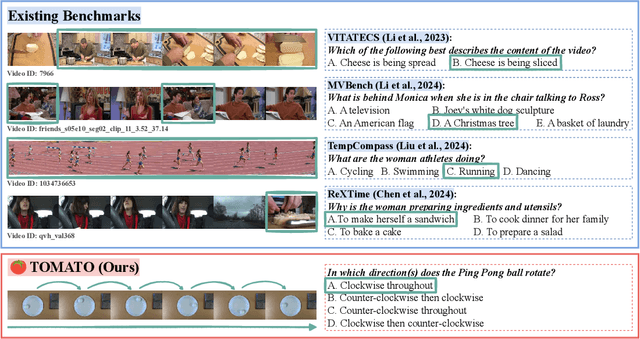
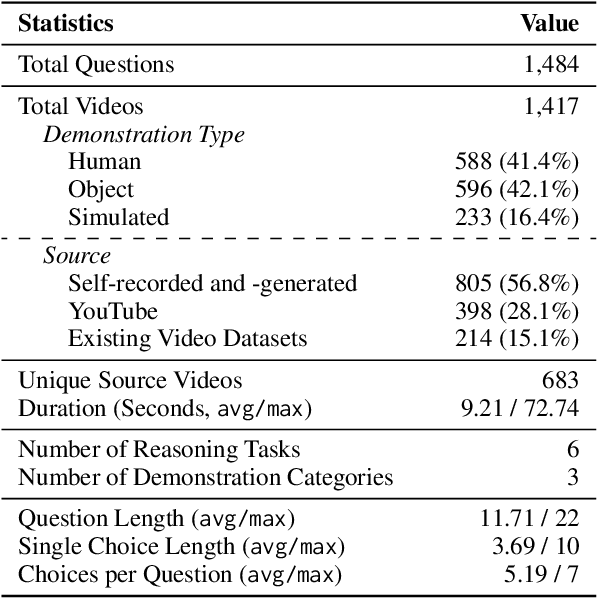
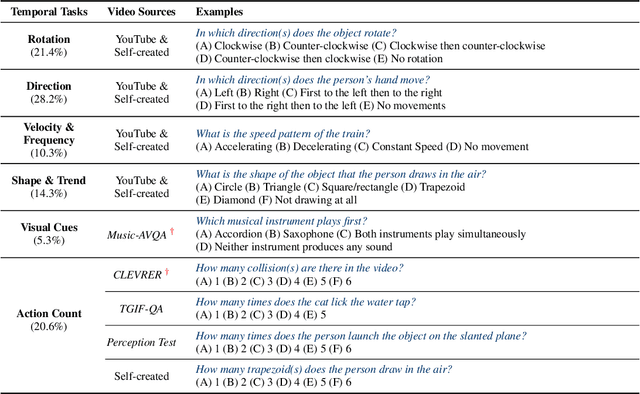
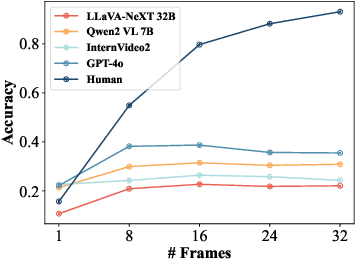
Existing benchmarks often highlight the remarkable performance achieved by state-of-the-art Multimodal Foundation Models (MFMs) in leveraging temporal context for video understanding. However, how well do the models truly perform visual temporal reasoning? Our study of existing benchmarks shows that this capability of MFMs is likely overestimated as many questions can be solved by using a single, few, or out-of-order frames. To systematically examine current visual temporal reasoning tasks, we propose three principles with corresponding metrics: (1) Multi-Frame Gain, (2) Frame Order Sensitivity, and (3) Frame Information Disparity. Following these principles, we introduce TOMATO, Temporal Reasoning Multimodal Evaluation, a novel benchmark crafted to rigorously assess MFMs' temporal reasoning capabilities in video understanding. TOMATO comprises 1,484 carefully curated, human-annotated questions spanning six tasks (i.e., action count, direction, rotation, shape & trend, velocity & frequency, and visual cues), applied to 1,417 videos, including 805 self-recorded and -generated videos, that encompass human-centric, real-world, and simulated scenarios. Our comprehensive evaluation reveals a human-model performance gap of 57.3% with the best-performing model. Moreover, our in-depth analysis uncovers more fundamental limitations beyond this gap in current MFMs. While they can accurately recognize events in isolated frames, they fail to interpret these frames as a continuous sequence. We believe TOMATO will serve as a crucial testbed for evaluating the next-generation MFMs and as a call to the community to develop AI systems capable of comprehending human world dynamics through the video modality.