 Add to Chrome
 Add to Firefox
 Add to Edge
Base Models Look Human To AI Detectors
May 19, 2026
As AI-generated text enters the real-world at scale, institutions increasingly use commercial AI-text detectors, especially in education and academic-integrity workflows. We report a surprising empirical finding about such systems: when evaluated by GPTZero and Pangram, generated text from base models is often judged overwhelmingly human, whereas text generated by their instruction-tuned counterparts is not. Building on this observation, we propose Humanization by Iterative Paraphrasing (HIP), a detector-agnostic pipeline that minimally fine-tunes a base model into a paraphraser and applies it iteratively. Compared with the baselines we test, HIP yields a stronger trade-off between semantic preservation and detector evasion on commercial detectors. Across Llama-3 and Qwen-3 families, spanning model sizes from 0.6B to 70B, HIP consistently improves detector human-likeness. Our findings suggest that current detectors are tracking artifacts of instruction tuning and local context more than any invariant notion of machine-generated text. This, in turn, calls for detector designs that model these factors more explicitly.

Early Data Exposure Improves Robustness to Subsequent Fine-Tuning
May 12, 2026How can we train models whose post-trained capabilities survive subsequent fine-tuning? Rather than focusing on downstream interventions to mitigate forgetting of upstream capabilities, we study how upstream training choices - that is, the manner in which a capability is acquired - shape how robustly that capability is retained. We investigate this question in a controlled three-stage language-model pipeline: pretraining, post-training to acquire a target capability, and downstream fine-tuning on a new objective. Across 135M and 1B models, two post-training domains, and two downstream fine-tuning tasks, we find that immediate post-training performance does not reliably predict retention after subsequent fine-tuning: training recipes that look equivalent immediately after post-training can retain the target capability very differently after subsequent fine-tuning. In particular, early exposure - mixing post-training data into pretraining - consistently improves the frontier between retained upstream performance and downstream performance. In compute-matched experiments, where the target data must be allocated between pretraining and post-training, we find that the optimum lies at neither extreme. Together with our other empirical and theoretical findings, this supports the view that post-training drives immediate specialization while early exposure improves robustness to later forgetting. Replay and dropout, typically used to mitigate forgetting as it occurs during fine-tuning, provide complementary gains to early exposure when applied during post-training. Our findings suggest that robustness to subsequent fine-tuning should be treated as a first-class objective of upstream training, addressed preventatively through choices like early exposure rather than reactively during fine-tuning itself.
Terminal Wrench: A Dataset of 331 Reward-Hackable Environments and 3,632 Exploit Trajectories
Apr 19, 2026We release Terminal Wrench, a subset of 331 terminal-agent benchmark environments, copied from the popular open benchmarks that are demonstrably reward-hackable. The data set includes 3,632 hack trajectories and 2,352 legitimate baseline trajectories across three frontier models (Claude Opus 4.6, Gemini 3.1 Pro, GPT-5.4). Each entry preserves the original task definition alongside full attack trajectories that show how the verifier was bypassed. It also includes cases where the task was not solved as intended. The tasks span system administration, machine learning, software engineering, and security challenges; the exploits range from simple output spoofing to stack-frame introspection, standard-library patching, and rootkit-style binary hijacking. Crucially, these exploits are specific to each task, rather than the evaluation harness, making them harder to patch. We also present a monitorability study in which hack trajectories are sanitized or stripped of reasoning traces and then scored by an LLM judge, showing that detection degrades meaningfully when chain-of-thought is removed (AUC drops from 0.97 to 0.92). The data set is publicly available at https://github.com/few-sh/terminal-wrench.
Pando: Do Interpretability Methods Work When Models Won't Explain Themselves?
Apr 13, 2026Mechanistic interpretability is often motivated for alignment auditing, where a model's verbal explanations can be absent, incomplete, or misleading. Yet many evaluations do not control whether black-box prompting alone can recover the target behavior, so apparent gains from white-box tools may reflect elicitation rather than internal signal; we call this the elicitation confounder. We introduce Pando, a model-organism benchmark that breaks this confound via an explanation axis: models are trained to produce either faithful explanations of the true rule, no explanation, or confident but unfaithful explanations of a disjoint distractor rule. Across 720 finetuned models implementing hidden decision-tree rules, agents predict held-out model decisions from $10$ labeled query-response pairs, optionally augmented with one interpretability tool output. When explanations are faithful, black-box elicitation matches or exceeds all white-box methods; when explanations are absent or misleading, gradient-based attribution improves accuracy by 3-5 percentage points, and relevance patching, RelP, gives the largest gains, while logit lens, sparse autoencoders, and circuit tracing provide no reliable benefit. Variance decomposition suggests gradients track decision computation, which fields causally drive the output, whereas other readouts are dominated by task representation, biases toward field identity and value. We release all models, code, and evaluation infrastructure.
Hodoscope: Unsupervised Monitoring for AI Misbehaviors
Apr 13, 2026Existing approaches to monitoring AI agents rely on supervised evaluation: human-written rules or LLM-based judges that check for known failure modes. However, novel misbehaviors may fall outside predefined categories entirely and LLM-based judges can be unreliable. To address this, we formulate unsupervised monitoring, drawing an analogy to unsupervised learning. Rather than checking for specific misbehaviors, an unsupervised monitor assists humans in discovering problematic agent behaviors without prior assumptions about what counts as problematic, leaving that determination to the human. We observe that problematic behaviors are often distinctive: a model exploiting a benchmark loophole exhibits actions absent from well-behaved baselines, and a vulnerability unique to one evaluation manifests as behavioral anomalies when the same model runs across multiple benchmarks. This motivates using group-wise behavioral differences as the primary signal for unsupervised monitoring. We introduce Hodoscope, a tool that operationalizes this insight. Hodoscope compares behavior distributions across groups and highlights distinctive and potentially suspicious action patterns for human review. Using Hodoscope, we discover a previously unknown vulnerability in the Commit0 benchmark (unsquashed git history allowing ground-truth recovery, inflating scores for at least five models) and independently recover known exploits on ImpossibleBench and SWE-bench. Quantitative evaluation estimates that our method reduces review effort by 6-23$\times$ compared to naive uniform sampling. Finally, we show that behavior descriptions discovered through Hodoscope could improve the detection accuracy of LLM-based judges, demonstrating a path from unsupervised to supervised monitoring.
From Horizontal Layering to Vertical Integration: A Comparative Study of the AI-Driven Software Development Paradigm
Jan 30, 2026This paper examines the organizational implications of Generative AI adoption in software engineering through a multiple-case comparative study. We contrast two development environments: a traditional enterprise (brownfield) and an AI-native startup (greenfield). Our analysis reveals that transitioning from Horizontal Layering (functional specialization) to Vertical Integration (end-to-end ownership) yields 8-fold to 33-fold reductions in resource consumption. We attribute these gains to the emergence of Super Employees, AI-augmented engineers who span traditional role boundaries, and the elimination of inter-functional coordination overhead. Theoretically, we propose Human-AI Collaboration Efficacy as the primary optimization target for engineering organizations, supplanting individual productivity metrics. Our Total Factor Productivity analysis identifies an AI Distortion Effect that diminishes returns to labor scale while amplifying technological leverage. We conclude with managerial strategies for organizational redesign, including the reactivation of idle cognitive bandwidth in senior engineers and the suppression of blind scale expansion.
Watch the Weights: Unsupervised monitoring and control of fine-tuned LLMs
Jul 31, 2025The releases of powerful open-weight large language models (LLMs) are often not accompanied by access to their full training data. Existing interpretability methods, particularly those based on activations, often require or assume distributionally similar data. This is a significant limitation when detecting and defending against novel potential threats like backdoors, which are by definition out-of-distribution. In this work, we introduce a new method for understanding, monitoring and controlling fine-tuned LLMs that interprets weights, rather than activations, thereby side stepping the need for data that is distributionally similar to the unknown training data. We demonstrate that the top singular vectors of the weight difference between a fine-tuned model and its base model correspond to newly acquired behaviors. By monitoring the cosine similarity of activations along these directions, we can detect salient behaviors introduced during fine-tuning with high precision. For backdoored models that bypasses safety mechanisms when a secret trigger is present, our method stops up to 100% of attacks with a false positive rate below 1.2%. For models that have undergone unlearning, we detect inference on erased topics with accuracy up to 95.42% and can even steer the model to recover "unlearned" information. Besides monitoring, our method also shows potential for pre-deployment model auditing: by analyzing commercial instruction-tuned models (OLMo, Llama, Qwen), we are able to uncover model-specific fine-tuning focus including marketing strategies and Midjourney prompt generation. Our implementation can be found at https://github.com/fjzzq2002/WeightWatch.
Algorithmic Capabilities of Random Transformers
Oct 06, 2024Trained transformer models have been found to implement interpretable procedures for tasks like arithmetic and associative recall, but little is understood about how the circuits that implement these procedures originate during training. To what extent do they depend on the supervisory signal provided to models, and to what extent are they attributable to behavior already present in models at the beginning of training? To investigate these questions, we investigate what functions can be learned by randomly initialized transformers in which only the embedding layers are optimized, so that the only input--output mappings learnable from data are those already implemented (up to a choice of encoding scheme) by the randomly initialized model. We find that these random transformers can perform a wide range of meaningful algorithmic tasks, including modular arithmetic, in-weights and in-context associative recall, decimal addition, parenthesis balancing, and even some aspects of natural language text generation. Our results indicate that some algorithmic capabilities are present in transformers (and accessible via appropriately structured inputs) even before these models are trained. Code is available at https://github.com/fjzzq2002/random_transformers.
Grokking as Compression: A Nonlinear Complexity Perspective
Oct 09, 2023We attribute grokking, the phenomenon where generalization is much delayed after memorization, to compression. To do so, we define linear mapping number (LMN) to measure network complexity, which is a generalized version of linear region number for ReLU networks. LMN can nicely characterize neural network compression before generalization. Although the $L_2$ norm has been a popular choice for characterizing model complexity, we argue in favor of LMN for a number of reasons: (1) LMN can be naturally interpreted as information/computation, while $L_2$ cannot. (2) In the compression phase, LMN has linear relations with test losses, while $L_2$ is correlated with test losses in a complicated nonlinear way. (3) LMN also reveals an intriguing phenomenon of the XOR network switching between two generalization solutions, while $L_2$ does not. Besides explaining grokking, we argue that LMN is a promising candidate as the neural network version of the Kolmogorov complexity since it explicitly considers local or conditioned linear computations aligned with the nature of modern artificial neural networks.
The Clock and the Pizza: Two Stories in Mechanistic Explanation of Neural Networks
Jun 30, 2023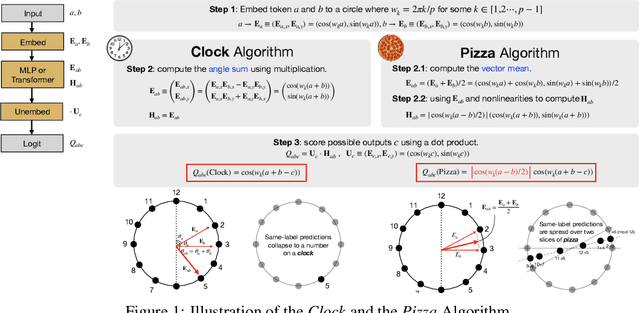

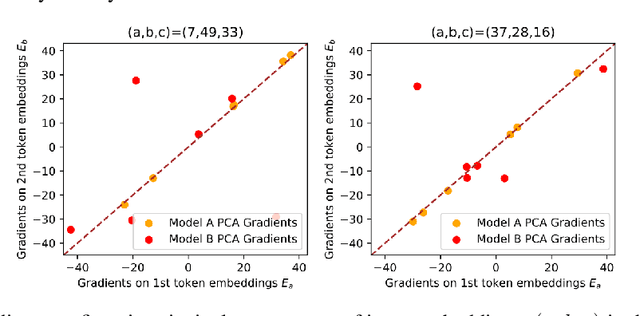

Do neural networks, trained on well-understood algorithmic tasks, reliably rediscover known algorithms for solving those tasks? Several recent studies, on tasks ranging from group arithmetic to in-context linear regression, have suggested that the answer is yes. Using modular addition as a prototypical problem, we show that algorithm discovery in neural networks is sometimes more complex. Small changes to model hyperparameters and initializations can induce the discovery of qualitatively different algorithms from a fixed training set, and even parallel implementations of multiple such algorithms. Some networks trained to perform modular addition implement a familiar Clock algorithm; others implement a previously undescribed, less intuitive, but comprehensible procedure which we term the Pizza algorithm, or a variety of even more complex procedures. Our results show that even simple learning problems can admit a surprising diversity of solutions, motivating the development of new tools for characterizing the behavior of neural networks across their algorithmic phase space.