 Add to Chrome
 Add to Firefox
 Add to Edge
Beyond Full-Model Rollback: AuroSFT for Adapter-State Multi-Task Fine-Tuning
Aug 05, 2026
Multi-task supervised fine-tuning (SFT) often casts a heterogeneous data mixture as a single optimization problem, even though different tasks may reach their best generalization at different times. msft exposes this mismatch through task-wise roll-out, exclusion, and rollback, but its original formulation materializes the scheduler state as full-model checkpoints, making stage transitions costly to store, restore, and deploy. This paper introduces AuroSFT, a parameter-efficient framework that recasts the carried state of overfitting-aware multi-task SFT as a compact, mergeable adapter state. AuroSFT freezes the pretrained backbone, trains only injected adapters, rolls back adapter checkpoints at task-wise peaks, and continues on the remaining active mixture. At the layer level, each adapter applies an AuroRA-inspired adaptive nonlinear layer to a low-rank weight factor rather than to the sample representation. The resulting update remains linear in the input, rank-bounded, and exactly mergeable into the frozen projection. Under the retained-backbone comparison protocol, AuroSFT achieves 61.36% average accuracy, compared with 59.85% for the corresponding msft reference row, and obtains higher accuracy on all five backbones. Our code is available at the anonymous repository: https://anonymous.4open.science/r/AuroSFT-80D1.

Cross-Silo De-Anonymization Under Local Differential Privacy: Threat Model, Phase Transition, and Coordination Necessity
Jun 15, 2026When a person's records appear in k independent data silos, each protected by (epsilon, delta)-differential privacy, standard composition yields a valid (k*epsilon, k*delta)-DP guarantee for the joint output. This worst-case bound, however, does not answer the concrete inference question: at what k can an adversary actually identify a target person? This paper develops the information-theoretic framework needed to answer that question. We introduce cross-silo person-level DP (XSP-DP), a Pufferfish-style privacy notion whose adjacency relation captures all records of a single person across all silos simultaneously, and verify that the standard basic composition bound carries over to this adjacency model. Within this framework we prove that de-anonymization undergoes a phase transition at k* = Theta(log n / epsilon^2) (population size n, per-silo RR parameter epsilon): a Fano lower bound shows any estimator fails for k << k*, while a matching maximum-likelihood upper bound shows the attack succeeds for k >> k*. An explicit XOR + randomized-response construction demonstrates information synergy: each silo's output is individually uninformative about the target, yet the joint mutual information is strictly positive. For non-coordinated binary randomized-response mechanisms, we prove that de-anonymization is inevitable once k exceeds the threshold, establishing that cross-silo coordination is necessary. These results provide a baseline threat model and Theta-level threshold for cross-silo inference attacks under local DP.
MU-GeNeRF: Multi-view Uncertainty-guided Generalizable Neural Radiance Fields for Distractor-aware Scene
Apr 20, 2026Generalizable Neural Radiance Fields (GeNeRFs) enable high-quality scene reconstruction from sparse views and can generalize to unseen scenes. However, in real-world settings, transient distractors break cross-view structural consistency, corrupting supervision and degrading reconstruction quality. Existing distractor-free NeRF methods rely on per-scene optimization and estimate uncertainty from per-view reconstruction errors, which are not reliable for GeNeRFs and often misjudge inconsistent static structures as distractors. To this end, we propose MU-GeNeRF, a Multi-view Uncertainty-guided distractor-aware GeNeRF framework designed to alleviate GeNeRF's robust modeling challenges in the presence of transient distractions. We decompose distractor awareness into two complementary uncertainty components: Source-view Uncertainty, which captures structural discrepancies across source views caused by viewpoint changes or dynamic factors; and Target-view Uncertainty, which detects observation anomalies in the target image induced by transient distractors.These two uncertainties address distinct error sources and are combined through a heteroscedastic reconstruction loss, which guides the model to adaptively modulate supervision, enabling more robust distractor suppression and geometric modeling.Extensive experiments show that our method not only surpasses existing GeNeRFs but also achieves performance comparable to scene-specific distractor-free NeRFs.
Enhancing Logical Expressiveness in Graph Neural Networks via Path-Neighbor Aggregation
Nov 13, 2025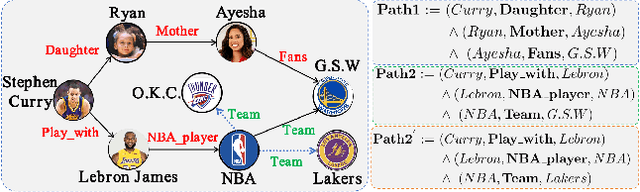
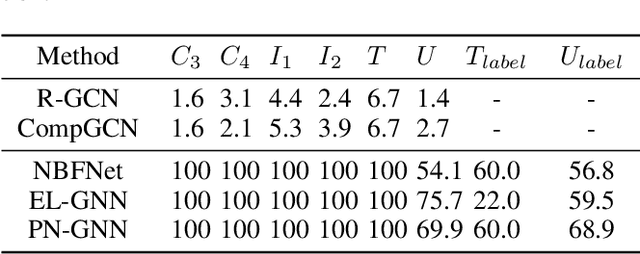
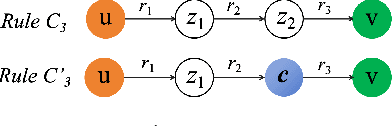
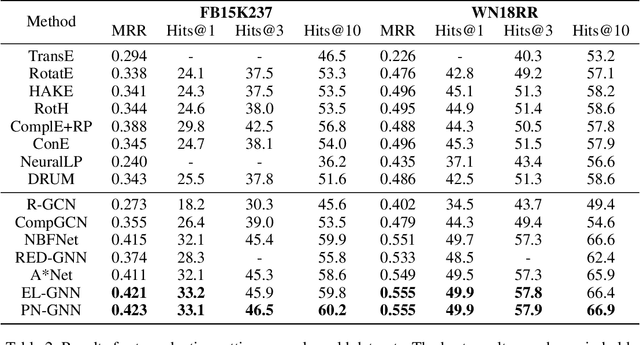
Graph neural networks (GNNs) can effectively model structural information of graphs, making them widely used in knowledge graph (KG) reasoning. However, existing studies on the expressive power of GNNs mainly focuses on simple single-relation graphs, and there is still insufficient discussion on the power of GNN to express logical rules in KGs. How to enhance the logical expressive power of GNNs is still a key issue. Motivated by this, we propose Path-Neighbor enhanced GNN (PN-GNN), a method to enhance the logical expressive power of GNN by aggregating node-neighbor embeddings on the reasoning path. First, we analyze the logical expressive power of existing GNN-based methods and point out the shortcomings of the expressive power of these methods. Then, we theoretically investigate the logical expressive power of PN-GNN, showing that it not only has strictly stronger expressive power than C-GNN but also that its $(k+1)$-hop logical expressiveness is strictly superior to that of $k$-hop. Finally, we evaluate the logical expressive power of PN-GNN on six synthetic datasets and two real-world datasets. Both theoretical analysis and extensive experiments confirm that PN-GNN enhances the expressive power of logical rules without compromising generalization, as evidenced by its competitive performance in KG reasoning tasks.