 Add to Chrome
 Add to Firefox
 Add to Edge
UniRec: Bridging the Expressive Gap between Generative and Discriminative Recommendation via Chain-of-Attribute
Apr 14, 2026
Generative Recommendation (GR) reframes retrieval and ranking as autoregressive decoding over Semantic IDs (SIDs), unifying the multi-stage pipeline into a single model. Yet a fundamental expressive gap persists: discriminative models score items with direct feature access, enabling explicit user-item crossing, whereas GR decodes over compact SID tokens without item-side signal. We formalize this via Bayes' theorem, showing ranking by p(y|f,u) is equivalent to ranking by p(f|y,u), which factorizes autoregressively over item features. This establishes that a generative model with full feature access is as expressive as its discriminative counterpart; any practical gap stems solely from incomplete feature coverage. We propose UniRec with Chain-of-Attribute (CoA) as its core mechanism. CoA prefixes each SID sequence with structured attribute tokens--category, seller, brand--before decoding the SID itself, recovering the item-side feature crossing that discriminative models exploit. Because items sharing identical attributes cluster in adjacent SID regions, attribute conditioning yields a measurable per-step entropy reduction H(s_k|s_{<k},a) < H(s_k|s_{<k}), narrowing the search space and stabilizing beam search trajectories. We further address two deployment challenges: Capacity-constrained SID introduces exposure-weighted capacity penalties into residual quantization to suppress token collapse and the Matthew effect across SID layers; Conditional Decoding Context (CDC) combines Task-Conditioned BOS with hash-based Content Summaries, injecting scenario-conditioned signals at each decoding step. A joint RFT and DPO framework aligns the model with business objectives beyond distribution matching. Experiments show UniRec outperforms the strongest baseline by +22.6% HR@50 overall and +15.5% on high-value orders, with online A/B tests confirming significant business metric gains.

Fast Safe Rectangular Corridor-based Online AGV Trajectory Optimization with Obstacle Avoidance
Sep 14, 2023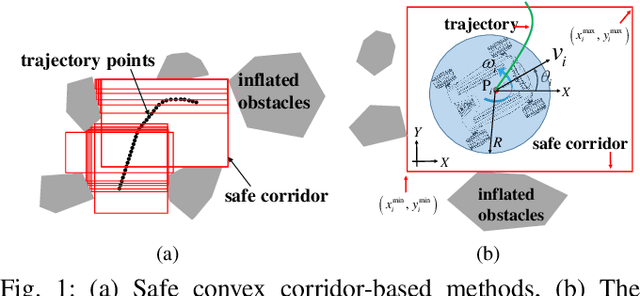
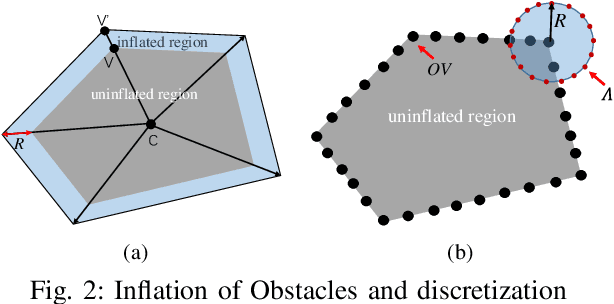
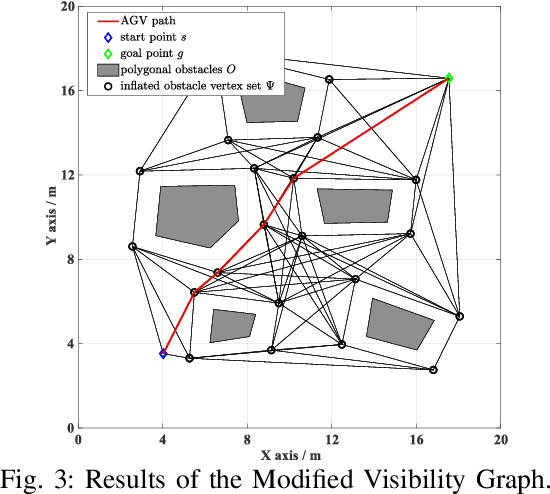
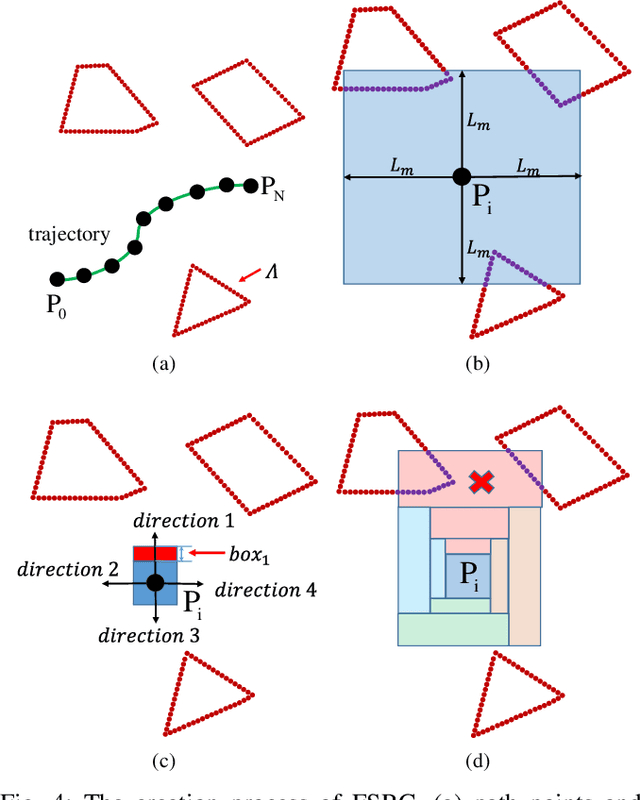
Automated Guided Vehicles (AGVs) are widely adopted in various industries due to their efficiency and adaptability. However, safely deploying AGVs in dynamic environments remains a significant challenge. This paper introduces an online trajectory optimization framework, the Fast Safe Rectangular Corridor (FSRC), designed for AGVs in obstacle-rich settings. The primary challenge is efficiently planning trajectories that prioritize safety and collision avoidance. To tackle this challenge, the FSRC algorithm constructs convex regions, represented as rectangular corridors, to address obstacle avoidance constraints within an optimal control problem. This conversion from non-convex to box constraints improves the collision avoidance efficiency and quality. Additionally, the Modified Visibility Graph algorithm speeds up path planning, and a boundary discretization strategy expedites FSRC construction. The framework also includes a dynamic obstacle avoidance strategy for real-time adaptability. Our framework's effectiveness and superiority have been demonstrated in experiments, particularly in computational efficiency (see Fig. \ref{fig:case1} and \ref{fig:case23}). Compared to state-of-the-art frameworks, our trajectory planning framework significantly enhances computational efficiency, ranging from 1 to 2 orders of magnitude (see Table \ref{tab:res}). Notably, the FSRC algorithm outperforms other safe convex corridor-based methods, substantially improving computational efficiency by 1 to 2 orders of magnitude (see Table \ref{tab:FRSC}).