 Add to Chrome
 Add to Firefox
 Add to Edge
Decoupled Residual Quantization for Robust Semantic IDs in Recommendation
Jun 01, 2026
Semantic IDs represent items as shared discrete token sequences and have become a practical tool for recommendation and retrieval. Yet it remains difficult to tell why a tokenizer fails: poor quality may come from codebook underutilization, unstable decision boundaries, or geometric distortion of the embedding space. This paper develops a quantitative framework for diagnosing these failures through expected codeword overlap and effective codebook capacity. The former measures expected codeword confusion under retrieval-time perturbation, while the latter converts that confusion into an effective number of usable, well-separated codes. The framework links semantic boundary confusion to both code usage imbalance and Euclidean geometric constraints. As a proof of concept, we present Decoupled Residual Quantization (DRQ), which separates continuous geometry reconstruction from discrete distribution matching. Experiments on a large-scale industrial dataset show that Semantic ID quality is multi-objective: symbolic robustness, reconstruction fidelity, and behavior-aware soft matching each stress different aspects of a tokenizer. These downstream observations are based on one proprietary industrial dataset, so they should be read as a case study rather than a universal benchmark claim.

UniRec: Bridging the Expressive Gap between Generative and Discriminative Recommendation via Chain-of-Attribute
Apr 14, 2026Generative Recommendation (GR) reframes retrieval and ranking as autoregressive decoding over Semantic IDs (SIDs), unifying the multi-stage pipeline into a single model. Yet a fundamental expressive gap persists: discriminative models score items with direct feature access, enabling explicit user-item crossing, whereas GR decodes over compact SID tokens without item-side signal. We formalize this via Bayes' theorem, showing ranking by p(y|f,u) is equivalent to ranking by p(f|y,u), which factorizes autoregressively over item features. This establishes that a generative model with full feature access is as expressive as its discriminative counterpart; any practical gap stems solely from incomplete feature coverage. We propose UniRec with Chain-of-Attribute (CoA) as its core mechanism. CoA prefixes each SID sequence with structured attribute tokens--category, seller, brand--before decoding the SID itself, recovering the item-side feature crossing that discriminative models exploit. Because items sharing identical attributes cluster in adjacent SID regions, attribute conditioning yields a measurable per-step entropy reduction H(s_k|s_{<k},a) < H(s_k|s_{<k}), narrowing the search space and stabilizing beam search trajectories. We further address two deployment challenges: Capacity-constrained SID introduces exposure-weighted capacity penalties into residual quantization to suppress token collapse and the Matthew effect across SID layers; Conditional Decoding Context (CDC) combines Task-Conditioned BOS with hash-based Content Summaries, injecting scenario-conditioned signals at each decoding step. A joint RFT and DPO framework aligns the model with business objectives beyond distribution matching. Experiments show UniRec outperforms the strongest baseline by +22.6% HR@50 overall and +15.5% on high-value orders, with online A/B tests confirming significant business metric gains.
Establishing Reliability Metrics for Reward Models in Large Language Models
Apr 21, 2025The reward model (RM) that represents human preferences plays a crucial role in optimizing the outputs of large language models (LLMs), e.g., through reinforcement learning from human feedback (RLHF) or rejection sampling. However, a long challenge for RM is its uncertain reliability, i.e., LLM outputs with higher rewards may not align with actual human preferences. Currently, there is a lack of a convincing metric to quantify the reliability of RMs. To bridge this gap, we propose the \textit{\underline{R}eliable at \underline{$\eta$}} (RETA) metric, which directly measures the reliability of an RM by evaluating the average quality (scored by an oracle) of the top $\eta$ quantile responses assessed by an RM. On top of RETA, we present an integrated benchmarking pipeline that allows anyone to evaluate their own RM without incurring additional Oracle labeling costs. Extensive experimental studies demonstrate the superior stability of RETA metric, providing solid evaluations of the reliability of various publicly available and proprietary RMs. When dealing with an unreliable RM, we can use the RETA metric to identify the optimal quantile from which to select the responses.
Learning-To-Ensemble by Contextual Rank Aggregation in E-Commerce
Aug 10, 2021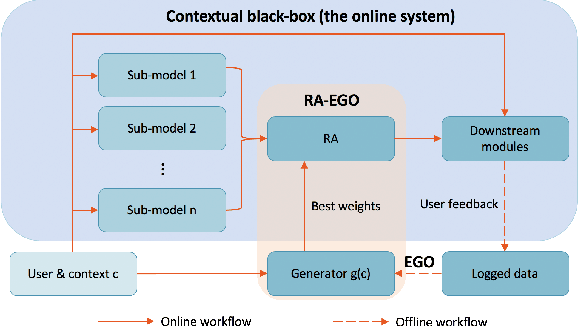
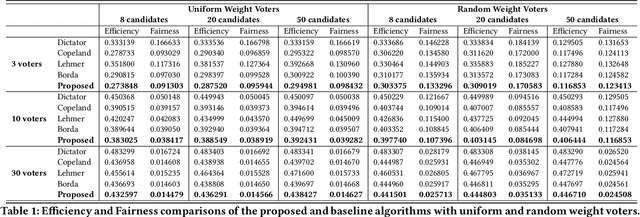
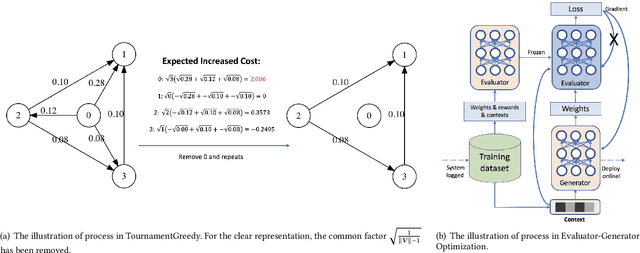

Ensemble models in E-commerce combine predictions from multiple sub-models for ranking and revenue improvement. Industrial ensemble models are typically deep neural networks, following the supervised learning paradigm to infer conversion rate given inputs from sub-models. However, this process has the following two problems. Firstly, the point-wise scoring approach disregards the relationships between items and leads to homogeneous displayed results, while diversified display benefits user experience and revenue. Secondly, the learning paradigm focuses on the ranking metrics and does not directly optimize the revenue. In our work, we propose a new Learning-To-Ensemble (LTE) framework RAEGO, which replaces the ensemble model with a contextual Rank Aggregator (RA) and explores the best weights of sub-models by the Evaluator-Generator Optimization (EGO). To achieve the best online performance, we propose a new rank aggregation algorithm TournamentGreedy as a refinement of classic rank aggregators, which also produces the best average weighted Kendall Tau Distance (KTD) amongst all the considered algorithms with quadratic time complexity. Under the assumption that the best output list should be Pareto Optimal on the KTD metric for sub-models, we show that our RA algorithm has higher efficiency and coverage in exploring the optimal weights. Combined with the idea of Bayesian Optimization and gradient descent, we solve the online contextual Black-Box Optimization task that finds the optimal weights for sub-models given a chosen RA model. RA-EGO has been deployed in our online system and has improved the revenue significantly.