 Add to Chrome
 Add to Firefox
 Add to Edge
Link prediction on multi-relational graphs from an influence propagation perspective
Aug 05, 2026
Predicting the existence and type of links (edges) between nodes in a multi-relational graph is key for applications from social interaction prediction to knowledge relationship identification. Enhancing local features with relevant global information is crucial for accurate link prediction, yet it remains challenging. We address this by modeling the relationship between node pairs as node influence. That is, whether the node influence can be propagated and what type of influence is propagated indicates where and what type the edge is, which will be the most relevant local and global information to predict the edges. To this end, we extend the Susceptible-Infectious-Recovered (SIR) epidemic model to capture the influence propagation of nodes on a large scale through sub-graph structures. Subsequently, these sub-graphs are compressed using virtual edges, thereby substantially reducing the computation associated with utilizing the global graph structure. Finally, we propose the Influential Graph Neural Predictor, referred to as IGNP, a link prediction framework guided by influence propagation. Extensive experiments demonstrate the superiority of the proposed method, which outperforms strong baselines by a large margin on the widely used and real-world datasets.
* Accepted for publication in Pattern Recognition

Boundary Embedding Shaping with Adaptive Contrastive Learning for Graph Structural Disentanglement
Jun 18, 2026Graph neural networks (GNNs) excel at aggregating neighbor information for classification, yet their performance is hindered by graph structural entanglement, where spurious correlations from semantically irrelevant neighbors contaminate node embeddings. This challenge is most acute for nodes near class boundaries in the embedding space, where amplified structural noise blurs decision boundaries and destabilizes predictions. Existing robust GNN methods largely treat all nodes uniformly, ignoring boundary vulnerabilities. In this paper, to improve classification performance, we tackle graph structural disentanglement by identifying boundary-region entanglement as the primary bottleneck and propose Boundary Embedding Shaping (BES), an adaptive contrastive learning GNN plug-in module that selectively suppresses spurious structural noise at decision boundaries with minimal model parameter perturbation. Extensive experiments demonstrate that BES consistently improves boundary discrimination and outperforms existing leading methods. Notably, BES boosts GCN performance by an average of 3.3% in node classification (up to 5.0% on WikiCS) and achieves superior accuracy in link prediction.
Highway Graph to Accelerate Reinforcement Learning
May 20, 2024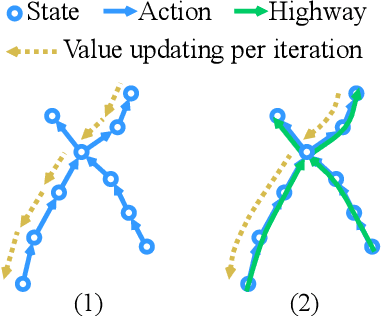
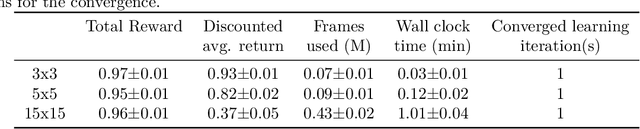
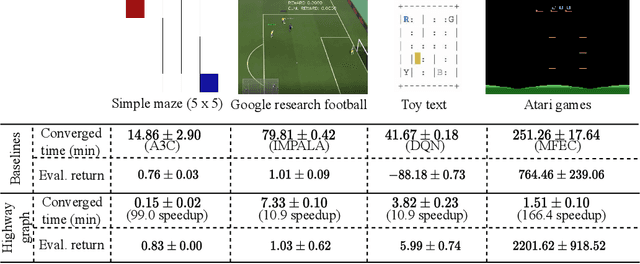

Reinforcement Learning (RL) algorithms often suffer from low training efficiency. A strategy to mitigate this issue is to incorporate a model-based planning algorithm, such as Monte Carlo Tree Search (MCTS) or Value Iteration (VI), into the environmental model. The major limitation of VI is the need to iterate over a large tensor. These still lead to intensive computations. We focus on improving the training efficiency of RL algorithms by improving the efficiency of the value learning process. For the deterministic environments with discrete state and action spaces, a non-branching sequence of transitions moves the agent without deviating from intermediate states, which we call a highway. On such non-branching highways, the value-updating process can be merged as a one-step process instead of iterating the value step-by-step. Based on this observation, we propose a novel graph structure, named highway graph, to model the state transition. Our highway graph compresses the transition model into a concise graph, where edges can represent multiple state transitions to support value propagation across multiple time steps in each iteration. We thus can obtain a more efficient value learning approach by facilitating the VI algorithm on highway graphs. By integrating the highway graph into RL (as a model-based off-policy RL method), the RL training can be remarkably accelerated in the early stages (within 1 million frames). Comparison against various baselines on four categories of environments reveals that our method outperforms both representative and novel model-free and model-based RL algorithms, demonstrating 10 to more than 150 times more efficiency while maintaining an equal or superior expected return, as confirmed by carefully conducted analyses. Moreover, a deep neural network-based agent is trained using the highway graph, resulting in better generalization and lower storage costs.