 Add to Chrome
 Add to Firefox
 Add to Edge
Lean Clients, Full Accuracy: Hybrid Zeroth- and First-Order Split Federated Learning
Jan 14, 2026
Split Federated Learning (SFL) enables collaborative training between resource-constrained edge devices and a compute-rich server. Communication overhead is a central issue in SFL and can be mitigated with auxiliary networks. Yet, the fundamental client-side computation challenge remains, as back-propagation requires substantial memory and computation costs, severely limiting the scale of models that edge devices can support. To enable more resource-efficient client computation and reduce the client-server communication, we propose HERON-SFL, a novel hybrid optimization framework that integrates zeroth-order (ZO) optimization for local client training while retaining first-order (FO) optimization on the server. With the assistance of auxiliary networks, ZO updates enable clients to approximate local gradients using perturbed forward-only evaluations per step, eliminating memory-intensive activation caching and avoiding explicit gradient computation in the traditional training process. Leveraging the low effective rank assumption, we theoretically prove that HERON-SFL's convergence rate is independent of model dimensionality, addressing a key scalability concern common to ZO algorithms. Empirically, on ResNet training and language model (LM) fine-tuning tasks, HERON-SFL matches benchmark accuracy while reducing client peak memory by up to 64% and client-side compute cost by up to 33% per step, substantially expanding the range of models that can be trained or adapted on resource-limited devices.

Asynchronous Federated Learning with Incentive Mechanism Based on Contract Theory
Oct 10, 2023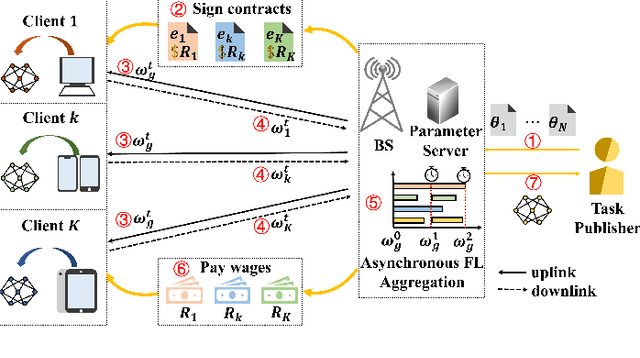
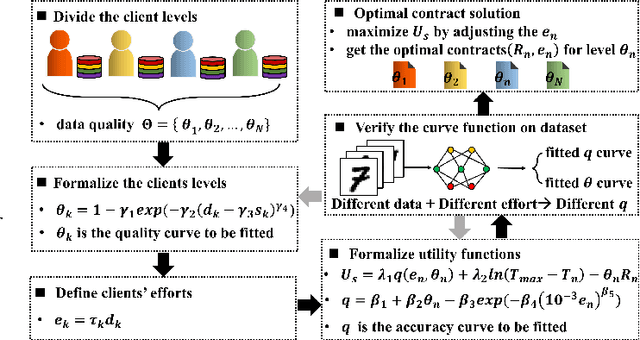
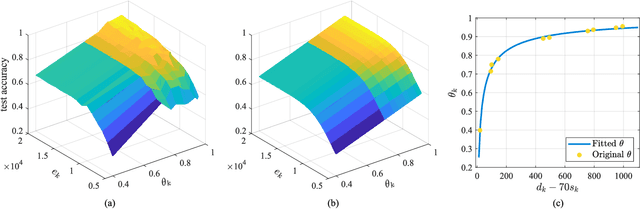
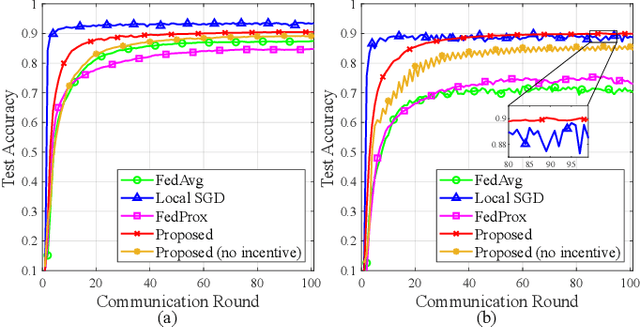
To address the challenges posed by the heterogeneity inherent in federated learning (FL) and to attract high-quality clients, various incentive mechanisms have been employed. However, existing incentive mechanisms are typically utilized in conventional synchronous aggregation, resulting in significant straggler issues. In this study, we propose a novel asynchronous FL framework that integrates an incentive mechanism based on contract theory. Within the incentive mechanism, we strive to maximize the utility of the task publisher by adaptively adjusting clients' local model training epochs, taking into account factors such as time delay and test accuracy. In the asynchronous scheme, considering client quality, we devise aggregation weights and an access control algorithm to facilitate asynchronous aggregation. Through experiments conducted on the MNIST dataset, the simulation results demonstrate that the test accuracy achieved by our framework is 3.12% and 5.84% higher than that achieved by FedAvg and FedProx without any attacks, respectively. The framework exhibits a 1.35% accuracy improvement over the ideal Local SGD under attacks. Furthermore, aiming for the same target accuracy, our framework demands notably less computation time than both FedAvg and FedProx.
Semi-Asynchronous Federated Edge Learning Mechanism via Over-the-air Computation
May 06, 2023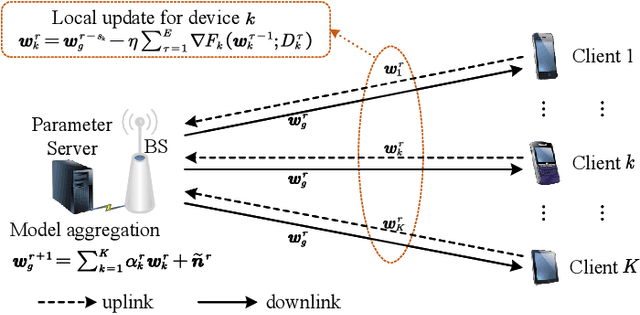
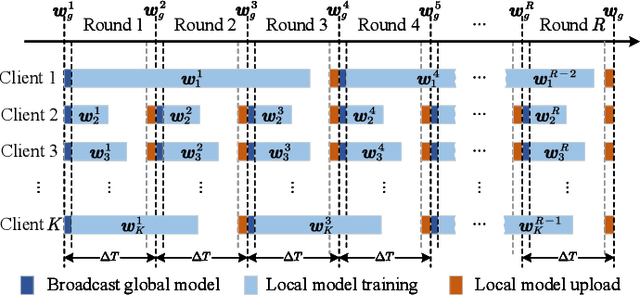
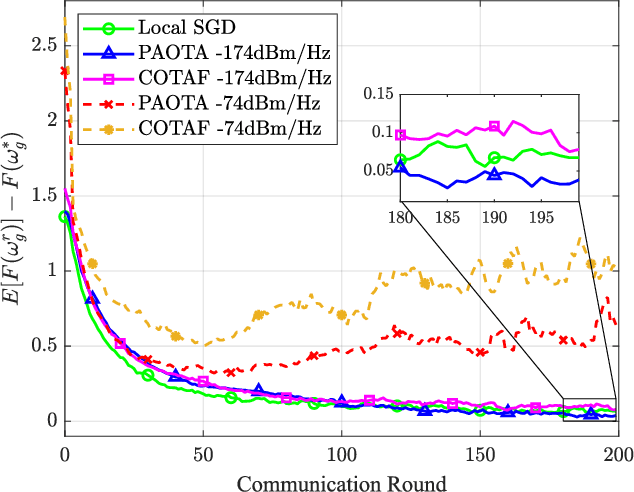
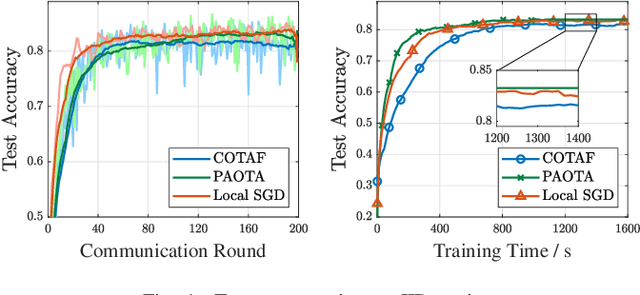
Over-the-air Computation (AirComp) has been demonstrated as an effective transmission scheme to boost the efficiency of federated edge learning (FEEL). However, existing FEEL systems with AirComp scheme often employ traditional synchronous aggregation mechanisms for local model aggregation in each global round, which suffer from the stragglers issues. In this paper, we propose a semi-asynchronous aggregation FEEL mechanism with AirComp scheme (PAOTA) to improve the training efficiency of the FEEL system in the case of significant heterogeneity in data and devices. Taking the staleness and divergence of model updates from edge devices into consideration, we minimize the convergence upper bound of the FEEL global model by adjusting the uplink transmit power of edge devices at each aggregation period. The simulation results demonstrate that our proposed algorithm achieves convergence performance close to that of the ideal Local SGD. Furthermore, with the same target accuracy, the training time required for PAOTA is less than that of the ideal Local SGD and the synchronous FEEL algorithm via AirComp.