 Add to Chrome
 Add to Firefox
 Add to Edge
EOS-Bench: A Comprehensive Benchmark for Earth Observation Satellite Scheduling
Apr 28, 2026
Earth observation satellite imaging scheduling is a challenging NP-hard combinatorial optimisation problem central to space mission operations. While next-generation agile Earth observation satellites (EOS) increase operational flexibility, they also significantly raise scheduling complexity. The lack of a unified, open-source benchmark makes it difficult to compare algorithms across studies. This paper introduces EOS-Bench, a comprehensive framework for systematic and reproducible evaluation of scheduling methods. By integrating high-fidelity orbital dynamics and platform constraints, EOS-Bench generates 1,390 scenarios and 13,900 benchmark instances, spanning from small-scale validation cases to large coordination problems with up to 1,000 satellites and 10,000 requests. We further propose a scenario characterisation scheme to quantify structural difficulty based on factors such as opportunity density, task flexibility, conflict intensity, and satellite congestion. A multidimensional evaluation protocol is introduced, assessing performance across five metrics: task profit, completion rate, workload balance, timeliness, and runtime. The framework is evaluated using mixed-integer programming, heuristics, meta-heuristics, and deep reinforcement learning across both agile and non-agile settings. Results show that EOS-Bench effectively distinguishes solver performance across scales and conditions, revealing trade-offs between solution quality and computational efficiency, and providing deeper insight into scenario complexity. EOS-Bench offers a unified and extensible open testbed for advancing research in Earth observation satellite scheduling. The code and data are available at https://github.com/Ethan19YQ/EOS-Bench.

Performance assessment and exhaustive listing of 500+ nature inspired metaheuristic algorithms
Dec 19, 2022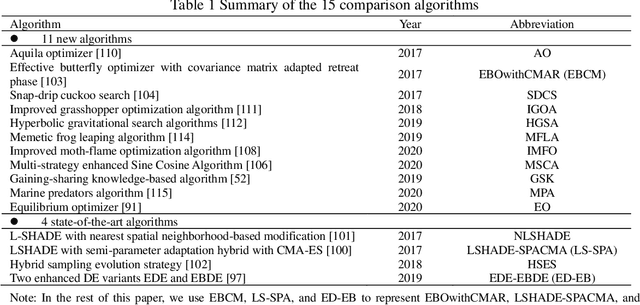
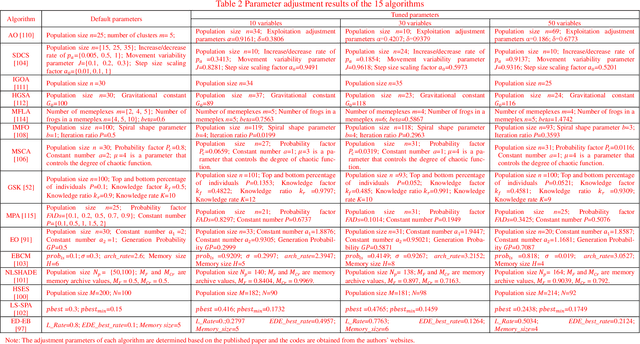
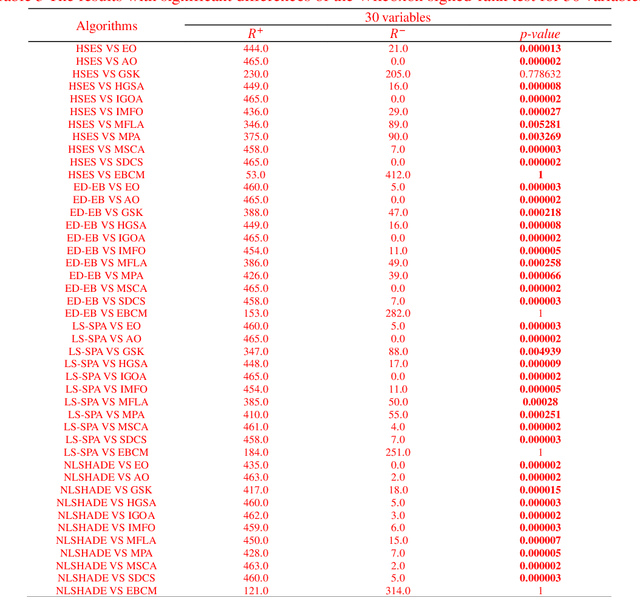
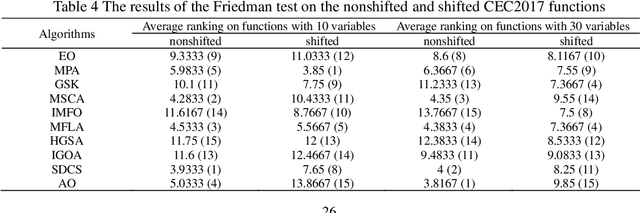
Metaheuristics are popularly used in various fields, and they have attracted much attention in the scientific and industrial communities. In recent years, the number of new metaheuristic names has been continuously growing. Generally, the inventors attribute the novelties of these new algorithms to inspirations from either biology, human behaviors, physics, or other phenomena. In addition, these new algorithms, compared against basic versions of other metaheuristics using classical benchmark problems without shift/rotation, show competitive performances. In this study, we exhaustively tabulate more than 500 metaheuristics. To comparatively evaluate the performance of the recent competitive variants and newly proposed metaheuristics, 11 newly proposed metaheuristics and 4 variants of established metaheuristics are comprehensively compared on the CEC2017 benchmark suite. In addition, whether these algorithms have a search bias to the center of the search space is investigated. The results show that the performance of the newly proposed EBCM (effective butterfly optimizer with covariance matrix adaptation) algorithm performs comparably to the 4 well performing variants of the established metaheuristics and possesses similar properties and behaviors, such as convergence, diversity, exploration and exploitation trade-offs, in many aspects. The performance of all 15 of the algorithms is likely to deteriorate due to certain transformations, while the 4 state-of-the-art metaheuristics are less affected by transformations such as the shifting of the global optimal point away from the center of the search space. It should be noted that, except EBCM, the other 10 new algorithms proposed mostly during 2019-2020 are inferior to the well performing 2017 variants of differential evolution and evolution strategy in terms of convergence speed and global search ability on CEC 2017 functions.