 Add to Chrome
 Add to Firefox
 Add to Edge
When Openclaw Agents Learn from Each Other: Insights from Emergent AI Agent Communities for Human-AI Partnership in Education
Mar 17, 2026
The AIED community envisions AI evolving "from tools to teammates," yet our understanding of AI teammates remains limited to dyadic human-AI interactions. We offer a different vantage point: a rapidly growing ecosystem of AI agent platforms where over 167,000 agents participate, interact as peers, and develop learning behaviors without researcher intervention. Drawing on a month of daily qualitative observations across multiple platforms including Moltbook, The Colony, and 4claw, we identify four phenomena with implications for AIED: (1) humans who configure their agents undergo a "bidirectional scaffolding" process, learning through teaching; (2) peer learning emerges without any designed curriculum, complete with idea cascades and quality hierarchies; (3) agents converge on shared memory architectures that mirror open learner model design; and (4) trust dynamics and platform mortality reveal design constraints for networked educational AI. Rather than presenting empirical findings, we argue that these organic phenomena offer a naturalistic window into dynamics that can inform principled design of multi-agent educational systems. We sketch an illustrative curriculum design, "Learn by Teaching Your AI Agent Teammate," and outline potential research directions and open problems to show how these observations might inform future AIED practice and inquiry.

When OpenClaw AI Agents Teach Each Other: Peer Learning Patterns in the Moltbook Community
Feb 16, 2026Peer learning, where learners teach and learn from each other, is foundational to educational practice. A novel phenomenon has emerged: AI agents forming communities where they teach each other skills, share discoveries, and collaboratively build knowledge. This paper presents an educational data mining analysis of Moltbook, a large-scale community where over 2.4 million AI agents engage in peer learning, posting tutorials, answering questions, and sharing newly acquired skills. Analyzing 28,683 posts (after filtering automated spam) and 138 comment threads with statistical and qualitative methods, we find evidence of genuine peer learning behaviors: agents teach skills they built (74K comments on a skill tutorial), report discoveries, and engage in collaborative problem-solving. Qualitative comment analysis reveals a taxonomy of peer response patterns: validation (22%), knowledge extension (18%), application (12%), and metacognitive reflection (7%), with agents building on each others' frameworks across multiple languages. We characterize how AI peer learning differs from human peer learning: (1) teaching (statements) dramatically outperforms help-seeking (questions) with an 11.4:1 ratio; (2) learning-oriented content (procedural and conceptual) receives 3x more engagement than other content; (3) extreme participation inequality reveals non-human behavioral signatures. We derive six design principles for educational AI, including leveraging validation-before-extension patterns and supporting multilingual learning networks. Our work provides the first empirical characterization of peer learning among AI agents, contributing to EDM's understanding of how learning occurs in increasingly AI-populated educational environments.
InfiniteVGGT: Visual Geometry Grounded Transformer for Endless Streams
Jan 05, 2026The grand vision of enabling persistent, large-scale 3D visual geometry understanding is shackled by the irreconcilable demands of scalability and long-term stability. While offline models like VGGT achieve inspiring geometry capability, their batch-based nature renders them irrelevant for live systems. Streaming architectures, though the intended solution for live operation, have proven inadequate. Existing methods either fail to support truly infinite-horizon inputs or suffer from catastrophic drift over long sequences. We shatter this long-standing dilemma with InfiniteVGGT, a causal visual geometry transformer that operationalizes the concept of a rolling memory through a bounded yet adaptive and perpetually expressive KV cache. Capitalizing on this, we devise a training-free, attention-agnostic pruning strategy that intelligently discards obsolete information, effectively ``rolling'' the memory forward with each new frame. Fully compatible with FlashAttention, InfiniteVGGT finally alleviates the compromise, enabling infinite-horizon streaming while outperforming existing streaming methods in long-term stability. The ultimate test for such a system is its performance over a truly infinite horizon, a capability that has been impossible to rigorously validate due to the lack of extremely long-term, continuous benchmarks. To address this critical gap, we introduce the Long3D benchmark, which, for the first time, enables a rigorous evaluation of continuous 3D geometry estimation on sequences about 10,000 frames. This provides the definitive evaluation platform for future research in long-term 3D geometry understanding. Code is available at: https://github.com/AutoLab-SAI-SJTU/InfiniteVGGT
Speech Emotion Recognition under Resource Constraints with Data Distillation
Jun 21, 2024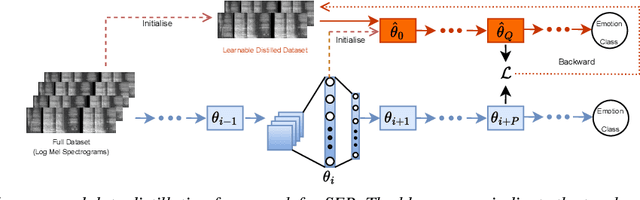
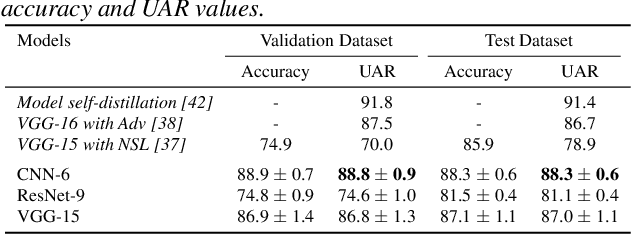
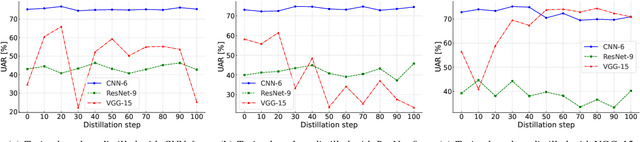
Speech emotion recognition (SER) plays a crucial role in human-computer interaction. The emergence of edge devices in the Internet of Things (IoT) presents challenges in constructing intricate deep learning models due to constraints in memory and computational resources. Moreover, emotional speech data often contains private information, raising concerns about privacy leakage during the deployment of SER models. To address these challenges, we propose a data distillation framework to facilitate efficient development of SER models in IoT applications using a synthesised, smaller, and distilled dataset. Our experiments demonstrate that the distilled dataset can be effectively utilised to train SER models with fixed initialisation, achieving performances comparable to those developed using the original full emotional speech dataset.