 Add to Chrome
 Add to Firefox
 Add to Edge
SegDiff: Segmented Trajectory Diffusion for Consistent and Adaptive Robot Manipulation
Jul 13, 2026
Imitation learning enables robots to acquire manipulation skills from demonstrations by mapping observations to actions. Existing approaches predict either short-horizon continuous action sequences or discrete keyposes. However, continuous prediction methods suffer from compounding errors due to short prediction horizons and struggle with multi-modal action distributions, whereas keypose-based methods necessitate an external planner, constraining real-time applicability. To address these challenges, we introduce SegDiff, a closed-loop visuomotor policy that integrates the strengths of both paradigms. SegDiff decomposes demonstrations into motion segments between keyposes and learns to predict the continuous trajectory from the current state to the next keypose, enabling long-horizon prediction with real-time refinement. Furthermore, we leverage the capability of diffusion models and DDIM inversion to propose a Dynamic Temporal Ensembling mechanism, which allows the policy to efficiently respond to dynamic environments and mitigate discontinuities caused by inconsistent multi-modal sampling. SegDiff demonstrates significant performance gains over existing approaches across various simulated and real-world scenarios, indicating its strong ability to reason over extended temporal dependencies while maintaining real-time adaptability and control stability.

GuidedVLA: Specifying Task-Relevant Factors via Plug-and-Play Action Attention Specialization
May 12, 2026Vision-Language-Action (VLA) models aim for general robot learning by aligning action as a modality within powerful Vision-Language Models (VLMs). Existing VLAs rely on end-to-end supervision to implicitly enable the action decoding process to learn task-relevant features. However, without explicit guidance, these models often overfit to spurious correlations, such as visual shortcuts or environmental noise, limiting their generalization. In this paper, we introduce GuidedVLA, a framework designed to manually guide the action generation to focus on task-relevant factors. Our core insight is to treat the action decoder not as a monolithic learner, but as an assembly of functional components. Individual attention heads are supervised by manually defined auxiliary signals to capture distinct factors. As an initial study, we instantiate this paradigm with three specialized heads: object grounding, spatial geometry, and temporal skill logic. Across simulation and real-robot experiments, GuidedVLA improves success rates in both in-domain and out-of-domain settings compared to strong VLA baselines. Finally, we show that the quality of these specialized factors correlates positively with task performance and that our mechanism yields decoupled, high-quality features. Our results suggest that explicitly guiding action-decoder learning is a promising direction for building more robust and general VLA models.
FlashMotion: Few-Step Controllable Video Generation with Trajectory Guidance
Mar 12, 2026Recent advances in trajectory-controllable video generation have achieved remarkable progress. Previous methods mainly use adapter-based architectures for precise motion control along predefined trajectories. However, all these methods rely on a multi-step denoising process, leading to substantial time redundancy and computational overhead. While existing video distillation methods successfully distill multi-step generators into few-step, directly applying these approaches to trajectory-controllable video generation results in noticeable degradation in both video quality and trajectory accuracy. To bridge this gap, we introduce FlashMotion, a novel training framework designed for few-step trajectory-controllable video generation. We first train a trajectory adapter on a multi-step video generator for precise trajectory control. Then, we distill the generator into a few-step version to accelerate video generation. Finally, we finetune the adapter using a hybrid strategy that combines diffusion and adversarial objectives, aligning it with the few-step generator to produce high-quality, trajectory-accurate videos. For evaluation, we introduce FlashBench, a benchmark for long-sequence trajectory-controllable video generation that measures both video quality and trajectory accuracy across varying numbers of foreground objects. Experiments on two adapter architectures show that FlashMotion surpasses existing video distillation methods and previous multi-step models in both visual quality and trajectory consistency.
Preference Score Distillation: Leveraging 2D Rewards to Align Text-to-3D Generation with Human Preference
Mar 02, 2026Human preference alignment presents a critical yet underexplored challenge for diffusion models in text-to-3D generation. Existing solutions typically require task-specific fine-tuning, posing significant hurdles in data-scarce 3D domains. To address this, we propose Preference Score Distillation (PSD), an optimization-based framework that leverages pretrained 2D reward models for human-aligned text-to-3D synthesis without 3D training data. Our key insight stems from the incompatibility of pixel-level gradients: due to the absence of noisy samples during reward model training, direct application of 2D reward gradients disturbs the denoising process. Noticing that similar issue occurs in the naive classifier guidance in conditioned diffusion models, we fundamentally rethink preference alignment as a classifier-free guidance (CFG)-style mechanism through our implicit reward model. Furthermore, recognizing that frozen pretrained diffusion models constrain performance, we introduce an adaptive strategy to co-optimize preference scores and negative text embeddings. By incorporating CFG during optimization, online refinement of negative text embeddings dynamically enhances alignment. To our knowledge, we are the first to bridge human preference alignment with CFG theory under score distillation framework. Experiments demonstrate the superiority of PSD in aesthetic metrics, seamless integration with diverse pipelines, and strong extensibility.
Human2Robot: Learning Robot Actions from Paired Human-Robot Videos
Feb 23, 2025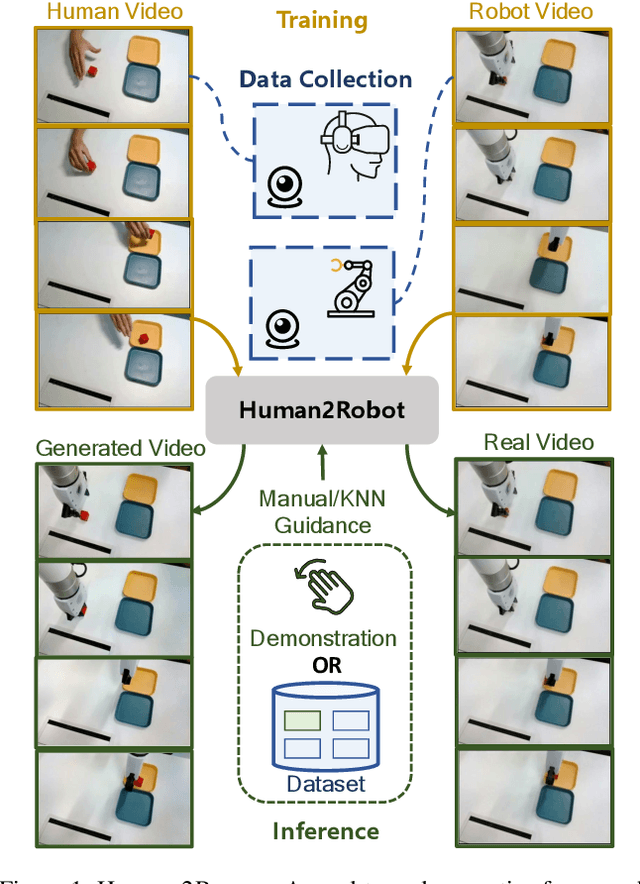
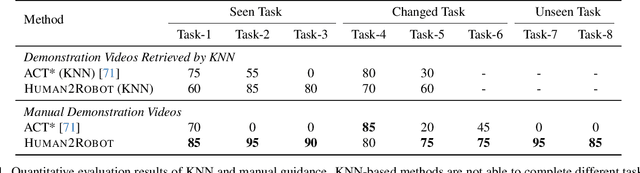
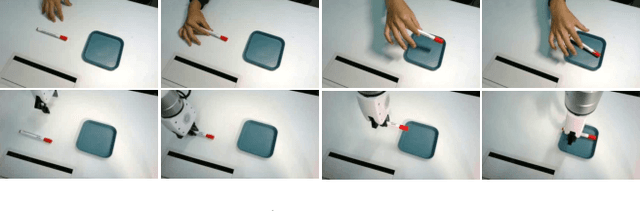
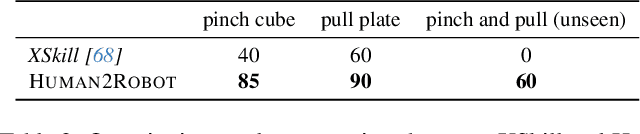
Distilling knowledge from human demonstrations is a promising way for robots to learn and act. Existing work often overlooks the differences between humans and robots, producing unsatisfactory results. In this paper, we study how perfectly aligned human-robot pairs benefit robot learning. Capitalizing on VR-based teleportation, we introduce H\&R, a third-person dataset with 2,600 episodes, each of which captures the fine-grained correspondence between human hands and robot gripper. Inspired by the recent success of diffusion models, we introduce Human2Robot, an end-to-end diffusion framework that formulates learning from human demonstrates as a generative task. Human2Robot fully explores temporal dynamics in human videos to generate robot videos and predict actions at the same time. Through comprehensive evaluations of 8 seen, changed and unseen tasks in real-world settings, we demonstrate that Human2Robot can not only generate high-quality robot videos but also excel in seen tasks and generalize to unseen objects, backgrounds and even new tasks effortlessly.