 Add to Chrome
 Add to Firefox
 Add to Edge
When to Think Deeply: Inhibitory Deliberation for LLM Reasoning
Jun 04, 2026
Reasoning Large Language Models can improve problem-solving performance through deliberative inference, but invoking slow reasoning for every input is computationally expensive and often unnecessary. We propose IDPR, a framework for response-conditioned inhibitory deliberation. IDPR first generates a concise intuitive answer and then uses an inhibition controller to decide whether that specific response should be released or suppressed in favor of slow reasoning. Unlike input-only routers, the inhibition controller conditions on the fast answer and fast-side evidence, including confidence, logit margin, parseability, and generation cost. We train the controller from paired fast-slow outcomes and select the inhibition threshold on a held-out validation set under an accuracy-first slow-call budget. On a held-out 5,000-example mathematical reasoning test set, IDPR invokes slow reasoning on only 8.20% of examples and improves accuracy from 47.90% to 48.92%. Under the same slow-call budget, random routing decreases accuracy to 46.76%, while the strongest confidence-based baseline reaches 48.22%. IDPR also achieves the highest corrective precision, showing that response-conditioned inhibition better identifies fast answers that benefit from slow reasoning.

A Survey on Human Preference Learning for Large Language Models
Jun 18, 2024


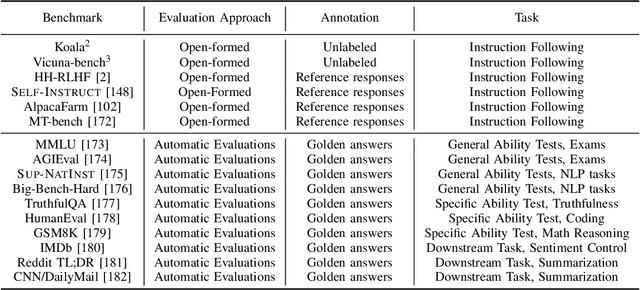
The recent surge of versatile large language models (LLMs) largely depends on aligning increasingly capable foundation models with human intentions by preference learning, enhancing LLMs with excellent applicability and effectiveness in a wide range of contexts. Despite the numerous related studies conducted, a perspective on how human preferences are introduced into LLMs remains limited, which may prevent a deeper comprehension of the relationships between human preferences and LLMs as well as the realization of their limitations. In this survey, we review the progress in exploring human preference learning for LLMs from a preference-centered perspective, covering the sources and formats of preference feedback, the modeling and usage of preference signals, as well as the evaluation of the aligned LLMs. We first categorize the human feedback according to data sources and formats. We then summarize techniques for human preferences modeling and compare the advantages and disadvantages of different schools of models. Moreover, we present various preference usage methods sorted by the objectives to utilize human preference signals. Finally, we summarize some prevailing approaches to evaluate LLMs in terms of alignment with human intentions and discuss our outlooks on the human intention alignment for LLMs.