 Add to Chrome
 Add to Firefox
 Add to Edge
Designing AI-Supported Focus Groups: A Role x Modality Playbook
Jun 10, 2026
Collecting participants' lived experiences is central to design research. Focus groups are uniquely valuable because participants not only share individual accounts but also respond to one another, surfacing comparison, disagreement, and collective sensemaking. However, focus groups are resource-intensive and highly sensitive to facilitation: moderators must probe for specificity, balance participation, manage topic flow, and sustain psychological safety, and subtle facilitation choices can shape what becomes salient. Recent HCI work and commercial meeting tools show that generative AI can scaffold live conversation through prompting, turn regulation, thematic mapping, and real-time summarization. Yet UXR teams lack a clear map of what these capabilities mean in focus groups and what methodological risks they introduce. We synthesize AI supports for live conversation and translate them into a focus-group-specific playbook organized by AI role (tool, co-host, host) and modality (text, voice, embodied).We synthesize prior work on AI-supported live conversation and propose a focus-group-specific playbook of AI supports organized by role (tool, co-host, host) and modality (text, voice, embodied). We characterize interactional trade-offs and identify open questions for evaluating AI-supported focus groups as methodological configurations.

Dual Mean-Teacher: An Unbiased Semi-Supervised Framework for Audio-Visual Source Localization
Mar 05, 2024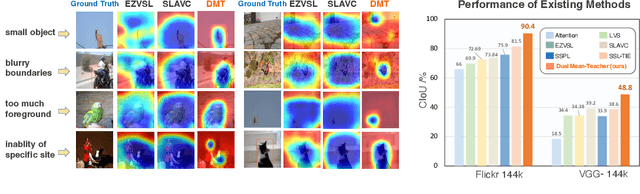
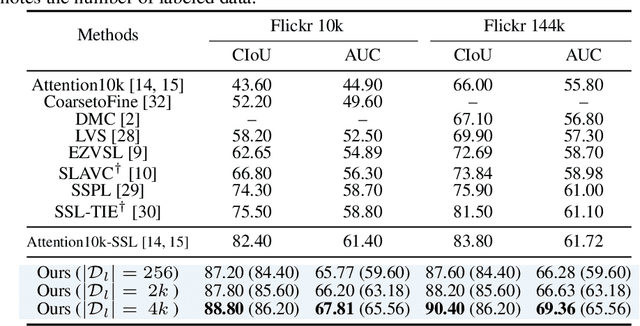
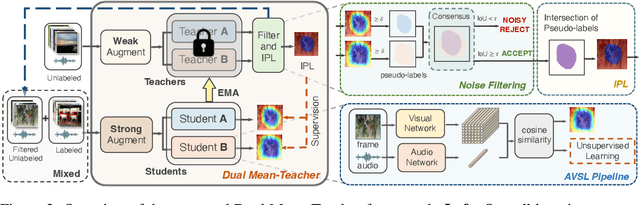
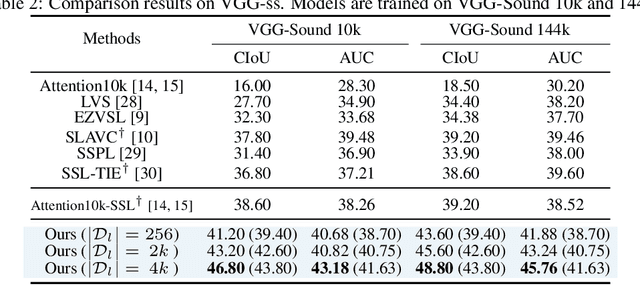
Audio-Visual Source Localization (AVSL) aims to locate sounding objects within video frames given the paired audio clips. Existing methods predominantly rely on self-supervised contrastive learning of audio-visual correspondence. Without any bounding-box annotations, they struggle to achieve precise localization, especially for small objects, and suffer from blurry boundaries and false positives. Moreover, the naive semi-supervised method is poor in fully leveraging the information of abundant unlabeled data. In this paper, we propose a novel semi-supervised learning framework for AVSL, namely Dual Mean-Teacher (DMT), comprising two teacher-student structures to circumvent the confirmation bias issue. Specifically, two teachers, pre-trained on limited labeled data, are employed to filter out noisy samples via the consensus between their predictions, and then generate high-quality pseudo-labels by intersecting their confidence maps. The sufficient utilization of both labeled and unlabeled data and the proposed unbiased framework enable DMT to outperform current state-of-the-art methods by a large margin, with CIoU of 90.4% and 48.8% on Flickr-SoundNet and VGG-Sound Source, obtaining 8.9%, 9.6% and 4.6%, 6.4% improvements over self- and semi-supervised methods respectively, given only 3% positional-annotations. We also extend our framework to some existing AVSL methods and consistently boost their performance.