 Add to Chrome
 Add to Firefox
 Add to Edge
Designing AI-Supported Focus Groups: A Role x Modality Playbook
Jun 10, 2026
Collecting participants' lived experiences is central to design research. Focus groups are uniquely valuable because participants not only share individual accounts but also respond to one another, surfacing comparison, disagreement, and collective sensemaking. However, focus groups are resource-intensive and highly sensitive to facilitation: moderators must probe for specificity, balance participation, manage topic flow, and sustain psychological safety, and subtle facilitation choices can shape what becomes salient. Recent HCI work and commercial meeting tools show that generative AI can scaffold live conversation through prompting, turn regulation, thematic mapping, and real-time summarization. Yet UXR teams lack a clear map of what these capabilities mean in focus groups and what methodological risks they introduce. We synthesize AI supports for live conversation and translate them into a focus-group-specific playbook organized by AI role (tool, co-host, host) and modality (text, voice, embodied).We synthesize prior work on AI-supported live conversation and propose a focus-group-specific playbook of AI supports organized by role (tool, co-host, host) and modality (text, voice, embodied). We characterize interactional trade-offs and identify open questions for evaluating AI-supported focus groups as methodological configurations.

Prompting for products: Investigating design space exploration strategies for text-to-image generative models
Jul 22, 2024Text-to-image models are enabling efficient design space exploration, rapidly generating images from text prompts. However, many generative AI tools are imperfect for product design applications as they are not built for the goals and requirements of product design. The unclear link between text input and image output further complicates their application. This work empirically investigates design space exploration strategies that can successfully yield product images that are feasible, novel, and aesthetic, which are three common goals in product design. Specifically, user actions within the global and local editing modes, including their time spent, prompt length, mono vs. multi-criteria prompts, and goal orientation of prompts, are analyzed. Key findings reveal the pivotal role of mono vs. multi-criteria and goal orientation of prompts in achieving specific design goals over time and prompt length. The study recommends prioritizing the use of multi-criteria prompts for feasibility and novelty during global editing, while favoring mono-criteria prompts for aesthetics during local editing. Overall, this paper underscores the nuanced relationship between the AI-driven text-to-image models and their effectiveness in product design, urging designers to carefully structure prompts during different editing modes to better meet the unique demands of product design.
CAD-Prompted Generative Models: A Pathway to Feasible and Novel Engineering Designs
Jul 11, 2024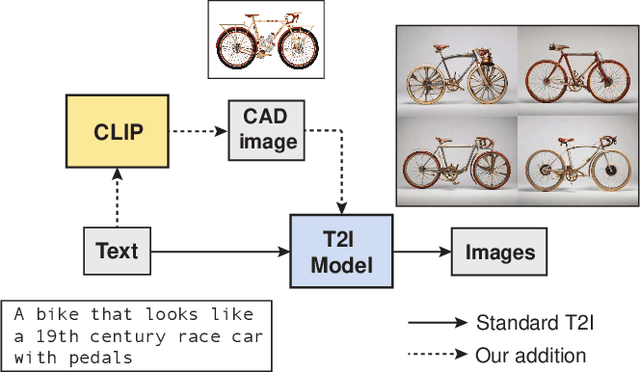

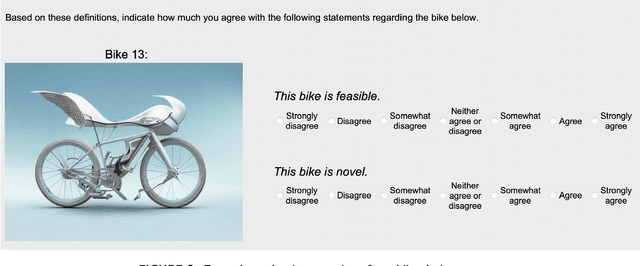
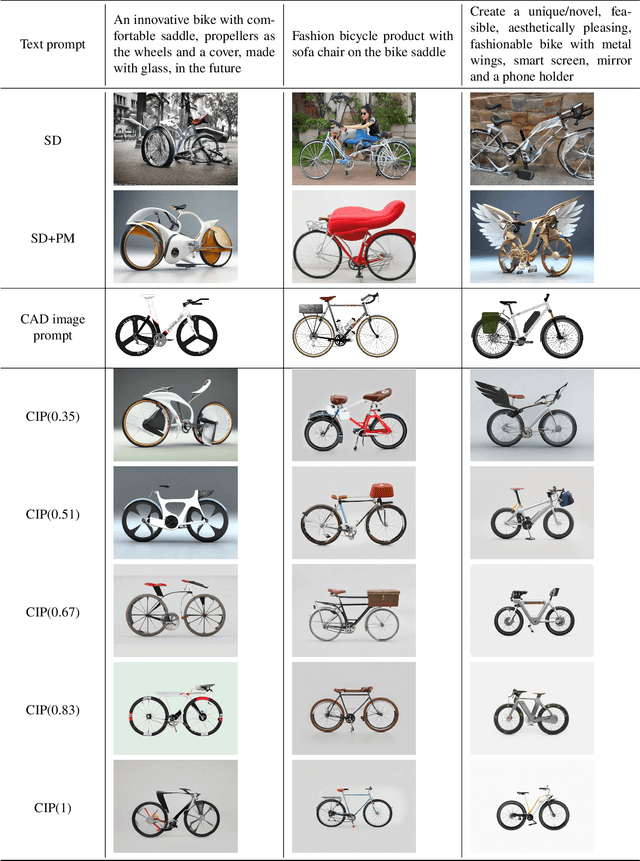
Text-to-image generative models have increasingly been used to assist designers during concept generation in various creative domains, such as graphic design, user interface design, and fashion design. However, their applications in engineering design remain limited due to the models' challenges in generating images of feasible designs concepts. To address this issue, this paper introduces a method that improves the design feasibility by prompting the generation with feasible CAD images. In this work, the usefulness of this method is investigated through a case study with a bike design task using an off-the-shelf text-to-image model, Stable Diffusion 2.1. A diverse set of bike designs are produced in seven different generation settings with varying CAD image prompting weights, and these designs are evaluated on their perceived feasibility and novelty. Results demonstrate that the CAD image prompting successfully helps text-to-image models like Stable Diffusion 2.1 create visibly more feasible design images. While a general tradeoff is observed between feasibility and novelty, when the prompting weight is kept low around 0.35, the design feasibility is significantly improved while its novelty remains on par with those generated by text prompts alone. The insights from this case study offer some guidelines for selecting the appropriate CAD image prompting weight for different stages of the engineering design process. When utilized effectively, our CAD image prompting method opens doors to a wider range of applications of text-to-image models in engineering design.