 Add to Chrome
 Add to Firefox
 Add to Edge
SimpleSearch-VL: A Simple Recipe for Multimodal Agentic Deep Search
Jun 30, 2026
We present SimpleSearch-VL, an efficient, reliable, and practical framework for multimodal agentic search. Its core idea is to improve the agent's own search-and-verification process rather than scaling data, tools, or auxiliary model components. For efficiency, Factorized Adaptive Rollout (FAR) improves sampling efficiency by forming more informative training groups while using redundant samples to mitigate long-tail latency and expose hard samples. For reliability, SimpleSearch-VL performs evidence-verified reasoning, explicitly using chain-of-thought verification to assess the relevance of retrieved visual and textual cues to the original context. For practicality, SimpleSearch-VL keeps a lightweight tool interface and performs webpage self-summary within the agent, requiring no additional external dependencies. With only 5K supervised tool-interleaved trajectories and 2K RL data, SimpleSearch-VL improves Qwen3-VL agentic baselines by 15.8 and 16.0 average points for the 8B and 30B-A3B variants, respectively. The SimpleSearch-VL-30B-A3B model further achieves performance competitive with agentic Gemini-3-Pro.

PulseMind: A Multi-Modal Medical Model for Real-World Clinical Diagnosis
Jan 12, 2026Recent advances in medical multi-modal models focus on specialized image analysis like dermatology, pathology, or radiology. However, they do not fully capture the complexity of real-world clinical diagnostics, which involve heterogeneous inputs and require ongoing contextual understanding during patient-physician interactions. To bridge this gap, we introduce PulseMind, a new family of multi-modal diagnostic models that integrates a systematically curated dataset, a comprehensive evaluation benchmark, and a tailored training framework. Specifically, we first construct a diagnostic dataset, MediScope, which comprises 98,000 real-world multi-turn consultations and 601,500 medical images, spanning over 10 major clinical departments and more than 200 sub-specialties. Then, to better reflect the requirements of real-world clinical diagnosis, we develop the PulseMind Benchmark, a multi-turn diagnostic consultation benchmark with a four-dimensional evaluation protocol comprising proactiveness, accuracy, usefulness, and language quality. Finally, we design a training framework tailored for multi-modal clinical diagnostics, centered around a core component named Comparison-based Reinforcement Policy Optimization (CRPO). Compared to absolute score rewards, CRPO uses relative preference signals from multi-dimensional com-parisons to provide stable and human-aligned training guidance. Extensive experiments demonstrate that PulseMind achieves competitive performance on both the diagnostic consultation benchmark and public medical benchmarks.
AgentSociety: Large-Scale Simulation of LLM-Driven Generative Agents Advances Understanding of Human Behaviors and Society
Feb 12, 2025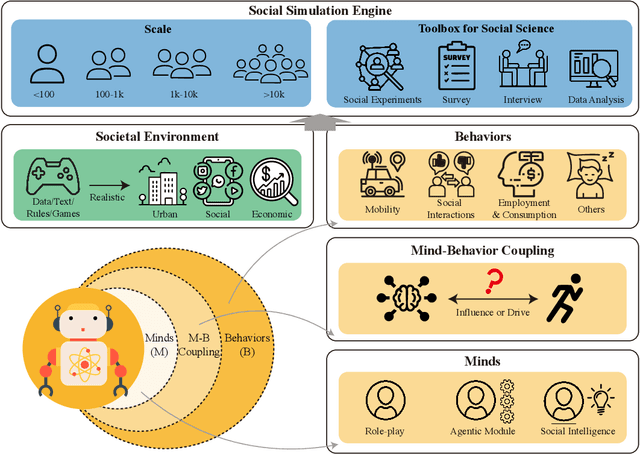
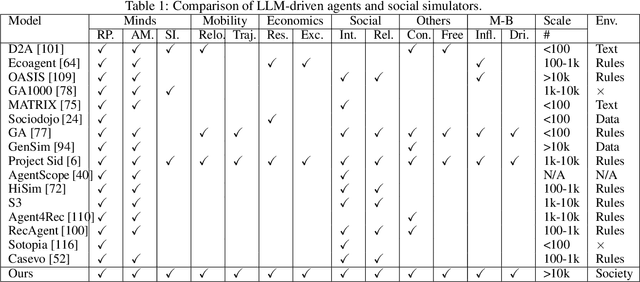
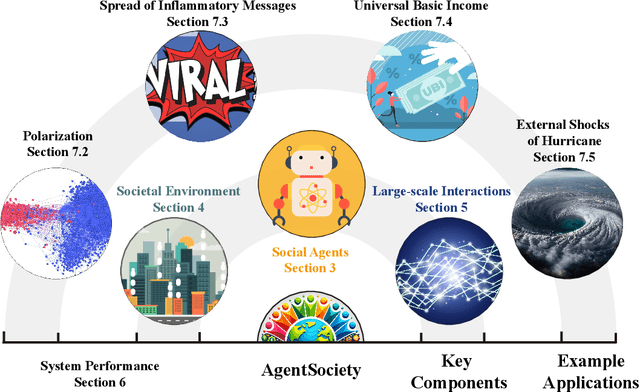
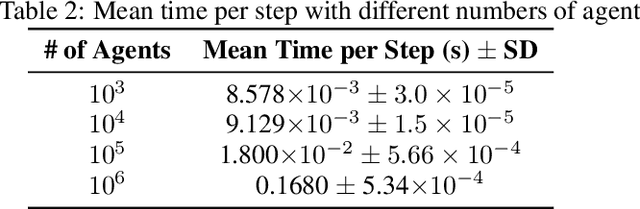
Understanding human behavior and society is a central focus in social sciences, with the rise of generative social science marking a significant paradigmatic shift. By leveraging bottom-up simulations, it replaces costly and logistically challenging traditional experiments with scalable, replicable, and systematic computational approaches for studying complex social dynamics. Recent advances in large language models (LLMs) have further transformed this research paradigm, enabling the creation of human-like generative social agents and realistic simulacra of society. In this paper, we propose AgentSociety, a large-scale social simulator that integrates LLM-driven agents, a realistic societal environment, and a powerful large-scale simulation engine. Based on the proposed simulator, we generate social lives for over 10k agents, simulating their 5 million interactions both among agents and between agents and their environment. Furthermore, we explore the potential of AgentSociety as a testbed for computational social experiments, focusing on four key social issues: polarization, the spread of inflammatory messages, the effects of universal basic income policies, and the impact of external shocks such as hurricanes. These four issues serve as valuable cases for assessing AgentSociety's support for typical research methods -- such as surveys, interviews, and interventions -- as well as for investigating the patterns, causes, and underlying mechanisms of social issues. The alignment between AgentSociety's outcomes and real-world experimental results not only demonstrates its ability to capture human behaviors and their underlying mechanisms, but also underscores its potential as an important platform for social scientists and policymakers.