 Add to Chrome
 Add to Firefox
 Add to Edge
StepGuard: Guarding Web Navigation via Single-Step Calibration
Jun 16, 2026
Web navigation requires agents to follow natural language goals, interact with web pages, and produce accurate answers. While recent advances leverage vision-language models and reinforcement learning, existing methods still suffer from single-step fragility due to reward misalignment and error propagation. To tackle the reward entanglement, we design Dynamic Dual-Policy Optimization (DDPO), which dynamically switches between a navigation-first mode for exploration and an answer-first mode for question-answering to mitigate reward conflict. To calibrate the single-step error, we propose Confidence-Guided Adaptive Navigation Reflection (CANR), a mechanism that estimates per-step confidence, triggers reflection only when necessary, and uses contrastive rewards to encourage self-correction to calibrate the single-step inaccuracy. With the above as the main components, we finally develop our StepGuard, a new framework of Guarding Web Navigation via Single-Step Calibration. Experiments demonstrate that our approach significantly improves navigation and answer accuracy, setting new state-of-the-art performance on standard web navigation benchmarks.

Safe Reinforcement Learning of Autonomous Highway Driving: A Unified Framework for Safety and Efficiency
Jun 12, 2026Deep reinforcement learning (DRL) offers a compelling route to decision-making for advanced autonomous vehicles (AVs), yet its trial-and-error nature makes it difficult to guarantee safety during training and to achieve both safety and efficiency at deployment. We propose a unified safe reinforcement learning (SRL) framework that integrates safe distance (SD), reward machines (RM), and mixture-of-experts (MoE), termed MoE-RM-SRL. For deployment, SD and RM jointly shape a rule-aware reward that encodes highway traffic regulations and stage-wise objectives, enabling safe and reliable behavior without sacrificing efficiency. For training, we introduce a sparsely gated MoE layer comprising up to 11 deep Q-networks (DQNs); an SD-based gating rule activates a minimal set of experts for lane-keeping and lane-changing, mitigating the instability, discontinuities, and impulsive transients commonly induced by switching between heterogeneous controllers (e.g., MPC/rule-based modules and learned policies). We implement the proposed architecture in CARLA and integrate it with a 6-DoF driver-in-the-loop virtual-reality (DiL-VR) platform. Experiments in stochastic two-lane traffic show that MoE-RM-SRL substantially improves safety and efficiency over state-of-the-art baselines, and the framework naturally extends to multi-lane driving as well as on-ramp merging and exiting scenarios.
Glioma Multimodal MRI Analysis System for Tumor Layered Diagnosis via Multi-task Semi-supervised Learning
Jan 29, 2025


Gliomas are the most common primary tumors of the central nervous system. Multimodal MRI is widely used for the preliminary screening of gliomas and plays a crucial role in auxiliary diagnosis, therapeutic efficacy, and prognostic evaluation. Currently, the computer-aided diagnostic studies of gliomas using MRI have focused on independent analysis events such as tumor segmentation, grading, and radiogenomic classification, without studying inter-dependencies among these events. In this study, we propose a Glioma Multimodal MRI Analysis System (GMMAS) that utilizes a deep learning network for processing multiple events simultaneously, leveraging their inter-dependencies through an uncertainty-based multi-task learning architecture and synchronously outputting tumor region segmentation, glioma histological subtype, IDH mutation genotype, and 1p/19q chromosome disorder status. Compared with the reported single-task analysis models, GMMAS improves the precision across tumor layered diagnostic tasks. Additionally, we have employed a two-stage semi-supervised learning method, enhancing model performance by fully exploiting both labeled and unlabeled MRI samples. Further, by utilizing an adaptation module based on knowledge self-distillation and contrastive learning for cross-modal feature extraction, GMMAS exhibited robustness in situations of modality absence and revealed the differing significance of each MRI modal. Finally, based on the analysis outputs of the GMMAS, we created a visual and user-friendly platform for doctors and patients, introducing GMMAS-GPT to generate personalized prognosis evaluations and suggestions.
PS6D: Point Cloud Based Symmetry-Aware 6D Object Pose Estimation in Robot Bin-Picking
May 18, 2024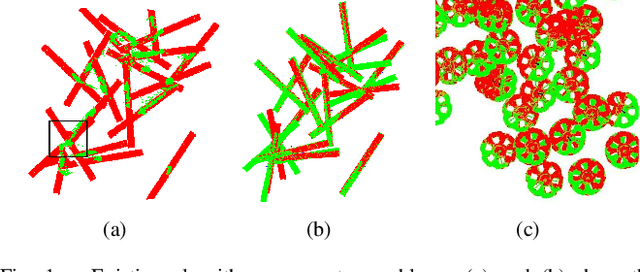
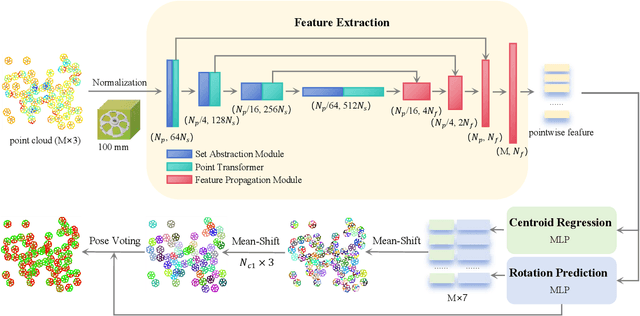
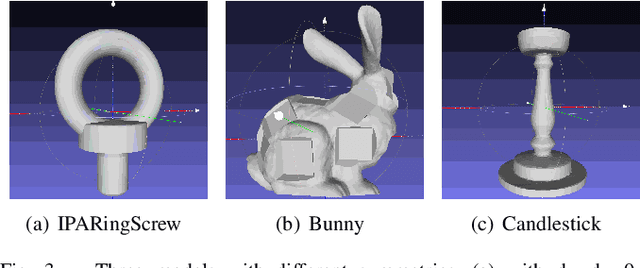
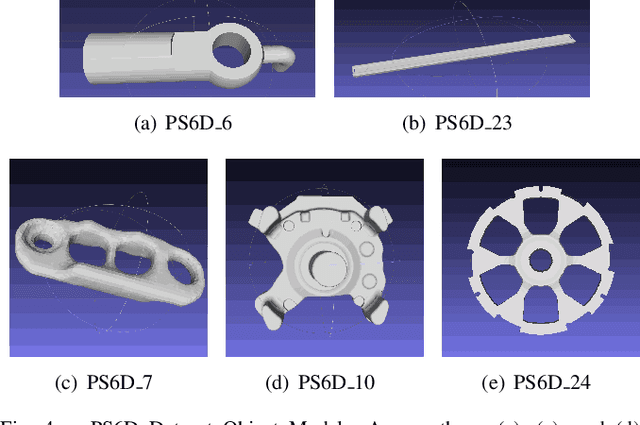
6D object pose estimation holds essential roles in various fields, particularly in the grasping of industrial workpieces. Given challenges like rust, high reflectivity, and absent textures, this paper introduces a point cloud based pose estimation framework (PS6D). PS6D centers on slender and multi-symmetric objects. It extracts multi-scale features through an attention-guided feature extraction module, designs a symmetry-aware rotation loss and a center distance sensitive translation loss to regress the pose of each point to the centroid of the instance, and then uses a two-stage clustering method to complete instance segmentation and pose estimation. Objects from the Sil\'eane and IPA datasets and typical workpieces from industrial practice are used to generate data and evaluate the algorithm. In comparison to the state-of-the-art approach, PS6D demonstrates an 11.5\% improvement in F$_{1_{inst}}$ and a 14.8\% improvement in Recall. The main part of PS6D has been deployed to the software of Mech-Mind, and achieves a 91.7\% success rate in bin-picking experiments, marking its application in industrial pose estimation tasks.