 Add to Chrome
 Add to Firefox
 Add to Edge
Beyond Prompt: Fine-grained Simulation of Cognitively Impaired Standardized Patients via Stochastic Steering
Apr 14, 2026
Simulating Standardized Patients with cognitive impairment offers a scalable and ethical solution for clinical training. However, existing methods rely on discrete prompt engineering and fail to capture the heterogeneity of deficits across varying domains and severity levels. To address this limitation, we propose StsPatient for the fine-grained simulation of cognitively impaired patients. We innovatively capture domain-specific features by extracting steering vectors from contrastive pairs of instructions and responses. Furthermore, we introduce a Stochastic Token Modulation (STM) mechanism to regulate the intervention probability. STM enables precise control over impairment severity while mitigating the instability of conventional vector methods. Comprehensive experiments demonstrate that StsPatient significantly outperforms baselines in both clinical authenticity and severity controllability.

Align then Adapt: Rethinking Parameter-Efficient Transfer Learning in 4D Perception
Feb 26, 2026Point cloud video understanding is critical for robotics as it accurately encodes motion and scene interaction. We recognize that 4D datasets are far scarcer than 3D ones, which hampers the scalability of self-supervised 4D models. A promising alternative is to transfer 3D pre-trained models to 4D perception tasks. However, rigorous empirical analysis reveals two critical limitations that impede transfer capability: overfitting and the modality gap. To overcome these challenges, we develop a novel "Align then Adapt" (PointATA) paradigm that decomposes parameter-efficient transfer learning into two sequential stages. Optimal-transport theory is employed to quantify the distributional discrepancy between 3D and 4D datasets, enabling our proposed point align embedder to be trained in Stage 1 to alleviate the underlying modality gap. To mitigate overfitting, an efficient point-video adapter and a spatial-context encoder are integrated into the frozen 3D backbone to enhance temporal modeling capacity in Stage 2. Notably, with the above engineering-oriented designs, PointATA enables a pre-trained 3D model without temporal knowledge to reason about dynamic video content at a smaller parameter cost compared to previous work. Extensive experiments show that PointATA can match or even outperform strong full fine-tuning models, whilst enjoying the advantage of parameter efficiency, e.g. 97.21 \% accuracy on 3D action recognition, $+8.7 \%$ on 4 D action segmentation, and 84.06\% on 4D semantic segmentation.
TikArt: Aperture-Guided Observation for Fine-Grained Visual Reasoning via Reinforcement Learning
Feb 16, 2026We address fine-grained visual reasoning in multimodal large language models (MLLMs), where key evidence may reside in tiny objects, cluttered regions, or subtle markings that are lost under a single global image encoding. We introduce TikArt (Thinking Aperture), an aperture-guided agent that casts multi-step vision-language reasoning as a decision process over regions of interest. TikArt follows a Think-Aperture-Observe loop, alternating between language generation and two aperture actions: Zoom extracts rectangular crops, while Segment invokes SAM2 to obtain mask-based crops for irregular targets. After every action, the model must produce an explicit observation, turning local visual cues into persistent linguistic memory. Built on Qwen3-VL-8B, TikArt optimizes its reasoning policy with AGRPO, a GRPO-style reinforcement learning algorithm with a two-stage curriculum: it warms up segmentation actions and then jointly optimizes visual math, fine-grained VQA, and segmentation, using rewards that couple task success with purposeful aperture use. Experiments on V*, HR-Bench-4K/8K, MME-RealWorld-Lite, MMStar, RefCOCO, and ReasonSeg show consistent gains over the backbone and yield interpretable aperture trajectories for high-resolution reasoning.
AFBS:Buffer Gradient Selection in Semi-asynchronous Federated Learning
Jun 15, 2025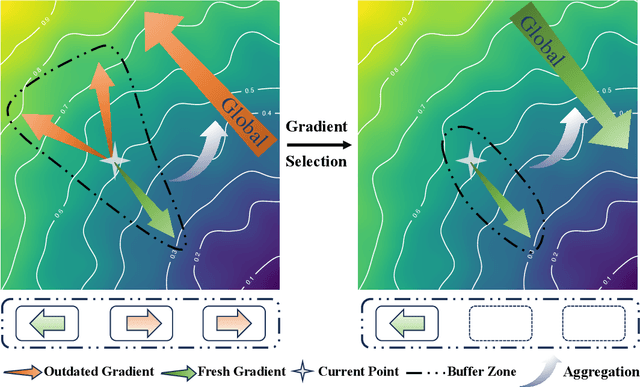
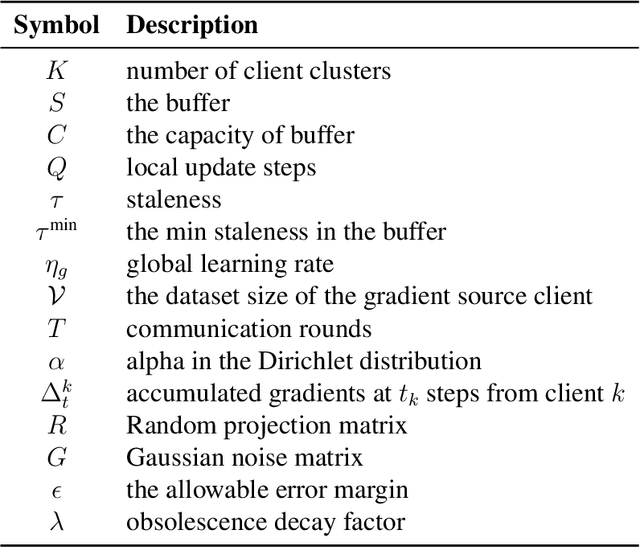
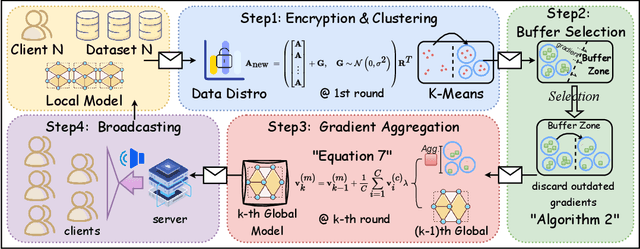
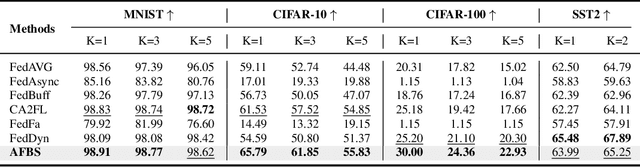
Asynchronous federated learning (AFL) accelerates training by eliminating the need to wait for stragglers, but its asynchronous nature introduces gradient staleness, where outdated gradients degrade performance. Existing solutions address this issue with gradient buffers, forming a semi-asynchronous framework. However, this approach struggles when buffers accumulate numerous stale gradients, as blindly aggregating all gradients can harm training. To address this, we propose AFBS (Asynchronous FL Buffer Selection), the first algorithm to perform gradient selection within buffers while ensuring privacy protection. Specifically, the client sends the random projection encrypted label distribution matrix before training, and the server performs client clustering based on it. During training, server scores and selects gradients within each cluster based on their informational value, discarding low-value gradients to enhance semi-asynchronous federated learning. Extensive experiments in highly heterogeneous system and data environments demonstrate AFBS's superior performance compared to state-of-the-art methods. Notably, on the most challenging task, CIFAR-100, AFBS improves accuracy by up to 4.8% over the previous best algorithm and reduces the time to reach target accuracy by 75%.
Corrected with the Latest Version: Make Robust Asynchronous Federated Learning Possible
Apr 09, 2025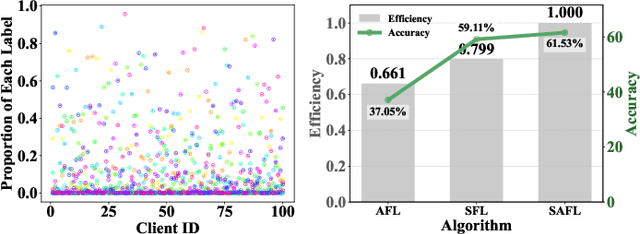
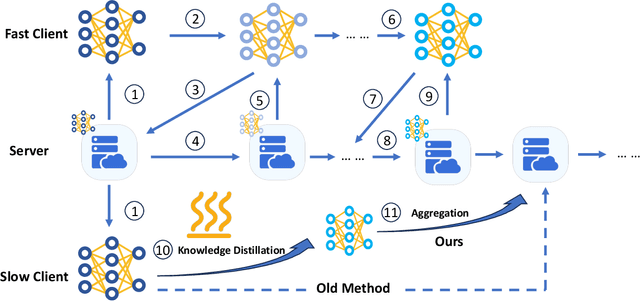
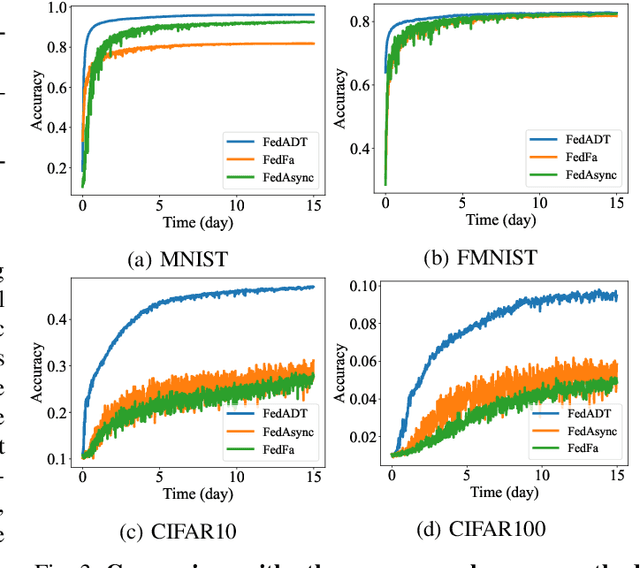
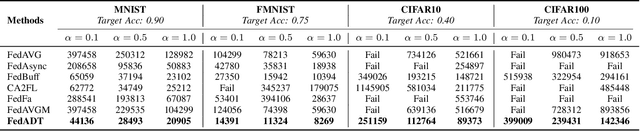
As an emerging paradigm of federated learning, asynchronous federated learning offers significant speed advantages over traditional synchronous federated learning. Unlike synchronous federated learning, which requires waiting for all clients to complete updates before aggregation, asynchronous federated learning aggregates the models that have arrived in realtime, greatly improving training speed. However, this mechanism also introduces the issue of client model version inconsistency. When the differences between models of different versions during aggregation become too large, it may lead to conflicts, thereby reducing the models accuracy. To address this issue, this paper proposes an asynchronous federated learning version correction algorithm based on knowledge distillation, named FedADT. FedADT applies knowledge distillation before aggregating gradients, using the latest global model to correct outdated information, thus effectively reducing the negative impact of outdated gradients on the training process. Additionally, FedADT introduces an adaptive weighting function that adjusts the knowledge distillation weight according to different stages of training, helps mitigate the misleading effects caused by the poorer performance of the global model in the early stages of training. This method significantly improves the overall performance of asynchronous federated learning without adding excessive computational overhead. We conducted experimental comparisons with several classical algorithms, and the results demonstrate that FedADT achieves significant improvements over other asynchronous methods and outperforms all methods in terms of convergence speed.