 Add to Chrome
 Add to Firefox
 Add to Edge
Mixture of Heterogeneous Grouped Experts for Language Modeling
Apr 28, 2026
Large Language Models (LLMs) based on Mixture-of-Experts (MoE) are pivotal in industrial applications for their ability to scale performance efficiently. However, standard MoEs enforce uniform expert sizes,creating a rigidity that fails to align computational costs with varying token-level complexity. While heterogeneous expert architectures attempt to address this by diversifying expert sizes, they often suffer from significant system-level challenges, specifically unbalanced GPU utilization and inefficient parameter utilization, which hinder practical deployment. To bridge the gap between theoretical heterogeneity and robust industrial application, we propose Mixture of Heterogeneous Grouped Experts (MoHGE) which introduces a two-level routing mechanism to enable flexible, resource-aware expert combinations. To optimize inference efficiency, we propose a Group-Wise Auxiliary Loss, which dynamically steers tokens to the most parameter-efficient expert groups based on task difficulty. To address the critical deployment challenge of GPU load balancing, we introduce an All-size Group-decoupling Allocation strategy coupled with an Intra-Group Experts Auxiliary Loss. These mechanisms collectively ensure uniform computation distribution across GPUs. Extensive evaluations demonstrate that MoHGE matches the performance of MoE architectures while reducing the total parameters by approximately 20% and maintaining balanced GPU utilization. Our work establishes a scalable paradigm for resource-efficient MoE design, offering a practical solution for optimizing inference costs in real-world scenarios. The code is publicly available at https://github.com/UnicomAI/MoHGE.

KAConvNet: Kolmogorov-Arnold Convolutional Networks for Vision Recognition
Apr 25, 2026The Convolutional Neural Networks (CNNs) have been the dominant and effective approach for general computer vision tasks. Recently, Kolmogorov-Arnold neural networks (KANs), based on the Kolmogorov-Arnold representation theorem, have shown potential to replace Multi-Layer Perceptrons (MLPs) in deep learning. KANs, which use learnable nonlinear activations on edges and simple summation on nodes, offer fewer parameters and greater explainability compared to MLPs. However, there has been limited exploration of integrating the Kolmogorov-Arnold representation theorem with convolutional methods for computer vision tasks. Existing attempts have merely replaced learnable activation functions with weights, undermining KANs' theoretical foundation and limiting their potential effectiveness. Additionally, the B-spline curves used in KANs suffer from computational inefficiency and a tendency to overfit. In this paper, we propose a novel Kolmogorov-Arnold Convolutional Layer that deeply integrates the Kolmogorov-Arnold representation theorem with convolution. This layer provides stronger method interpretability because it is based on established mathematical theorems and its design has theoretical alignment. Building on the Kolmogorov-Arnold Convolutional Layer, we design an efficient network architecture called KAConvNet, which outperforms existing methods combining KAN and convolution, and achieves competitive performance compared to mainstream ViTs and CNNs. We believe that our work offers valuable insight into the field of artificial intelligence and will inspire the development of more innovative CNNs in the 2020s. The code is publicly available at https://github.com/UnicomAI/KAConvNet.
DeepSeek-V3 Technical Report
Dec 27, 2024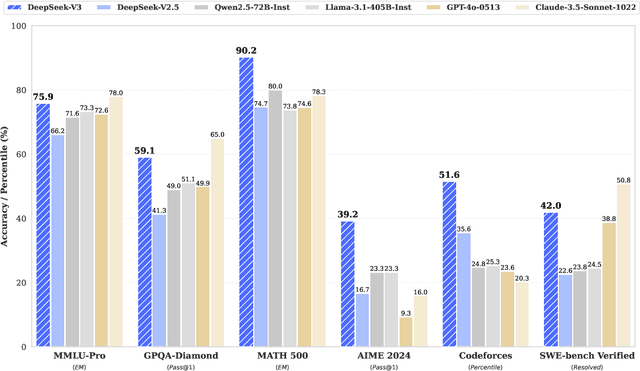


We present DeepSeek-V3, a strong Mixture-of-Experts (MoE) language model with 671B total parameters with 37B activated for each token. To achieve efficient inference and cost-effective training, DeepSeek-V3 adopts Multi-head Latent Attention (MLA) and DeepSeekMoE architectures, which were thoroughly validated in DeepSeek-V2. Furthermore, DeepSeek-V3 pioneers an auxiliary-loss-free strategy for load balancing and sets a multi-token prediction training objective for stronger performance. We pre-train DeepSeek-V3 on 14.8 trillion diverse and high-quality tokens, followed by Supervised Fine-Tuning and Reinforcement Learning stages to fully harness its capabilities. Comprehensive evaluations reveal that DeepSeek-V3 outperforms other open-source models and achieves performance comparable to leading closed-source models. Despite its excellent performance, DeepSeek-V3 requires only 2.788M H800 GPU hours for its full training. In addition, its training process is remarkably stable. Throughout the entire training process, we did not experience any irrecoverable loss spikes or perform any rollbacks. The model checkpoints are available at https://github.com/deepseek-ai/DeepSeek-V3.