 Add to Chrome
 Add to Firefox
 Add to Edge
FeatFix: Reuse What You Verify through Local Exact-Feature Correction for Faster Cached Diffusion Inference
Jul 30, 2026
Diffusion models are widely used to generate high-quality images and videos, but their iterative denoising process remains computationally intensive. A growing class of training-free accelerators reduces this cost by reusing cached intermediate features or forecasting future ones. To control draft drift, these methods sometimes compute an exact block feature for verification. Yet the resulting exact feature is typically used only to measure discrepancy or guide a later decision and is then discarded. We find that this previously computed feature can instead be reused for correction. Forwarding it at the verification site resets the local draft residual and reduces downstream feature error. Based on this observation, we introduce FeatFix, a local exact-feature correction method for cached diffusion inference. FeatFix operates at a fixed sparse set of layer--timestep sites. At each selected site, it replaces the complete draft block output with the exact output computed from the same incoming state, avoiding token- or channel-level partial replacement and full-timestep recomputation. Experiments across four image and video backbones show that FeatFix consistently accelerates generation, achieving a speedup of up to $6.70\times$ over Vanilla while maintaining competitive output quality.

MemTxn: A Transaction Boundary for Source-Supported Updates and Complete-State Recovery in Agent Memory
Jul 30, 2026Persistent memory lets long-running large language model agents reuse information across sessions and tasks. Yet errors in writable memory can persist and corrupt future behavior. Existing systems improve storage and retrieval, but they do not provide a transaction boundary for reliable updates and recovery. We therefore propose MemTxn, a governance layer outside the answer model. MemTxn verifies whether an update is supported by its source. It also selects the visible version when facts conflict and restores the application-visible state after a fault. The system uses Ordered PatchTest to validate writes, a Temporal Resolver to select versions, and a durable snapshot journal to recover state. On an item-disjoint audit, MemTxn accepts all 60 supported originals and rejects all 179 hard negatives. Under persistent multi-key faults on LongMemEval-S and LoCoMo states, it restores the complete declared active map without knowing the actual physical write set. On MemoryAgentBench FactConsolidation, MemTxn achieves the highest average F1 across all twelve answer-model configurations. It outperforms Dense by 17.06--24.07 points in five representative settings.
CONCORD: Asynchronous Sparse Aggregation for Device-Cloud RAG under Document Isolation
Jun 13, 2026Retrieval-augmented generation (RAG) has emerged as a pivotal technique for improving language models by incorporating external knowledge at inference time. As device-cloud collaborative inference makes it feasible to deploy small language models on edge devices, a new setting arises in which private documents remain on the device and public knowledge resides in the cloud. Privacy and policy constraints often forbid raw document exchange, creating a document-isolated dual-end RAG setting. However, existing methods rely on frequent remote synchronization and dense evidence transfer, limiting throughput under realistic latency and bandwidth conditions. To address this issue, we propose CONCORD, an asynchronous sparse aggregation framework for dual-end RAG under document isolation. CONCORD treats the cloud as an asynchronously arriving evidence source rather than a continuously synchronized co-generator. Specifically, we introduce waiting debt control to decide whether each decoding step should continue waiting for remote participation based on the observed return of waiting. We also design a certificate-guided minimal supplementation mechanism that requests only the remote evidence needed to determine the current greedy decision. Steps that consult the cloud preserve the same greedy token as dense dual-end aggregation, while the remaining steps commit locally without remote evidence. Experiments on Natural Questions and WikiText-2 show that CONCORD improves end-to-end throughput over baselines by $1.66\times$ and $2.15\times$, respectively, while reducing per-token communication by over two orders of magnitude and maintaining comparable answer quality and perplexity.
CogGuard: Cognitive and Operational Profiling for Proactive Warning in Edge Intelligent Services
Jun 13, 2026Proactive warning is an important capability for edge intelligent services, where the system predicts whether a subject will successfully complete an incoming task under strict latency and privacy constraints. Such prediction depends on both long-term static attributes and short-term dynamic states derived from historical interaction logs. Recent Large Language Models (LLMs) offer strong long-context reasoning for constructing structured profiles from these logs, but existing solutions face two challenges for edge deployment: (1) profiling methods are typically domain-specific and lack a reusable abstraction across service scenarios, and (2) fine-tuning alignment models on heterogeneous edge clusters incurs high synchronization overhead due to the variance in input sequence lengths. To address these challenges, we propose CogGuard, a proactive-warning framework for edge intelligent services. CogGuard decouples offline LLM-based profile construction from online Small Language Model (SLM)-based score prediction through a shared static-dynamic profile-to-score pipeline, and instantiates it in two representative scenarios: educational performance warning and operational task outcome warning. For efficient profile construction, we design scenario-specific profiling methods with prefix-aligned KV-cache reuse to reduce repeated encoding overhead. For edge-side model alignment, we propose a length-aware distributed fine-tuning strategy with contrastive regularization to mitigate workload imbalance on heterogeneous clusters. Experiments on education and operation datasets show that CogGuard reduces profile construction time by up to 48% and distributed fine-tuning time by 19%, while achieving MAEs of 13.4 and 5.9, respectively, on 100-point-scale warning tasks. In the largest educational setting, CogGuard reduces prediction error by 15.4% compared with the strongest baseline.
Semantic Cache Distillation: Efficient State Transfer via Reuse and Selective Patching
Jun 05, 2026Disaggregated serving alleviates memory bottlenecks in Large Language Model (LLM) inference but creates a severe communication bottleneck: transmitting high-dimensional Key-Value (KV) caches often dominates time-to-first-token (TTFT). Moreover, reusing caches across heterogeneous models (e.g., base and fine-tuned variants) causes semantic misalignment that accumulates over layers, degrading generation quality. We propose Semantic Cache Distillation (SCD), a loss-constrained framework that replaces raw KV transmission with compact semantic codes. SCD addresses these challenges via two mechanisms: (1) Reuse, which reconstructs most layers from low-rank subspaces to minimize transfer cost, and (2) Patch, which predicts normalized inputs at sparse transition layers to truncate error propagation. Empirically, SCD delivers up to 2.65 $\times$ TTFT speedup over the oracle consumer prefill and dominates quantization and selective recomputation baselines on the quality--latency Pareto frontier in bandwidth-constrained regimes, while keeping generation quality within 5\% F1 of the oracle.
Not All Frames Deserve Full Computation: Accelerating Autoregressive Video Generation via Selective Computation and Predictive Extrapolation
Apr 03, 2026Autoregressive (AR) video diffusion models enable long-form video generation but remain expensive due to repeated multi-step denoising. Existing training-free acceleration methods rely on binary cache-or-recompute decisions, overlooking intermediate cases where direct reuse is too coarse yet full recomputation is unnecessary. Moreover, asynchronous AR schedules assign different noise levels to co-generated frames, yet existing methods process the entire valid interval uniformly. To address these AR-specific inefficiencies, we present SCOPE, a training-free framework for efficient AR video diffusion. SCOPE introduces a tri-modal scheduler over cache, predict, and recompute, where prediction via noise-level Taylor extrapolation fills the gap between reuse and recomputation with explicit stability controls backed by error propagation analysis. It further introduces selective computation that restricts execution to the active frame interval. On MAGI-1 and SkyReels-V2, SCOPE achieves up to 4.73x speedup while maintaining quality comparable to the original output, outperforming all training-free baselines.
MatterChat: A Multi-Modal LLM for Material Science
Feb 18, 2025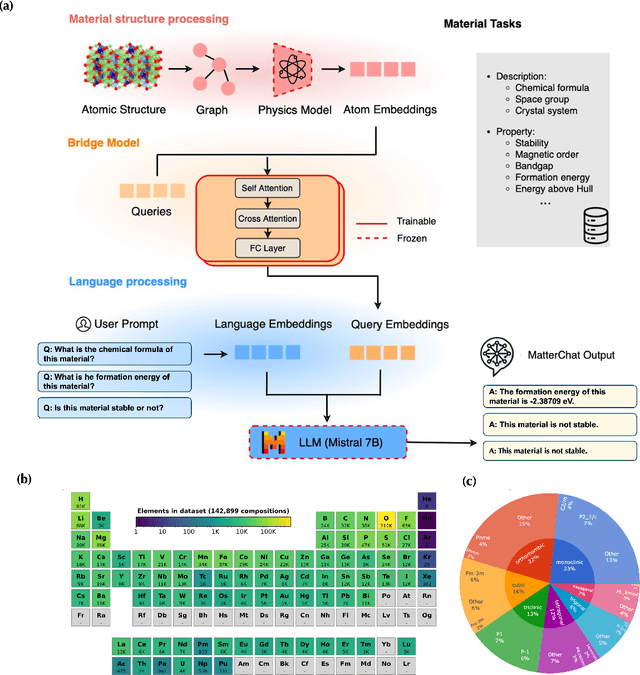
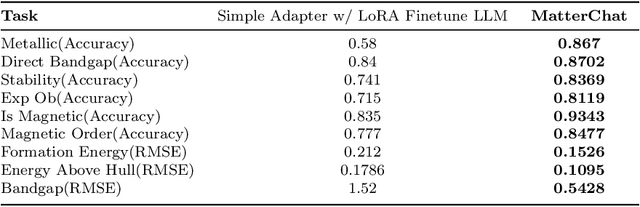
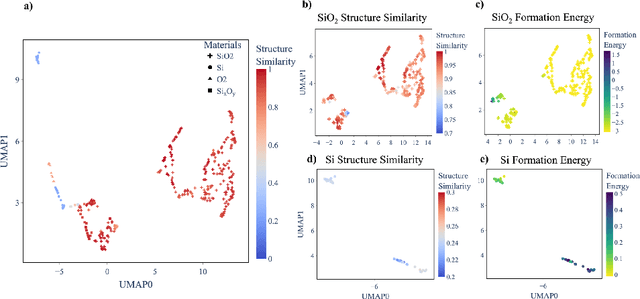
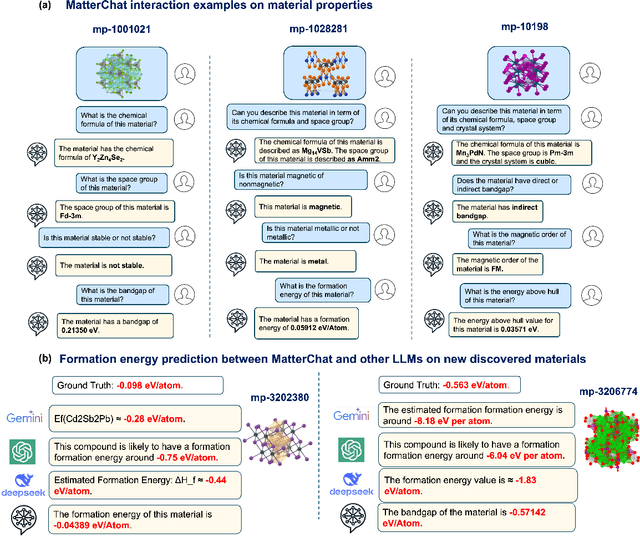
Understanding and predicting the properties of inorganic materials is crucial for accelerating advancements in materials science and driving applications in energy, electronics, and beyond. Integrating material structure data with language-based information through multi-modal large language models (LLMs) offers great potential to support these efforts by enhancing human-AI interaction. However, a key challenge lies in integrating atomic structures at full resolution into LLMs. In this work, we introduce MatterChat, a versatile structure-aware multi-modal LLM that unifies material structural data and textual inputs into a single cohesive model. MatterChat employs a bridging module to effectively align a pretrained machine learning interatomic potential with a pretrained LLM, reducing training costs and enhancing flexibility. Our results demonstrate that MatterChat significantly improves performance in material property prediction and human-AI interaction, surpassing general-purpose LLMs such as GPT-4. We also demonstrate its usefulness in applications such as more advanced scientific reasoning and step-by-step material synthesis.
VELO: A Vector Database-Assisted Cloud-Edge Collaborative LLM QoS Optimization Framework
Jun 19, 2024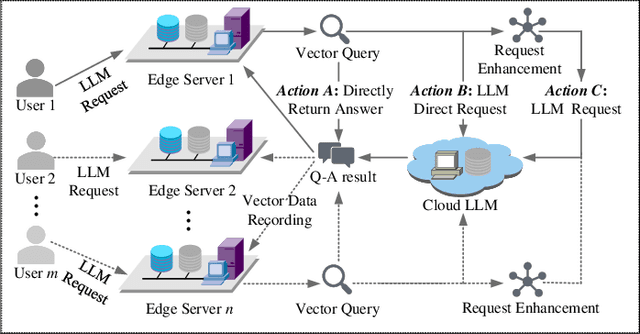
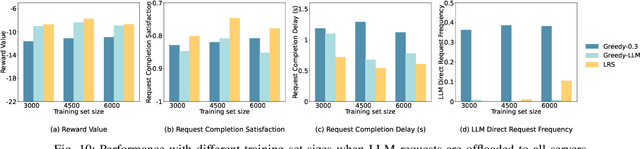
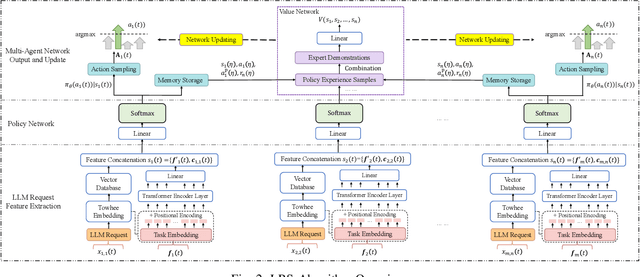
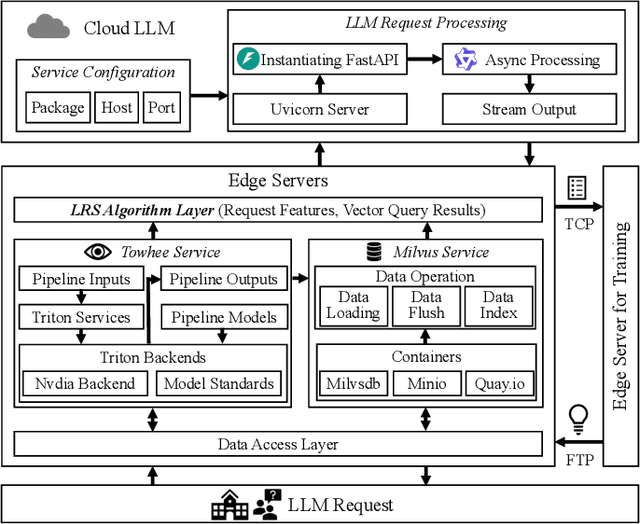
The Large Language Model (LLM) has gained significant popularity and is extensively utilized across various domains. Most LLM deployments occur within cloud data centers, where they encounter substantial response delays and incur high costs, thereby impacting the Quality of Services (QoS) at the network edge. Leveraging vector database caching to store LLM request results at the edge can substantially mitigate response delays and cost associated with similar requests, which has been overlooked by previous research. Addressing these gaps, this paper introduces a novel Vector database-assisted cloud-Edge collaborative LLM QoS Optimization (VELO) framework. Firstly, we propose the VELO framework, which ingeniously employs vector database to cache the results of some LLM requests at the edge to reduce the response time of subsequent similar requests. Diverging from direct optimization of the LLM, our VELO framework does not necessitate altering the internal structure of LLM and is broadly applicable to diverse LLMs. Subsequently, building upon the VELO framework, we formulate the QoS optimization problem as a Markov Decision Process (MDP) and devise an algorithm grounded in Multi-Agent Reinforcement Learning (MARL) to decide whether to request the LLM in the cloud or directly return the results from the vector database at the edge. Moreover, to enhance request feature extraction and expedite training, we refine the policy network of MARL and integrate expert demonstrations. Finally, we implement the proposed algorithm within a real edge system. Experimental findings confirm that our VELO framework substantially enhances user satisfaction by concurrently diminishing delay and resource consumption for edge users utilizing LLMs.