 Add to Chrome
 Add to Firefox
 Add to Edge
Conditioning Matters: Stabilizing Inversion and Attention in Diffusion Image Editing
Jun 12, 2026
Inversion-based image editing offers flexible and training-free control but still struggles with inversion accuracy and the trade-off between editing fidelity and background preservation. While recent methods improve inversion formulations or attention interactions, the role of textual conditioning in shaping diffusion dynamics and editing behavior remains underexplored. We show both empirically and theoretically that the precision of textual conditioning influences inversion stability by modulating the geometry of the diffusion velocity field, while also affecting the consistency of cross-branch attention during editing. These effects directly impact background preservation and semantic fidelity. Building on this analysis, we propose SimEdit, a conditioning-aware framework with two complementary components: (a) conditioning refinement, which constructs conditioning signals with improved semantic precision and structural alignment to facilitate stable inversion and consistent attention manipulation, and (b) token-wise cross-branch attention control, which separates edit-relevant and structure-preserving components and modulates them asymmetrically during attention manipulation. Extensive experiments on PIE-Bench demonstrate that SimEdit consistently improves both inversion reconstruction quality and editing performance over previous attention-manipulation approaches. Our code is available at https://github.com/zju-pi/SimEdit.

Conditional Image Synthesis with Diffusion Models: A Survey
Sep 28, 2024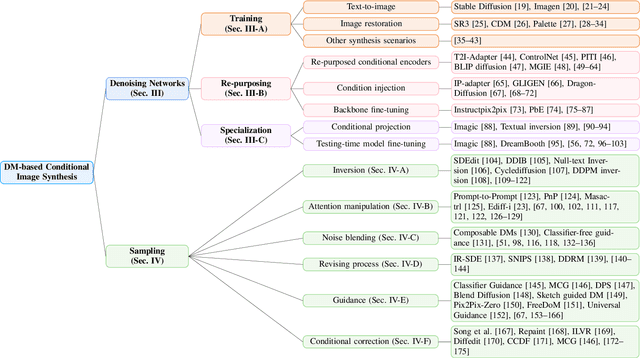
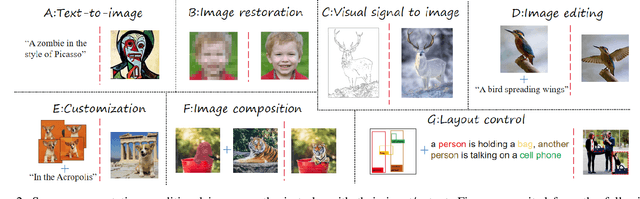
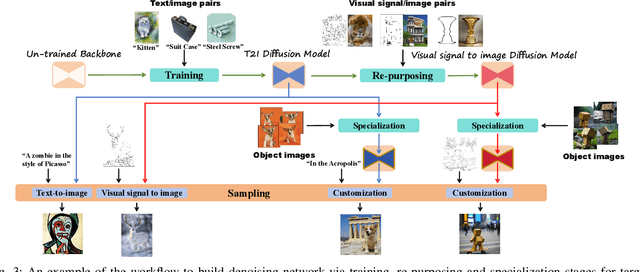

Conditional image synthesis based on user-specified requirements is a key component in creating complex visual content. In recent years, diffusion-based generative modeling has become a highly effective way for conditional image synthesis, leading to exponential growth in the literature. However, the complexity of diffusion-based modeling, the wide range of image synthesis tasks, and the diversity of conditioning mechanisms present significant challenges for researchers to keep up with rapid developments and understand the core concepts on this topic. In this survey, we categorize existing works based on how conditions are integrated into the two fundamental components of diffusion-based modeling, i.e., the denoising network and the sampling process. We specifically highlight the underlying principles, advantages, and potential challenges of various conditioning approaches in the training, re-purposing, and specialization stages to construct a desired denoising network. We also summarize six mainstream conditioning mechanisms in the essential sampling process. All discussions are centered around popular applications. Finally, we pinpoint some critical yet still open problems to be solved in the future and suggest some possible solutions. Our reviewed works are itemized at https://github.com/zju-pi/Awesome-Conditional-Diffusion-Models.