 Add to Chrome
 Add to Firefox
 Add to Edge
Fast Pinching-Antenna Activation for AirComp
Jul 09, 2026
A pinching-antenna system (PASS) is considered for over-the-air computation (AirComp). Multiple dielectric waveguides are deployed at the base station, and one pinching antenna (PA) is activated on each waveguide. For practical implementation, each PA is restricted to a finite set of preconfigured locations. The resulting discrete activation problem is formulated to minimize the AirComp mean-squared error (MSE). After the optimal aggregation vector is derived, the minimum MSE is expressed through an inverse Gram matrix. A rank-one recursion is derived to evaluate the exact MSE reduction produced by each candidate. Greedy search and beam search are then developed for fast tree search. To further reduce complexity, coherent aggregation search is proposed from a first-order MSE approximation. It admits a separable closed-form selection rule and is asymptotically optimal in the low signal-to-noise ratio (SNR) regime. Numerical results show that the proposed methods substantially improve the AirComp accuracy of PASS over conventional antenna arrays.

Beamforming Gain with Single-RF Movable Arrays
Jun 09, 2026A single-radio-frequency (RF) movable array is investigated, in which all movable elements are driven by a single RF chain with equal amplitude and equal phase. The achievable beamforming gain enabled by antenna placement is analyzed. Linear beamforming gain scaling with the number of antennas is shown to be achievable in single-path channels, while coherent-combining conditions and aperture requirements are established for multipath channels. For multiuser transmission, the optimal max-min power allocation is derived in closed form, based on which an element-wise coordinate-search algorithm is developed for antenna placement design. Numerical results validate the analysis and reveal a fundamental tradeoff: beamforming gains can be achieved through antenna placement alone, but only at the expense of increased aperture resources.
Spatio-Sequential Recurrent Network for 3-D Tunnel Propagation Modeling
Jun 06, 2026Fine-mesh parabolic wave equation (PWE) simulations are high-fidelity but time-consuming, which limits real-time tunnel propagation analysis and motivates coarse-to-fine reconstruction. Existing machine learning (ML)-assisted tunnel models typically provide only one-dimensional (1-D) longitudinal refinement or two-dimensional (2-D) cross-sectional refinement, rather than joint 3-D enhancement. Motivated by this gap, this letter proposes a U-shaped gated spatio-sequential recurrent neural network (UG-SSRNN), a spatio-sequential reconstruction model for tunnel electromagnetic fields. UG-SSRNN jointly super-resolves transverse slices and models longitudinal evolution. It uses sliding-window context encoding and a K-layer convolutional recurrent backbone with a shared propagation-context state and diagonal feedback. A prediction-aware upsampling head leverages the previous prediction to improve slice-to-slice consistency. Experiments on four tunnel cross sections, unseen-material and unseen-frequency tests, and validation in the Massif Central tunnel show close agreement with fine-mesh PWE references. The proposed approach significantly reduces tunnel electromagnetic modeling time.
Optimal Analog Beamforming and Power Allocation for Multiuser TDMA Systems
Apr 11, 2026The joint design of analog beamforming and power allocation is investigated for a single radio-frequency chain multiuser time-division multiple access system under a max-min signal-to-noise ratio (SNR) criterion. A hardware-efficient phased-array architecture is considered, where the beamforming vector is shared by all users and is subject to constant-modulus constraints. For any fixed analog beamformer, the optimal power allocation is first derived in closed form, by which the original problem is reduced to phase-shift optimization only. Then, globally optimal branch-and-bound (BB) algorithms are developed for discrete and continuous phase shifts. Numerical results show that the proposed BB algorithms achieve the global optimum and provide reliable benchmarks for evaluating the performance gap of low-complexity alternating-optimization methods.
Continuous-Aperture Array-Based ISAC Over Fading Channels
Mar 03, 2026A framework of continuous-aperture array (CAPA)-based integrated sensing and communications (ISAC) under a fading communication channel is proposed. A continuous operator-based signal model is developed, and the statistics of the communication channel gain are characterized via Landau's eigenvalue theorem. On this basis, the performance of the CAPA-based ISAC system is analyzed by considering three continuous beamforming designs: i) the sensing-centric (S-C) design that optimizes sensing performance, ii) the communication-centric (C-C) design that optimizes communication performance, and iii) the Pareto-optimal design that balances the sensing-communication trade-off. For the S-C and C-C design, closed-form expressions for the sensing rate (SR), ergodic communication rate (CR), and outage probability are derived, and high-signal-to-noise ratio asymptotic analysis is conducted to obtain the multiplexing and diversity gains. For the Pareto-optimal design, the Pareto-optimal beamformer achieving the Pareto boundary is derived, and the achievable SR-CR region is characterized. Numerical results demonstrate that the proposed CAPA-ISAC scheme outperforms both conventional spatially discrete arrays-based ISAC and CAPA-based frequency-division sensing and communications.
Uncertainty Quantification of Radio Wave Propagation over Irregular Terrains Using Adaptive Polynomial Chaos Expansion
Mar 03, 2026Accurate modeling of radio wave propagation over irregular terrains is crucial for designing reliable wireless communication systems in such environments, yet uncertainties in the antenna configuration are not quantified within deterministic models. In this paper, we present, to the best of our knowledge, the first uncertainty quantification (UQ) study of realistic antenna configurations for irregular-terrain propagation. An adaptive polynomial chaos expansion (APCE) method is improved and coupled with a two-way parabolic wave equation (PWE) method to address this problem efficiently. The polynomial basis is extended according to variance contributions and terminated by a composite criterion combining validation error and sample-to-basis ratio, enabling stable coefficient estimations via least-square regression without additional regularization. Convergence analysis shows a monotonic error decay with increasing training samples, producing compact, low-interaction models and improved accuracy and robustness over the previous APCE methods. For two realistic terrain profiles, the proposed method accurately predicts the mean and the 5th-95th percentile range of the path loss, matching Monte Carlo (MC) references using only 30 PWE simulations. Using a fixed sampling budget, APCE outperforms standard and sparse PCE, with the largest gains observed for the 5th and 95th percentile estimates; as the sample size increases, APCE maintains low errors with reduced trial-to-trial variability.
Dynamic Antenna Placement for Mobile Users in Urban Micro Pinching-Antenna Systems
Feb 28, 2026The pinching-antenna systems (PASS) enable blockage mitigation in urban micro (UMi) networks through flexible antenna placement. However, the joint optimization of antenna positions and beamforming precoding is inherently nonconvex and becomes significantly more challenging under user mobility. To address this issue, we propose a bilevel optimization framework for dynamic antenna positioning and beamforming precoding design. In the outer level, a soft actor-critic (SAC) agent learns a continuous control policy for real-time antenna positioning, while in the inner level, zero-forcing (ZF) precoding is applied based on the instantaneous effective channel. Numerical results demonstrate that the proposed framework significantly improves spectral efficiency (SE) and enhances robustness against user mobility and random blockages.
Fairness-Oriented Optimization of NOMA-Enabled Pinching-Antenna Systems Under Blockage and Imperfect CSI
Feb 28, 2026The pinching-antenna system (PASS) has been proposed as a promising solution for mitigating line-of-sight (LoS) blockages by dynamically repositioning pinching antennas (PAs) along a dielectric waveguide. This paper develops a fairness-oriented downlink design for a non-orthogonal multiple access (NOMA)-enabled PASS, where the longitudinal placement of PAs and the NOMA power allocation coefficients are jointly optimized to maximize the minimum user signal-to-interference-plus-noise ratio (SINR) across all users under transmit power and waveguide constraints. A soft-blockage channel model incorporating waveguide attenuation and imperfect channel state information (CSI) is developed. To ensure the feasibility of successive interference cancellation under CSI uncertainty, a conservative SINR evaluation framework is proposed. The resulting non-convex max-min SINR optimization problem is efficiently solved using a tailored particle swarm optimization (PSO) algorithm. Numerical results demonstrate that the proposed design improves the minimum user SINR by approximately 7-10 dB compared with fixed-antenna systems and non-robust optimization baselines under moderate blockage and imperfect CSI.
Secure Multiuser Beamforming With Movable Antenna Arrays
Jan 09, 2026A movable antennas (MAs)-enabled secure multiuser transmission framework is developed to enhance physical-layer security. Novel expressions are derived to characterize the achievable sum secrecy rate based on the secure channel coding theorem. On this basis, a joint optimization algorithm for digital beamforming and MA placement is proposed to maximize the sum secrecy rate via fractional programming and block coordinate descent. In each iteration, every variable admits either a closed-form update or a low-complexity one-dimensional or bisection search, which yields an efficient implementation. Numerical results demonstrate the effectiveness of the proposed method and show that the MA-enabled design achieves higher secrecy rates than conventional fixed-position antenna arrays.
Electromagnetic Degrees of Freedom for Continuous-Aperture Array (CAPA) Systems
Feb 20, 2025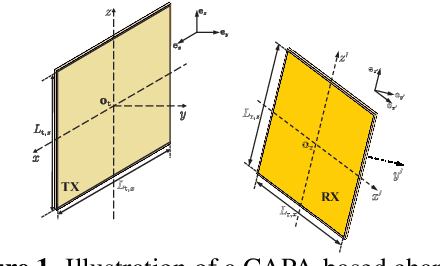
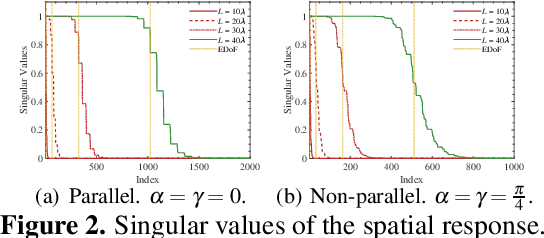
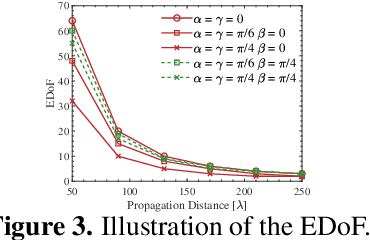
The spatial degrees of freedom (DoFs) of a continuous-aperture array (CAPA)-based continuous electromagnetic (EM) channel are analyzed. To this end, a simplified spatial model is derived using the Fresnel approximation. Leveraging this model and Landau's theorem, a closed-form expression for the spatial DoFs is derived. It is demonstrated that the number of DoFs is proportional to the transmit and receive aperture sizes while being inversely proportional to the propagation distance. Numerical results are provided to validate the accuracy of the derived expressions.