 Add to Chrome
 Add to Firefox
 Add to Edge
SpatCode: Rotary-based Unified Encoding Framework for Efficient Spatiotemporal Vector Retrieval
Jan 14, 2026
Spatiotemporal vector retrieval has emerged as a critical paradigm in modern information retrieval, enabling efficient access to massive, heterogeneous data that evolve over both time and space. However, existing spatiotemporal retrieval methods are often extensions of conventional vector search systems that rely on external filters or specialized indices to incorporate temporal and spatial constraints, leading to inefficiency, architectural complexity, and limited flexibility in handling heterogeneous modalities. To overcome these challenges, we present a unified spatiotemporal vector retrieval framework that integrates temporal, spatial, and semantic cues within a coherent similarity space while maintaining scalability and adaptability to continuous data streams. Specifically, we propose (1) a Rotary-based Unified Encoding Method that embeds time and location into rotational position vectors for consistent spatiotemporal representation; (2) a Circular Incremental Update Mechanism that supports efficient sliding-window updates without global re-encoding or index reconstruction; and (3) a Weighted Interest-based Retrieval Algorithm that adaptively balances modality weights for context-aware and personalized retrieval. Extensive experiments across multiple real-world datasets demonstrate that our framework substantially outperforms state-of-the-art baselines in both retrieval accuracy and efficiency, while maintaining robustness under dynamic data evolution. These results highlight the effectiveness and practicality of the proposed approach for scalable spatiotemporal information retrieval in intelligent systems.

P2P: Automated Paper-to-Poster Generation and Fine-Grained Benchmark
May 21, 2025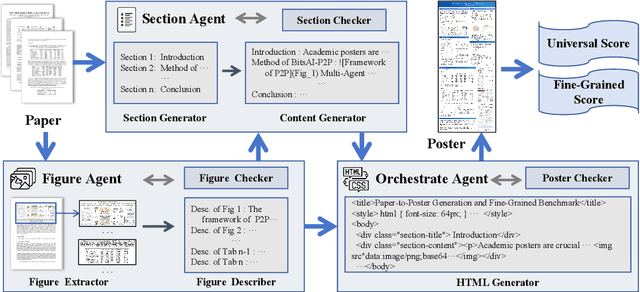
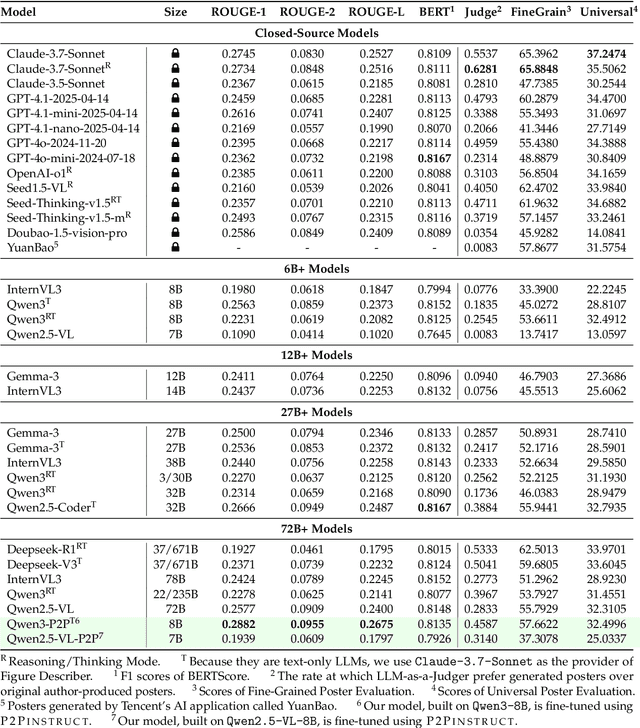
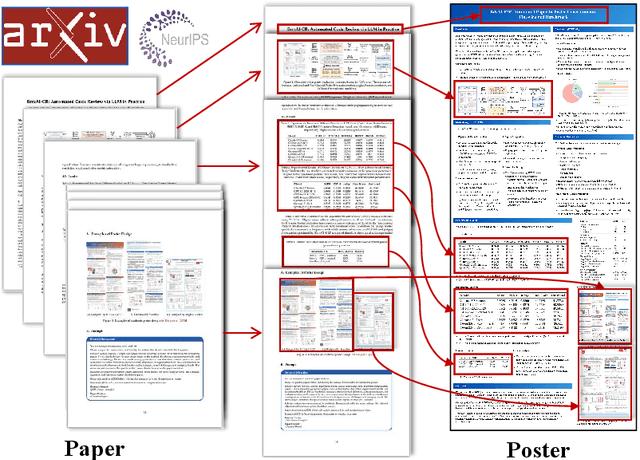

Academic posters are vital for scholarly communication, yet their manual creation is time-consuming. However, automated academic poster generation faces significant challenges in preserving intricate scientific details and achieving effective visual-textual integration. Existing approaches often struggle with semantic richness and structural nuances, and lack standardized benchmarks for evaluating generated academic posters comprehensively. To address these limitations, we introduce P2P, the first flexible, LLM-based multi-agent framework that generates high-quality, HTML-rendered academic posters directly from research papers, demonstrating strong potential for practical applications. P2P employs three specialized agents-for visual element processing, content generation, and final poster assembly-each integrated with dedicated checker modules to enable iterative refinement and ensure output quality. To foster advancements and rigorous evaluation in this domain, we construct and release P2PInstruct, the first large-scale instruction dataset comprising over 30,000 high-quality examples tailored for the academic paper-to-poster generation task. Furthermore, we establish P2PEval, a comprehensive benchmark featuring 121 paper-poster pairs and a dual evaluation methodology (Universal and Fine-Grained) that leverages LLM-as-a-Judge and detailed, human-annotated checklists. Our contributions aim to streamline research dissemination and provide the community with robust tools for developing and evaluating next-generation poster generation systems.