 Add to Chrome
 Add to Firefox
 Add to Edge
POINTS-Long: Adaptive Dual-Mode Visual Reasoning in MLLMs
Apr 13, 2026
Multimodal Large Language Models (MLLMs) have recently demonstrated remarkable capabilities in cross-modal understanding and generation. However, the rapid growth of visual token sequences--especially in long-video and streaming scenarios--poses a major challenge to their scalability and real-world deployment. Thus, we introduce POINTS-Long, a native dual-mode MLLM featuring dynamic visual token scaling inspired by the human visual system. The model supports two complementary perception modes: focus mode and standby mode, enabling users to dynamically trade off efficiency and accuracy during inference. On fine-grained visual tasks, the focus mode retains the optimal performance, while on long-form general visual understanding, the standby mode retains 97.7-99.7% of the original accuracy using only 1/40-1/10th of the visual tokens. Moreover, POINTS-Long natively supports streaming visual understanding via a dynamically detachable KV-cache design, allowing efficient maintenance of ultra-long visual memory. Our work provides new insights into the design of future MLLMs and lays the foundation for adaptive and efficient long-form visual understanding.

FOLDER: Accelerating Multi-modal Large Language Models with Enhanced Performance
Jan 05, 2025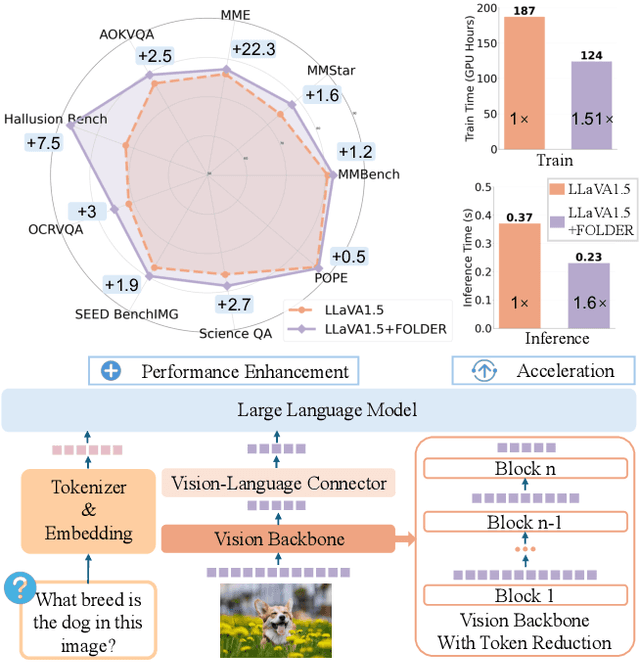
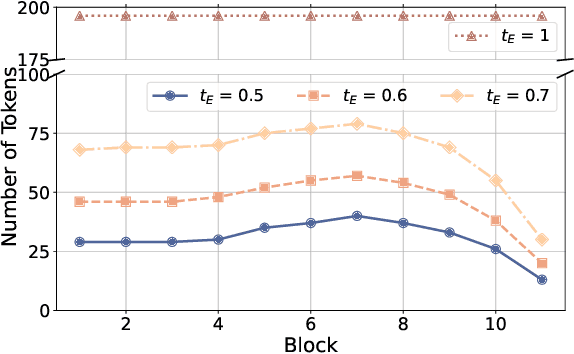
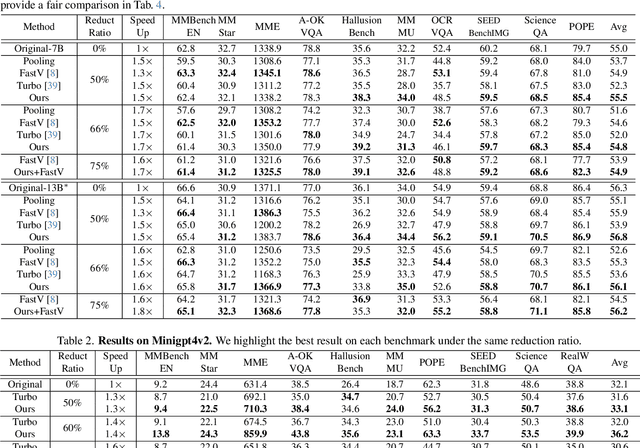
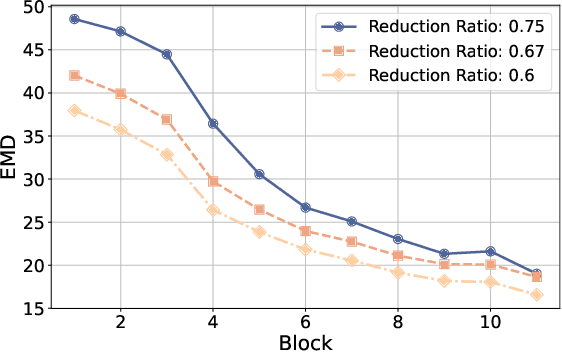
Recently, Multi-modal Large Language Models (MLLMs) have shown remarkable effectiveness for multi-modal tasks due to their abilities to generate and understand cross-modal data. However, processing long sequences of visual tokens extracted from visual backbones poses a challenge for deployment in real-time applications. To address this issue, we introduce FOLDER, a simple yet effective plug-and-play module designed to reduce the length of the visual token sequence, mitigating both computational and memory demands during training and inference. Through a comprehensive analysis of the token reduction process, we analyze the information loss introduced by different reduction strategies and develop FOLDER to preserve key information while removing visual redundancy. We showcase the effectiveness of FOLDER by integrating it into the visual backbone of several MLLMs, significantly accelerating the inference phase. Furthermore, we evaluate its utility as a training accelerator or even performance booster for MLLMs. In both contexts, FOLDER achieves comparable or even better performance than the original models, while dramatically reducing complexity by removing up to 70% of visual tokens.
Adaptive Two-Stage Cloud Resource Scaling via Hierarchical Multi-Indicator Forecasting and Bayesian Decision-Making
Aug 02, 2024The surging demand for cloud computing resources, driven by the rapid growth of sophisticated large-scale models and data centers, underscores the critical importance of efficient and adaptive resource allocation. As major tech enterprises deploy massive infrastructures with thousands of GPUs, existing cloud platforms still struggle with low resource utilization due to key challenges: capturing hierarchical indicator structures, modeling non-Gaussian distributions, and decision-making under uncertainty. To address these challenges, we propose HRAMONY, an adaptive Hierarchical Attention-based Resource Modeling and Decision-Making System. HARMONY combines hierarchical multi-indicator distribution forecasting and uncertainty-aware Bayesian decision-making. It introduces a novel hierarchical attention mechanism that comprehensively models complex inter-indicator dependencies, enabling accurate predictions that can adapt to evolving environment states. By transforming Gaussian projections into adaptive non-Gaussian distributions via Normalizing Flows. Crucially, HARMONY leverages the full predictive distributions in an adaptive Bayesian process, proactively incorporating uncertainties to optimize resource allocation while robustly meeting SLA constraints under varying conditions. Extensive evaluations across four large-scale cloud datasets demonstrate HARMONY's state-of-the-art performance, significantly outperforming nine established methods. A month-long real-world deployment validated HARMONY's substantial practical impact, realizing over 35,000 GPU hours in savings and translating to $100K+ in cost reduction, showcasing its remarkable economic value through adaptive, uncertainty-aware scaling. Our code is available at https://github.com/Floating-LY/HARMONY1.