 Add to Chrome
 Add to Firefox
 Add to Edge
World Narrative Model for Highly Controllable Video Generation: A Paradigm Shift from Pixel Sampling to Physical World Orchestration
Jun 30, 2026
The fundamental obstacle to industrial grade video generation is the lack of controllability: existing models treat video as a pixel distribution sampling problem, bypassing the explicit, instance level $4D$ $(3D + T)$ physical world. Consequently, content creators cannot specify geometry, motion, camera parameters, or lighting in a deterministic, quantitative way, leading to the infamous ''gacha'' loop that makes professional content creation prohibitively inefficient and expensive. To address this, we introduce the World Narrative Model (WNM), a paradigm that decouples what to render -- the structured physical narrative -- from how to render -- the pixel generation process. WNM replaces end-to-end black-box sampling with orchestrated $4D$ pre-visualization for media generation. Collaborative agents translate sparse multimodal inputs, including text, reference videos, and sketches, into a fully editable world representation with scene geometry, object layouts, character/animal skeleton motion, trajectories, camera motion, and lighting at quantitative, physically meaningful granularity. This representation acts as a deterministic structural blueprint that drives existing video foundation models, either frozen or lightly adapted, to render final footage, turning the base model into a faithful neural shader. Built on this engine, our human-AI platform supports automatic world generation and pre-visualization aligned with professional filmmaking pipelines, while director consoles enable seamless human refinement. Experiments show that WNM greatly reduces probabilistic ``gacha'' calls and produces videos whose layout, motion, and cinematography closely follow creator intent. The framework is open and modular, allowing each component, such as world representation, control agents, and adapters, to be independently improved. Project website: https://glassroom.sjtu.edu.cn/WNM/.

Differentiable Stroke Planning with Dual Parameterization for Efficient and High-Fidelity Painting Creation
Apr 03, 2026In stroke-based rendering, search methods often get trapped in local minima due to discrete stroke placement, while differentiable optimizers lack structural awareness and produce unstructured layouts. To bridge this gap, we propose a dual representation that couples discrete polylines with continuous Bézier control points via a bidirectional mapping mechanism. This enables collaborative optimization: local gradients refine global stroke structures, while content-aware stroke proposals help escape poor local optima. Our representation further supports Gaussian-splatting-inspired initialization, enabling highly parallel stroke optimization across the image. Experiments show that our approach reduces the number of strokes by 30-50%, achieves more structurally coherent layouts, and improves reconstruction quality, while cutting optimization time by 30-40% compared to existing differentiable vectorization methods.
ENADPool: The Edge-Node Attention-based Differentiable Pooling for Graph Neural Networks
May 16, 2024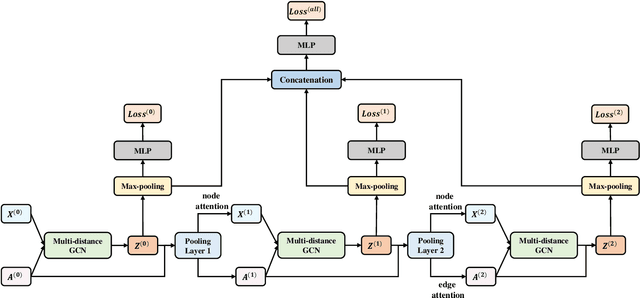
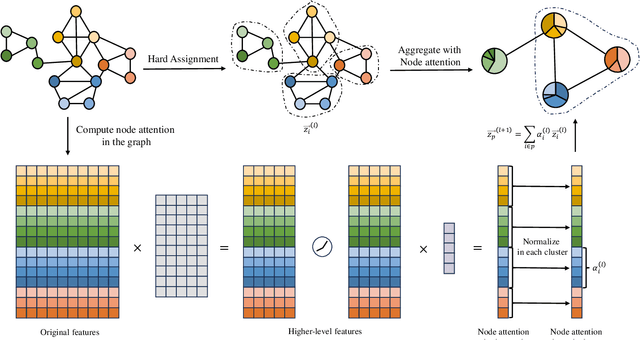
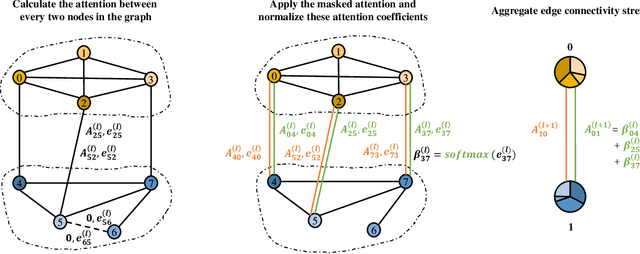
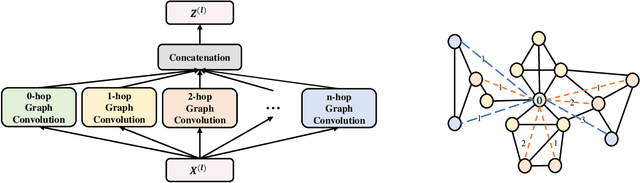
Graph Neural Networks (GNNs) are powerful tools for graph classification. One important operation for GNNs is the downsampling or pooling that can learn effective embeddings from the node representations. In this paper, we propose a new hierarchical pooling operation, namely the Edge-Node Attention-based Differentiable Pooling (ENADPool), for GNNs to learn effective graph representations. Unlike the classical hierarchical pooling operation that is based on the unclear node assignment and simply computes the averaged feature over the nodes of each cluster, the proposed ENADPool not only employs a hard clustering strategy to assign each node into an unique cluster, but also compress the node features as well as their edge connectivity strengths into the resulting hierarchical structure based on the attention mechanism after each pooling step. As a result, the proposed ENADPool simultaneously identifies the importance of different nodes within each separated cluster and edges between corresponding clusters, that significantly addresses the shortcomings of the uniform edge-node based structure information aggregation arising in the classical hierarchical pooling operation. Moreover, to mitigate the over-smoothing problem arising in existing GNNs, we propose a Multi-distance GNN (MD-GNN) model associated with the proposed ENADPool operation, allowing the nodes to actively and directly receive the feature information from neighbors at different random walk steps. Experiments demonstrate the effectiveness of the MD-GNN associated with the proposed ENADPool.