 Add to Chrome
 Add to Firefox
 Add to Edge
GS-STVSR: Ultra-Efficient Continuous Spatio-Temporal Video Super-Resolution via 2D Gaussian Splatting
Apr 20, 2026
Continuous Spatio-Temporal Video Super-Resolution (C-STVSR) aims to simultaneously enhance the spatial resolution and frame rate of videos by arbitrary scale factors, offering greater flexibility than fixed-scale methods that are constrained by predefined upsampling ratios. In recent years, methods based on Implicit Neural Representations (INR) have made significant progress in C-STVSR by learning continuous mappings from spatio-temporal coordinates to pixel values. However, these methods fundamentally rely on dense pixel-wise grid queries, causing computational cost to scale linearly with the number of interpolated frames and severely limiting inference efficiency. We propose GS-STVSR, an ultra-efficient C-STVSR framework based on 2D Gaussian Splatting (2D-GS) that drives the spatiotemporal evolution of Gaussian kernels through continuous motion modeling, bypassing dense grid queries entirely. We exploit the strong temporal stability of covariance parameters for lightweight intermediate fitting, design an optical flow-guided motion module to derive Gaussian position and color at arbitrary time steps, introduce a Covariance resampling alignment module to prevent covariance drift, and propose an adaptive offset window for large-scale motion. Extensive experiments on Vid4, GoPro, and Adobe240 show that GS-STVSR achieves state-of-the-art quality across all benchmarks. Moreover, its inference time remains nearly constant at conventional temporal scales (X2--X8) and delivers over X3 speedup at extreme scales X32, demonstrating strong practical applicability.

A Labeled Ophthalmic Ultrasound Dataset with Medical Report Generation Based on Cross-modal Deep Learning
Jul 26, 2024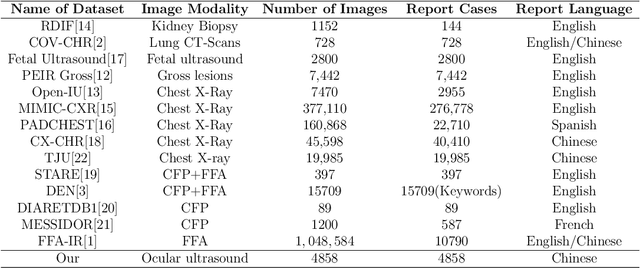
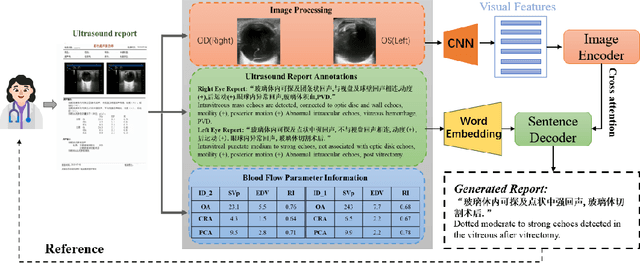
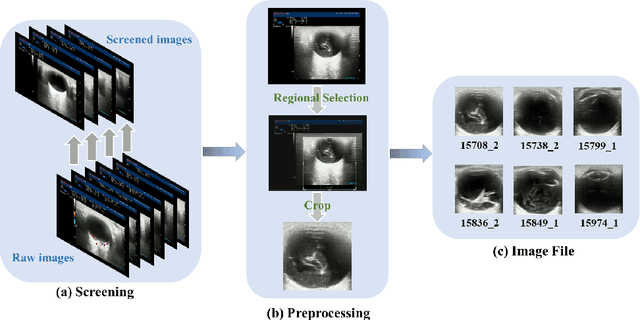
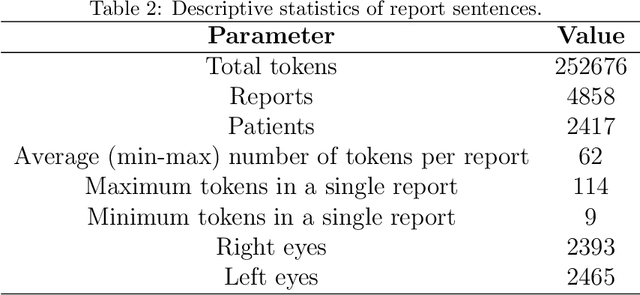
Ultrasound imaging reveals eye morphology and aids in diagnosing and treating eye diseases. However, interpreting diagnostic reports requires specialized physicians. We present a labeled ophthalmic dataset for the precise analysis and the automated exploration of medical images along with their associated reports. It collects three modal data, including the ultrasound images, blood flow information and examination reports from 2,417 patients at an ophthalmology hospital in Shenyang, China, during the year 2018, in which the patient information is de-identified for privacy protection. To the best of our knowledge, it is the only ophthalmic dataset that contains the three modal information simultaneously. It incrementally consists of 4,858 images with the corresponding free-text reports, which describe 15 typical imaging findings of intraocular diseases and the corresponding anatomical locations. Each image shows three kinds of blood flow indices at three specific arteries, i.e., nine parameter values to describe the spectral characteristics of blood flow distribution. The reports were written by ophthalmologists during the clinical care. The proposed dataset is applied to generate medical report based on the cross-modal deep learning model. The experimental results demonstrate that our dataset is suitable for training supervised models concerning cross-modal medical data.