 Add to Chrome
 Add to Firefox
 Add to Edge
MMShopBench: A Real-Log Benchmark for Multimodal, Multi-Turn Shopping Agents
Jul 31, 2026
Online shoppers increasingly turn to AI shopping assistants, using images and multi-turn dialogue to express and refine product needs that are difficult to articulate in text alone. However, existing benchmarks largely rely on text-only or synthetic requests, underrepresenting complex real-world shopping requirements jointly expressed through images and language. We introduce MMShopBench, the first real-log benchmark for multimodal, multi-turn shopping agents. Built from carefully cleaned and manually annotated shopping logs, MMShopBench provides ground-truth annotations of each request's purchase intent and mandatory product requirements. Agents must infer these requirements jointly from user images and multi-turn dialogue, retrieve candidate products through image and text search, and verify that each candidate satisfies all requirements using its product images and structured attributes. We evaluate representative open-source and proprietary models using an evidence-grounded multimodal protocol and construct a companion training set for fine-tuning an open-source model. To ensure reproducible experimentation, we build an offline shopping sandbox, where fine-tuning substantially narrows the performance gap between our open-source model and leading proprietary models, demonstrating the effectiveness of our training data.

SkillChain: Closing the Loop on Skill Evolution for Image-Based E-Commerce AI Assistants
Jun 11, 2026Image-based AI assistants are now deployed at production scale on e-commerce platforms, where a single uploaded image can trigger fundamentally different user intents: product search, style recommendation, visual encyclopedia, or utility tool calls, each demanding its own response format, tool invocation, and domain knowledge. Without per-intent behavioral constraints, LLM-based systems conflate these heterogeneous modes and fall short of domain quality standards, while the breadth and dynamism of the intent space render manual engineering infeasible. To address this, we present SkillChain, which closes the production feedback loop on Skill evolution, automating the lifecycle of Skills through three stages: Skill Creator for bootstrapping from task specs and trajectories, Route Optimizer for routing alignment, and Body Refiner for iterative Skill Body refinement via dual-path LLM-Judge evaluation. Deployed on a production-scale e-commerce image assistant, SkillChain substantially improves aggregate response quality, with the strongest gains on structural compliance and content quality; a one-week online A/B experiment further confirms significant gains in user engagement, content consumption, and long-term retention.
Terahertz Channels in Atmospheric Conditions: Propagation Characteristics and Security Performance
Aug 28, 2024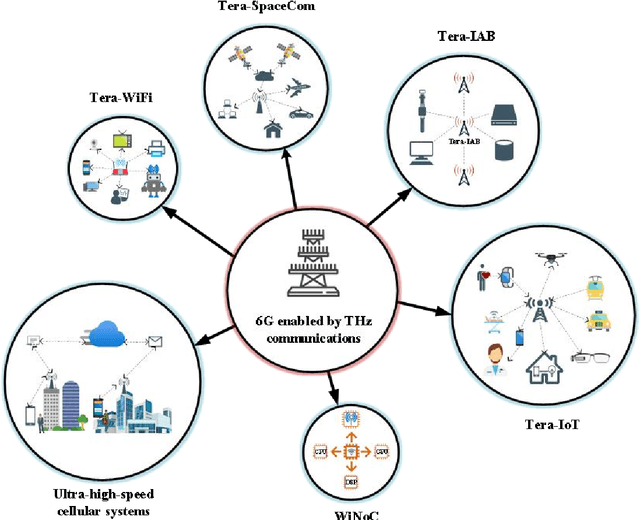
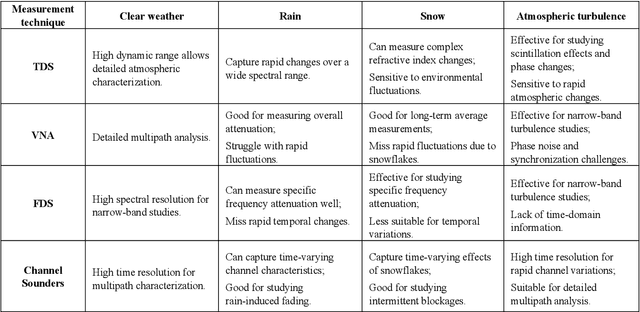
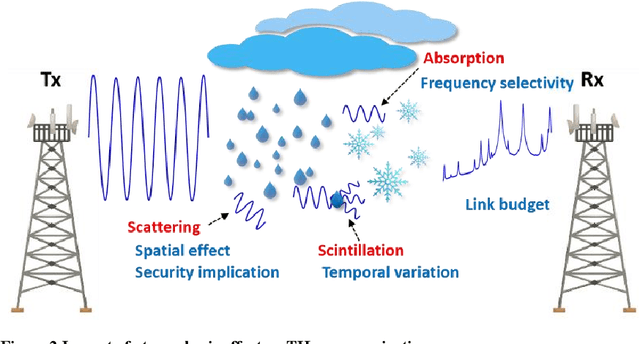
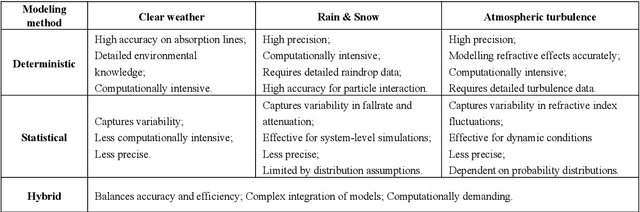
With the growing demand for higher wireless data rates, the interest in extending the carrier frequency of wireless links to the terahertz (THz) range has significantly increased. For long-distance outdoor wireless communications, THz channels may suffer substantial power loss and security issues due to atmospheric weather effects. It is crucial to assess the impact of weather on high-capacity data transmission to evaluate wireless system link budgets and performance accurately. In this article, we provide an insight into the propagation characteristics of THz channels under atmospheric conditions and the security aspects of THz communication systems in future applications. We conduct a comprehensive survey of our recent research and experimental findings on THz channel transmission and physical layer security, synthesizing and categorizing the state-of-the-art research in this domain. Our analysis encompasses various atmospheric phenomena, including molecular absorption, scattering effects, and turbulence, elucidating their intricate interactions with THz waves and the resultant implications for channel modeling and system design. Furthermore, we investigate the unique security challenges posed by THz communications, examining potential vulnerabilities and proposing novel countermeasures to enhance the resilience of these high-frequency systems against eavesdropping and other security threats. Finally, we discuss the challenges and limitations of such high-frequency wireless communications and provide insights into future research prospects for realizing the 6G vision, emphasizing the need for innovative solutions to overcome the atmospheric hurdles and security concerns in THz communications.
Improving Emotional Expression and Cohesion in Image-Based Playlist Description and Music Topics: A Continuous Parameterization Approach
Oct 12, 2023Text generation in image-based platforms, particularly for music-related content, requires precise control over text styles and the incorporation of emotional expression. However, existing approaches often need help to control the proportion of external factors in generated text and rely on discrete inputs, lacking continuous control conditions for desired text generation. This study proposes Continuous Parameterization for Controlled Text Generation (CPCTG) to overcome these limitations. Our approach leverages a Language Model (LM) as a style learner, integrating Semantic Cohesion (SC) and Emotional Expression Proportion (EEP) considerations. By enhancing the reward method and manipulating the CPCTG level, our experiments on playlist description and music topic generation tasks demonstrate significant improvements in ROUGE scores, indicating enhanced relevance and coherence in the generated text.