 Add to Chrome
 Add to Firefox
 Add to Edge
Hackers or Hallucinators? A Comprehensive Analysis of LLM-Based Automated Penetration Testing
Apr 07, 2026
The rapid advancement of Large Language Models (LLMs) has created new opportunities for Automated Penetration Testing (AutoPT), spawning numerous frameworks aimed at achieving end-to-end autonomous attacks. However, despite the proliferation of related studies, existing research generally lacks systematic architectural analysis and large-scale empirical comparisons under a unified benchmark. Therefore, this paper presents the first Systematization of Knowledge (SoK) focusing on the architectural design and comprehensive empirical evaluation of current LLM-based AutoPT frameworks. At systematization level, we comprehensively review existing framework designs across six dimensions: agent architecture, agent plan, agent memory, agent execution, external knowledge, and benchmarks. At empirical level, we conduct large-scale experiments on 13 representative open-source AutoPT frameworks and 2 baseline frameworks utilizing a unified benchmark. The experiments consumed over 10 billion tokens in total and generated more than 1,500 execution logs, which were manually reviewed and analyzed over four months by a panel of more than 15 researchers with expertise in cybersecurity. By investigating the latest progress in this rapidly developing field, we provide researchers with a structured taxonomy to understand existing LLM-based AutoPT frameworks and a large-scale empirical benchmark, along with promising directions for future research.

BezierSeg: Parametric Shape Representation for Fast Object Segmentation in Medical Images
Aug 02, 2021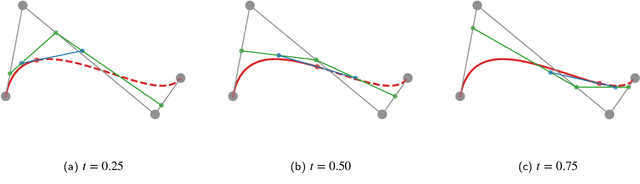
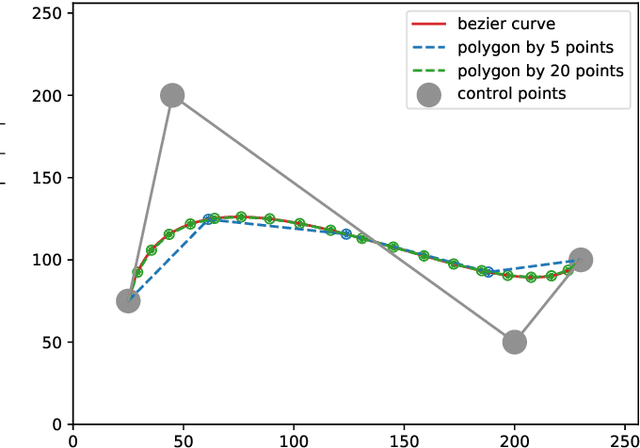
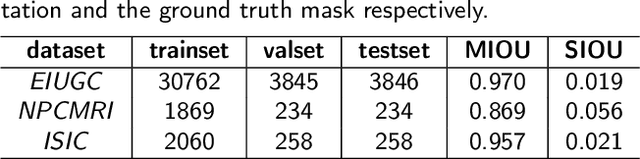
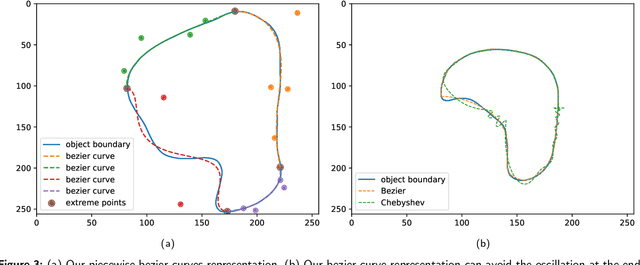
Delineating the lesion area is an important task in image-based diagnosis. Pixel-wise classification is a popular approach to segmenting the region of interest. However, at fuzzy boundaries such methods usually result in glitches, discontinuity, or disconnection, inconsistent with the fact that lesions are solid and smooth. To overcome these undesirable artifacts, we propose the BezierSeg model which outputs bezier curves encompassing the region of interest. Directly modelling the contour with analytic equations ensures that the segmentation is connected, continuous, and the boundary is smooth. In addition, it offers sub-pixel accuracy. Without loss of accuracy, the bezier contour can be resampled and overlaid with images of any resolution. Moreover, a doctor can conveniently adjust the curve's control points to refine the result. Our experiments show that the proposed method runs in real time and achieves accuracy competitive with pixel-wise segmentation models.