 Add to Chrome
 Add to Firefox
 Add to Edge
Hackers or Hallucinators? A Comprehensive Analysis of LLM-Based Automated Penetration Testing
Apr 07, 2026
The rapid advancement of Large Language Models (LLMs) has created new opportunities for Automated Penetration Testing (AutoPT), spawning numerous frameworks aimed at achieving end-to-end autonomous attacks. However, despite the proliferation of related studies, existing research generally lacks systematic architectural analysis and large-scale empirical comparisons under a unified benchmark. Therefore, this paper presents the first Systematization of Knowledge (SoK) focusing on the architectural design and comprehensive empirical evaluation of current LLM-based AutoPT frameworks. At systematization level, we comprehensively review existing framework designs across six dimensions: agent architecture, agent plan, agent memory, agent execution, external knowledge, and benchmarks. At empirical level, we conduct large-scale experiments on 13 representative open-source AutoPT frameworks and 2 baseline frameworks utilizing a unified benchmark. The experiments consumed over 10 billion tokens in total and generated more than 1,500 execution logs, which were manually reviewed and analyzed over four months by a panel of more than 15 researchers with expertise in cybersecurity. By investigating the latest progress in this rapidly developing field, we provide researchers with a structured taxonomy to understand existing LLM-based AutoPT frameworks and a large-scale empirical benchmark, along with promising directions for future research.

From Retrieval to Reasoning: A Framework for Cyber Threat Intelligence NER with Explicit and Adaptive Instructions
Dec 22, 2025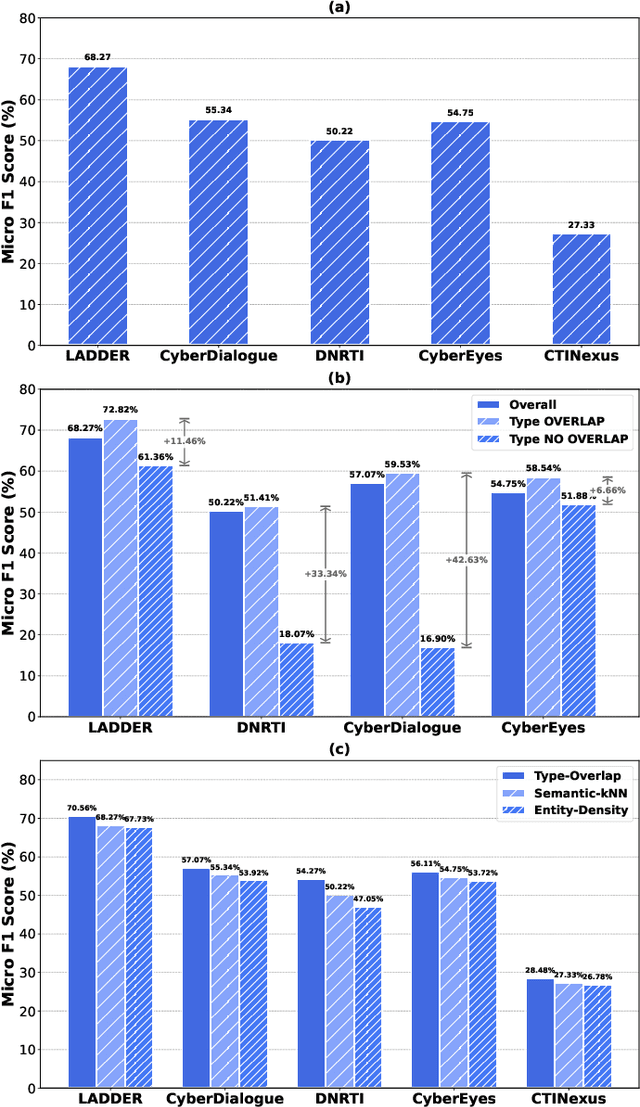
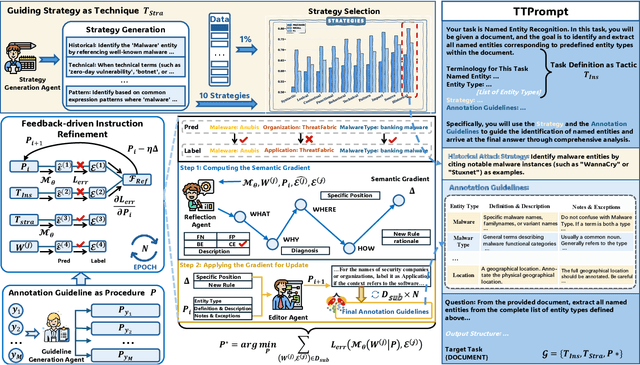
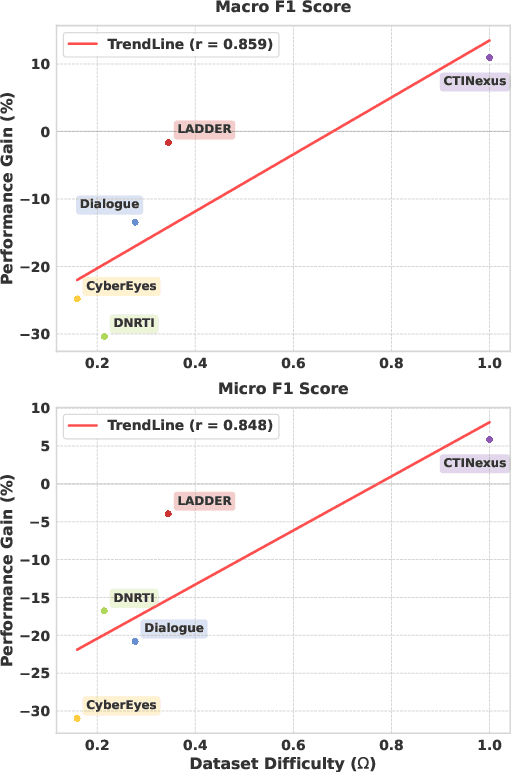
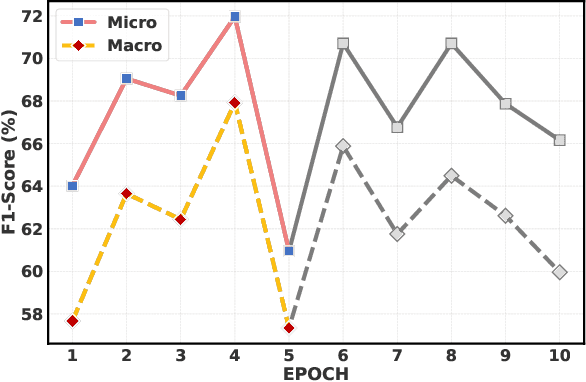
The automation of Cyber Threat Intelligence (CTI) relies heavily on Named Entity Recognition (NER) to extract critical entities from unstructured text. Currently, Large Language Models (LLMs) primarily address this task through retrieval-based In-Context Learning (ICL). This paper analyzes this mainstream paradigm, revealing a fundamental flaw: its success stems not from global semantic similarity but largely from the incidental overlap of entity types within retrieved examples. This exposes the limitations of relying on unreliable implicit induction. To address this, we propose TTPrompt, a framework shifting from implicit induction to explicit instruction. TTPrompt maps the core concepts of CTI's Tactics, Techniques, and Procedures (TTPs) into an instruction hierarchy: formulating task definitions as Tactics, guiding strategies as Techniques, and annotation guidelines as Procedures. Furthermore, to handle the adaptability challenge of static guidelines, we introduce Feedback-driven Instruction Refinement (FIR). FIR enables LLMs to self-refine guidelines by learning from errors on minimal labeled data, adapting to distinct annotation dialects. Experiments on five CTI NER benchmarks demonstrate that TTPrompt consistently surpasses retrieval-based baselines. Notably, with refinement on just 1% of training data, it rivals models fine-tuned on the full dataset. For instance, on LADDER, its Micro F1 of 71.96% approaches the fine-tuned baseline, and on the complex CTINexus, its Macro F1 exceeds the fine-tuned ACLM model by 10.91%.
Enhancing Medical Dialogue Generation through Knowledge Refinement and Dynamic Prompt Adjustment
Jun 12, 2025Medical dialogue systems (MDS) have emerged as crucial online platforms for enabling multi-turn, context-aware conversations with patients. However, existing MDS often struggle to (1) identify relevant medical knowledge and (2) generate personalized, medically accurate responses. To address these challenges, we propose MedRef, a novel MDS that incorporates knowledge refining and dynamic prompt adjustment. First, we employ a knowledge refining mechanism to filter out irrelevant medical data, improving predictions of critical medical entities in responses. Additionally, we design a comprehensive prompt structure that incorporates historical details and evident details. To enable real-time adaptability to diverse patient conditions, we implement two key modules, Triplet Filter and Demo Selector, providing appropriate knowledge and demonstrations equipped in the system prompt. Extensive experiments on MedDG and KaMed benchmarks show that MedRef outperforms state-of-the-art baselines in both generation quality and medical entity accuracy, underscoring its effectiveness and reliability for real-world healthcare applications.
One Small and One Large for Document-level Event Argument Extraction
Nov 08, 2024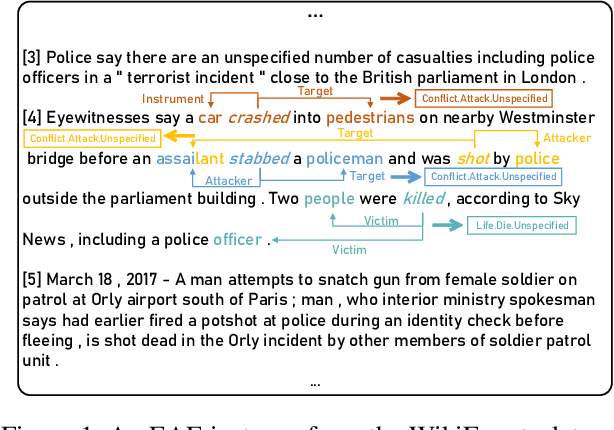
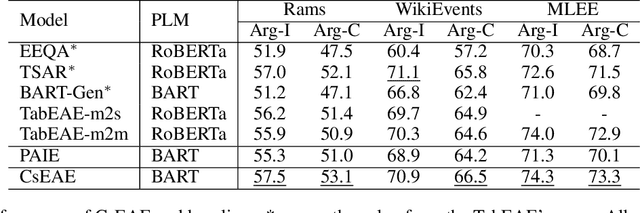


Document-level Event Argument Extraction (EAE) faces two challenges due to increased input length: 1) difficulty in distinguishing semantic boundaries between events, and 2) interference from redundant information. To address these issues, we propose two methods. The first method introduces the Co and Structure Event Argument Extraction model (CsEAE) based on Small Language Models (SLMs). CsEAE includes a co-occurrences-aware module, which integrates information about all events present in the current input through context labeling and co-occurrences event prompts extraction. Additionally, CsEAE includes a structure-aware module that reduces interference from redundant information by establishing structural relationships between the sentence containing the trigger and other sentences in the document. The second method introduces new prompts to transform the extraction task into a generative task suitable for Large Language Models (LLMs), addressing gaps in EAE performance using LLMs under Supervised Fine-Tuning (SFT) conditions. We also fine-tuned multiple datasets to develop an LLM that performs better across most datasets. Finally, we applied insights from CsEAE to LLMs, achieving further performance improvements. This suggests that reliable insights validated on SLMs are also applicable to LLMs. We tested our models on the Rams, WikiEvents, and MLEE datasets. The CsEAE model achieved improvements of 2.1\%, 2.3\%, and 3.2\% in the Arg-C F1 metric compared to the baseline, PAIE~\cite{PAIE}. For LLMs, we demonstrated that their performance on document-level datasets is comparable to that of SLMs~\footnote{All code is available at https://github.com/simon-p-j-r/CsEAE}.
MDF: A Dynamic Fusion Model for Multi-modal Fake News Detection
Jun 28, 2024Fake news detection has received increasing attention from researchers in recent years, especially multi-modal fake news detection containing both text and images. However, many previous works have fed two modal features, text and image, into a binary classifier after a simple concatenation or attention mechanism, in which the features contain a large amount of noise inherent in the data,which in turn leads to intra- and inter-modal uncertainty. In addition, although many methods based on simply splicing two modalities have achieved more prominent results, these methods ignore the drawback of holding fixed weights across modalities, which would lead to some features with higher impact factors being ignored. To alleviate the above problems, we propose a new dynamic fusion framework dubbed MDF for fake news detection. As far as we know, it is the first attempt of dynamic fusion framework in the field of fake news detection. Specifically, our model consists of two main components:(1) UEM as an uncertainty modeling module employing a multi-head attention mechanism to model intra-modal uncertainty; and (2) DFN is a dynamic fusion module based on D-S evidence theory for dynamically fusing the weights of two modalities, text and image. In order to present better results for the dynamic fusion framework, we use GAT for inter-modal uncertainty and weight modeling before DFN. Extensive experiments on two benchmark datasets demonstrate the effectiveness and superior performance of the MDF framework. We also conducted a systematic ablation study to gain insight into our motivation and architectural design. We make our model publicly available to:https://github.com/CoisiniStar/MDF