 Add to Chrome
 Add to Firefox
 Add to Edge
Hackers or Hallucinators? A Comprehensive Analysis of LLM-Based Automated Penetration Testing
Apr 07, 2026
The rapid advancement of Large Language Models (LLMs) has created new opportunities for Automated Penetration Testing (AutoPT), spawning numerous frameworks aimed at achieving end-to-end autonomous attacks. However, despite the proliferation of related studies, existing research generally lacks systematic architectural analysis and large-scale empirical comparisons under a unified benchmark. Therefore, this paper presents the first Systematization of Knowledge (SoK) focusing on the architectural design and comprehensive empirical evaluation of current LLM-based AutoPT frameworks. At systematization level, we comprehensively review existing framework designs across six dimensions: agent architecture, agent plan, agent memory, agent execution, external knowledge, and benchmarks. At empirical level, we conduct large-scale experiments on 13 representative open-source AutoPT frameworks and 2 baseline frameworks utilizing a unified benchmark. The experiments consumed over 10 billion tokens in total and generated more than 1,500 execution logs, which were manually reviewed and analyzed over four months by a panel of more than 15 researchers with expertise in cybersecurity. By investigating the latest progress in this rapidly developing field, we provide researchers with a structured taxonomy to understand existing LLM-based AutoPT frameworks and a large-scale empirical benchmark, along with promising directions for future research.

From Retrieval to Reasoning: A Framework for Cyber Threat Intelligence NER with Explicit and Adaptive Instructions
Dec 22, 2025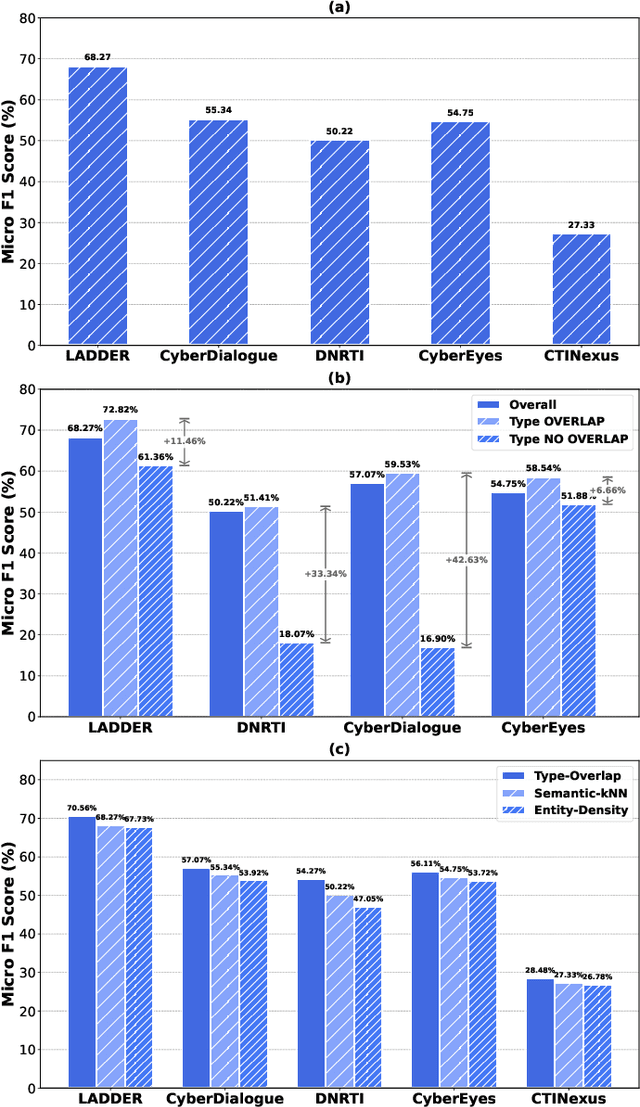
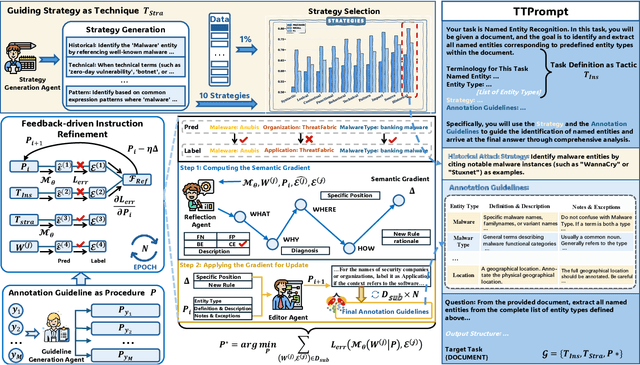
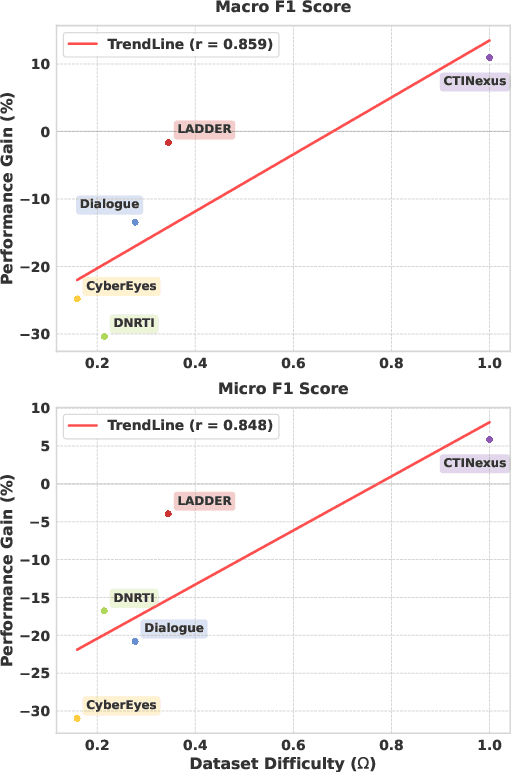
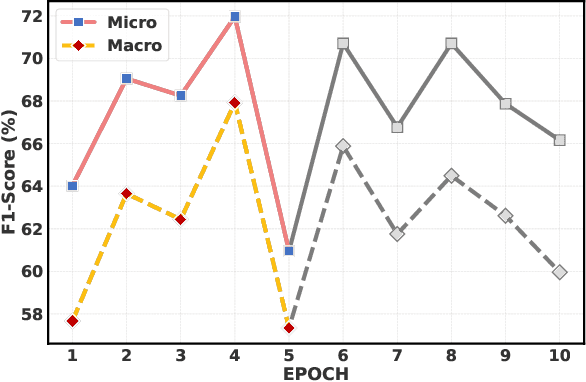
The automation of Cyber Threat Intelligence (CTI) relies heavily on Named Entity Recognition (NER) to extract critical entities from unstructured text. Currently, Large Language Models (LLMs) primarily address this task through retrieval-based In-Context Learning (ICL). This paper analyzes this mainstream paradigm, revealing a fundamental flaw: its success stems not from global semantic similarity but largely from the incidental overlap of entity types within retrieved examples. This exposes the limitations of relying on unreliable implicit induction. To address this, we propose TTPrompt, a framework shifting from implicit induction to explicit instruction. TTPrompt maps the core concepts of CTI's Tactics, Techniques, and Procedures (TTPs) into an instruction hierarchy: formulating task definitions as Tactics, guiding strategies as Techniques, and annotation guidelines as Procedures. Furthermore, to handle the adaptability challenge of static guidelines, we introduce Feedback-driven Instruction Refinement (FIR). FIR enables LLMs to self-refine guidelines by learning from errors on minimal labeled data, adapting to distinct annotation dialects. Experiments on five CTI NER benchmarks demonstrate that TTPrompt consistently surpasses retrieval-based baselines. Notably, with refinement on just 1% of training data, it rivals models fine-tuned on the full dataset. For instance, on LADDER, its Micro F1 of 71.96% approaches the fine-tuned baseline, and on the complex CTINexus, its Macro F1 exceeds the fine-tuned ACLM model by 10.91%.