 Add to Chrome
 Add to Firefox
 Add to Edge
LoRM: Learning the Language of Rotating Machinery for Self-Supervised Condition Monitoring
Apr 07, 2026
We present LoRM (Language of Rotating Machinery), a self-supervised framework for multi-modal rotating-machinery signal understanding and real-time condition monitoring. LoRM is built on the idea that rotating-machinery signals can be viewed as a machine language: local signals can be tokenised into discrete symbolic units, and their future evolution can be predicted from observed multi-sensor context. Unlike conventional signal-processing methods that rely on hand-crafted transforms and features, LoRM reformulates multi-modal sensor data as a token-based sequence-prediction problem. For each data window, the observed context segment is retained in continuous form, while the future target segment of each sensing channel is quantised into a discrete token. Then, efficient knowledge transfer is achieved by partially fine-tuning a general-purpose pre-trained language model on industrial signals, avoiding the need to train a large model from scratch. Finally, condition monitoring is performed by tracking token-prediction errors as a health indicator, where increasing errors indicate degradation. In-situ tool condition monitoring (TCM) experiments demonstrate stable real-time tracking and strong cross-tool generalisation, showing that LoRM provides a practical bridge between language modelling and industrial signal analysis. The source code is publicly available at https://github.com/Q159753258/LormPHM.

On Simplifying Large-Scale Spatial Vectors: Fast, Memory-Efficient, and Cost-Predictable k-means
Dec 03, 2024
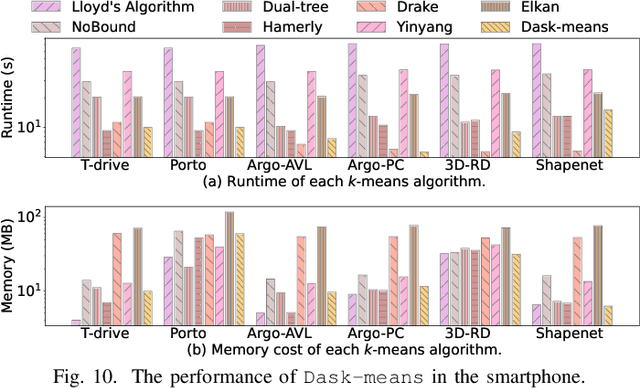


The k-means algorithm can simplify large-scale spatial vectors, such as 2D geo-locations and 3D point clouds, to support fast analytics and learning. However, when processing large-scale datasets, existing k-means algorithms have been developed to achieve high performance with significant computational resources, such as memory and CPU usage time. These algorithms, though effective, are not well-suited for resource-constrained devices. In this paper, we propose a fast, memory-efficient, and cost-predictable k-means called Dask-means. We first accelerate k-means by designing a memory-efficient accelerator, which utilizes an optimized nearest neighbor search over a memory-tunable index to assign spatial vectors to clusters in batches. We then design a lightweight cost estimator to predict the memory cost and runtime of the k-means task, allowing it to request appropriate memory from devices or adjust the accelerator's required space to meet memory constraints, and ensure sufficient CPU time for running k-means. Experiments show that when simplifying datasets with scale such as $10^6$, Dask-means uses less than $30$MB of memory, achieves over $168$ times speedup compared to the widely-used Lloyd's algorithm. We also validate Dask-means on mobile devices, where it demonstrates significant speedup and low memory cost compared to other state-of-the-art (SOTA) k-means algorithms. Our cost estimator estimates the memory cost with a difference of less than $3\%$ from the actual ones and predicts runtime with an MSE up to $33.3\%$ lower than SOTA methods.
SAGE-NDVI: A Stereotype-Breaking Evaluation Metric for Remote Sensing Image Dehazing Using Satellite-to-Ground NDVI Knowledge
Jun 09, 2023Image dehazing is a meaningful low-level computer vision task and can be applied to a variety of contexts. In our industrial deployment scenario based on remote sensing (RS) images, the quality of image dehazing directly affects the grade of our crop identification and growth monitoring products. However, the widely used peak signal-to-noise ratio (PSNR) and structural similarity index (SSIM) provide ambiguous visual interpretation. In this paper, we design a new objective metric for RS image dehazing evaluation. Our proposed metric leverages a ground-based phenology observation resource to calculate the vegetation index error between RS and ground images at a hazy date. Extensive experiments validate that our metric appropriately evaluates different dehazing models and is in line with human visual perception.