 Add to Chrome
 Add to Firefox
 Add to Edge
Approximate Speculative Decoding
Aug 04, 2026
Speculative decoding accelerates autoregressive generation by verifying a draft block with a target model in parallel. Under standard greedy verification, decoding stops at the first draft token that differs from the target argmax, discarding the remaining target-scored suffix. Although accepting such a mismatch changes the decoding trajectory, it can make a contiguous suffix reusable when its tokens remain target-greedy under the realized prefix. In this paper, we introduce \textbf{Approximate Speculative Decoding (ASD)}, a training-free verifier that replaces binary first-mismatch truncation with budgeted longest-prefix selection. ASD accepts selected mismatches subject to a local target-logit regret gate, a per-block exception cap, and a persistent request-level regret budget, then reuses the contiguous target-greedy suffix without additional approximate decisions or target-model forward passes. ASD requires neither a new draft model nor fine-tuning, and exactly reduces to standard greedy verification when the budget is zero. Experiments show that ASD improves fixed-workload throughput by $3.05\%$--$15.26\%$ over matched strict verification and averages a $7.78\%$ gain across seven Qwen3-14B + DSpark-14B tasks. On DeepSeek-V4-Flash (284B) with DSpark it also raises verifier-side acceptance by roughly $10\%$--$16\%$ on GSM8K and MATH-500 in an FP4-to-FP8 compatibility setting. The source code is publicly available at: https://github.com/Kissmetothemoon/ASD

EventDiff: A Unified and Efficient Diffusion Model Framework for Event-based Video Frame Interpolation
May 13, 2025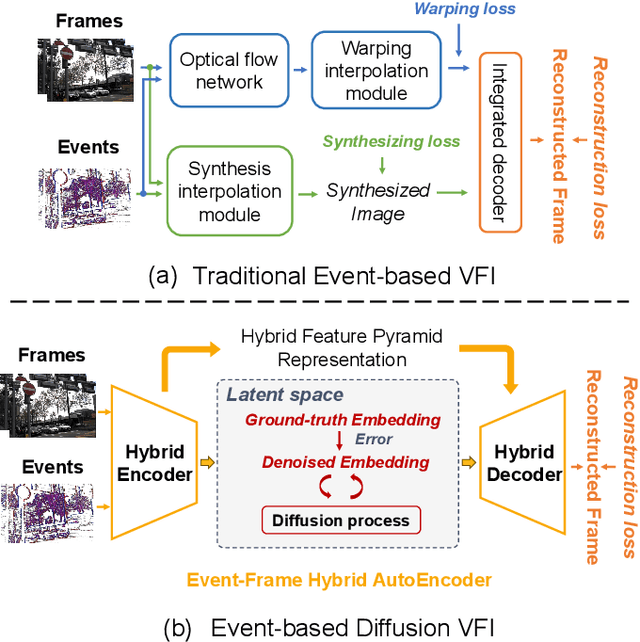
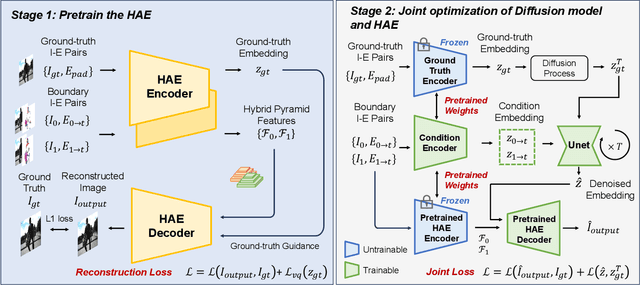
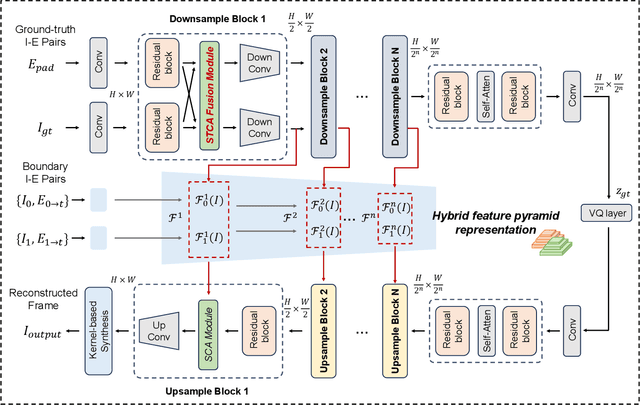
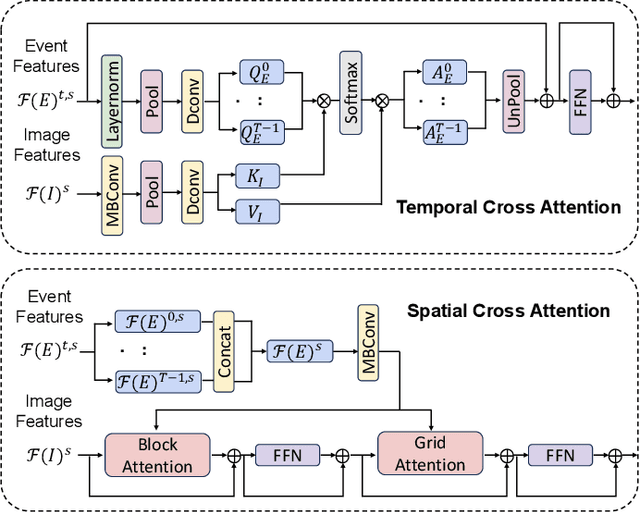
Video Frame Interpolation (VFI) is a fundamental yet challenging task in computer vision, particularly under conditions involving large motion, occlusion, and lighting variation. Recent advancements in event cameras have opened up new opportunities for addressing these challenges. While existing event-based VFI methods have succeeded in recovering large and complex motions by leveraging handcrafted intermediate representations such as optical flow, these designs often compromise high-fidelity image reconstruction under subtle motion scenarios due to their reliance on explicit motion modeling. Meanwhile, diffusion models provide a promising alternative for VFI by reconstructing frames through a denoising process, eliminating the need for explicit motion estimation or warping operations. In this work, we propose EventDiff, a unified and efficient event-based diffusion model framework for VFI. EventDiff features a novel Event-Frame Hybrid AutoEncoder (HAE) equipped with a lightweight Spatial-Temporal Cross Attention (STCA) module that effectively fuses dynamic event streams with static frames. Unlike previous event-based VFI methods, EventDiff performs interpolation directly in the latent space via a denoising diffusion process, making it more robust across diverse and challenging VFI scenarios. Through a two-stage training strategy that first pretrains the HAE and then jointly optimizes it with the diffusion model, our method achieves state-of-the-art performance across multiple synthetic and real-world event VFI datasets. The proposed method outperforms existing state-of-the-art event-based VFI methods by up to 1.98dB in PSNR on Vimeo90K-Triplet and shows superior performance in SNU-FILM tasks with multiple difficulty levels. Compared to the emerging diffusion-based VFI approach, our method achieves up to 5.72dB PSNR gain on Vimeo90K-Triplet and 4.24X faster inference.