 Add to Chrome
 Add to Firefox
 Add to Edge
End-to-End Efficient RL for Linear Bellman Complete MDPs with Deterministic Transitions
Mar 24, 2026
We study reinforcement learning (RL) with linear function approximation in Markov Decision Processes (MDPs) satisfying \emph{linear Bellman completeness} -- a fundamental setting where the Bellman backup of any linear value function remains linear. While statistically tractable, prior computationally efficient algorithms are either limited to small action spaces or require strong oracle assumptions over the feature space. We provide a computationally efficient algorithm for linear Bellman complete MDPs with \emph{deterministic transitions}, stochastic initial states, and stochastic rewards. For finite action spaces, our algorithm is end-to-end efficient; for large or infinite action spaces, we require only a standard argmax oracle over actions. Our algorithm learns an $\varepsilon$-optimal policy with sample and computational complexity polynomial in the horizon, feature dimension, and $1/\varepsilon$.

Decoupling Exploration and Policy Optimization: Uncertainty Guided Tree Search for Hard Exploration
Mar 23, 2026The process of discovery requires active exploration -- the act of collecting new and informative data. However, efficient autonomous exploration remains a major unsolved problem. The dominant paradigm addresses this challenge by using Reinforcement Learning (RL) to train agents with intrinsic motivation, maximizing a composite objective of extrinsic and intrinsic rewards. We suggest that this approach incurs unnecessary overhead: while policy optimization is necessary for precise task execution, employing such machinery solely to expand state coverage may be inefficient. In this paper, we propose a new paradigm that explicitly separates exploration from exploitation and bypasses RL during the exploration phase. Our method uses a tree-search strategy inspired by the Go-With-The-Winner algorithm, paired with a measure of epistemic uncertainty to systematically drive exploration. By removing the overhead of policy optimization, our approach explores an order of magnitude more efficiently than standard intrinsic motivation baselines on hard Atari benchmarks. Further, we demonstrate that the discovered trajectories can be distilled into deployable policies using existing supervised backward learning algorithms, achieving state-of-the-art scores by a wide margin on Montezuma's Revenge, Pitfall!, and Venture without relying on domain-specific knowledge. Finally, we demonstrate the generality of our framework in high-dimensional continuous action spaces by solving the MuJoCo Adroit dexterous manipulation and AntMaze tasks in a sparse-reward setting, directly from image observations and without expert demonstrations or offline datasets. To the best of our knowledge, this has not been achieved before.
Adaptive Matrix Online Learning through Smoothing with Guarantees for Nonsmooth Nonconvex Optimization
Feb 09, 2026We study online linear optimization with matrix variables constrained by the operator norm, a setting where the geometry renders designing data-dependent and efficient adaptive algorithms challenging. The best-known adaptive regret bounds are achieved by Shampoo-like methods, but they require solving a costly quadratic projection subproblem. To address this, we extend the gradient-based prediction scheme to adaptive matrix online learning and cast algorithm design as constructing a family of smoothed potentials for the nuclear norm. We define a notion of admissibility for such smoothings and prove any admissible smoothing yields a regret bound matching the best-known guarantees of one-sided Shampoo. We instantiate this framework with two efficient methods that avoid quadratic projections. The first is an adaptive Follow-the-Perturbed-Leader (FTPL) method using Gaussian stochastic smoothing. The second is Follow-the-Augmented-Matrix-Leader (FAML), which uses a deterministic hyperbolic smoothing in an augmented matrix space. By analyzing the admissibility of these smoothings, we show both methods admit closed-form updates and match one-sided Shampoo's regret up to a constant factor, while significantly reducing computational cost. Lastly, using the online-to-nonconvex conversion, we derive two matrix-based optimizers, Pion (from FTPL) and Leon (from FAML). We prove convergence guarantees for these methods in nonsmooth nonconvex settings, a guarantee that the popular Muon optimizer lacks.
Is a Good Foundation Necessary for Efficient Reinforcement Learning? The Computational Role of the Base Model in Exploration
Mar 10, 2025Language model alignment (or, reinforcement learning) techniques that leverage active exploration -- deliberately encouraging the model to produce diverse, informative responses -- offer the promise of super-human capabilities. However, current understanding of algorithm design primitives for computationally efficient exploration with language models is limited. To better understand how to leverage access to powerful pre-trained generative models to improve the efficiency of exploration, we introduce a new computational framework for RL with language models, in which the learner interacts with the model through a sampling oracle. Focusing on the linear softmax model parameterization, we provide new results that reveal the computational-statistical tradeoffs of efficient exploration: 1. Necessity of coverage: Coverage refers to the extent to which the pre-trained model covers near-optimal responses -- a form of hidden knowledge. We show that coverage, while not necessary for data efficiency, lower bounds the runtime of any algorithm in our framework. 2. Inference-time exploration: We introduce a new algorithm, SpannerSampling, which obtains optimal data efficiency and is computationally efficient whenever the pre-trained model enjoys sufficient coverage, matching our lower bound. SpannerSampling leverages inference-time computation with the pre-trained model to reduce the effective search space for exploration. 3. Insufficiency of training-time interventions: We contrast the result above by showing that training-time interventions that produce proper policies cannot achieve similar guarantees in polynomial time. 4. Computational benefits of multi-turn exploration: Finally, we show that under additional representational assumptions, one can achieve improved runtime (replacing sequence-level coverage with token-level coverage) through multi-turn exploration.
Beating Adversarial Low-Rank MDPs with Unknown Transition and Bandit Feedback
Nov 11, 2024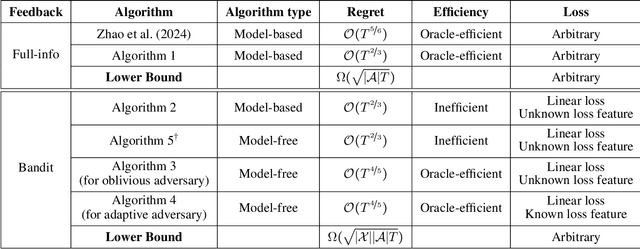
We consider regret minimization in low-rank MDPs with fixed transition and adversarial losses. Previous work has investigated this problem under either full-information loss feedback with unknown transitions (Zhao et al., 2024), or bandit loss feedback with known transition (Foster et al., 2022). First, we improve the $poly(d, A, H)T^{5/6}$ regret bound of Zhao et al. (2024) to $poly(d, A, H)T^{2/3}$ for the full-information unknown transition setting, where d is the rank of the transitions, A is the number of actions, H is the horizon length, and T is the number of episodes. Next, we initiate the study on the setting with bandit loss feedback and unknown transitions. Assuming that the loss has a linear structure, we propose both model based and model free algorithms achieving $poly(d, A, H)T^{2/3}$ regret, though they are computationally inefficient. We also propose oracle-efficient model-free algorithms with $poly(d, A, H)T^{4/5}$ regret. We show that the linear structure is necessary for the bandit case without structure on the reward function, the regret has to scale polynomially with the number of states. This is contrary to the full-information case (Zhao et al., 2024), where the regret can be independent of the number of states even for unstructured reward function.
Reinforcement Learning under Latent Dynamics: Toward Statistical and Algorithmic Modularity
Oct 23, 2024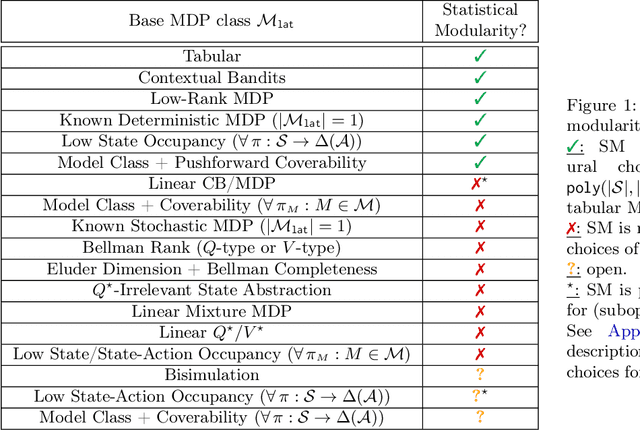
Real-world applications of reinforcement learning often involve environments where agents operate on complex, high-dimensional observations, but the underlying (''latent'') dynamics are comparatively simple. However, outside of restrictive settings such as small latent spaces, the fundamental statistical requirements and algorithmic principles for reinforcement learning under latent dynamics are poorly understood. This paper addresses the question of reinforcement learning under $\textit{general}$ latent dynamics from a statistical and algorithmic perspective. On the statistical side, our main negative result shows that most well-studied settings for reinforcement learning with function approximation become intractable when composed with rich observations; we complement this with a positive result, identifying latent pushforward coverability as a general condition that enables statistical tractability. Algorithmically, we develop provably efficient observable-to-latent reductions -- that is, reductions that transform an arbitrary algorithm for the latent MDP into an algorithm that can operate on rich observations -- in two settings: one where the agent has access to hindsight observations of the latent dynamics [LADZ23], and one where the agent can estimate self-predictive latent models [SAGHCB20]. Together, our results serve as a first step toward a unified statistical and algorithmic theory for reinforcement learning under latent dynamics.
Online Convex Optimization with a Separation Oracle
Oct 03, 2024
In this paper, we introduce a new projection-free algorithm for Online Convex Optimization (OCO) with a state-of-the-art regret guarantee among separation-based algorithms. Existing projection-free methods based on the classical Frank-Wolfe algorithm achieve a suboptimal regret bound of $O(T^{3/4})$, while more recent separation-based approaches guarantee a regret bound of $O(\kappa \sqrt{T})$, where $\kappa$ denotes the asphericity of the feasible set, defined as the ratio of the radii of the containing and contained balls. However, for ill-conditioned sets, $\kappa$ can be arbitrarily large, potentially leading to poor performance. Our algorithm achieves a regret bound of $\tilde{O}(\sqrt{dT} + \kappa d)$, while requiring only $\tilde{O}(1)$ calls to a separation oracle per round. Crucially, the main term in the bound, $\tilde{O}(\sqrt{d T})$, is independent of $\kappa$, addressing the limitations of previous methods. Additionally, as a by-product of our analysis, we recover the $O(\kappa \sqrt{T})$ regret bound of existing OCO algorithms with a more straightforward analysis and improve the regret bound for projection-free online exp-concave optimization. Finally, for constrained stochastic convex optimization, we achieve a state-of-the-art convergence rate of $\tilde{O}(\sigma/\sqrt{T} + \kappa d/T)$, where $\sigma$ represents the noise in the stochastic gradients, while requiring only $\tilde{O}(1)$ calls to a separation oracle per iteration.
Improved Sample Complexity of Imitation Learning for Barrier Model Predictive Control
Oct 01, 2024
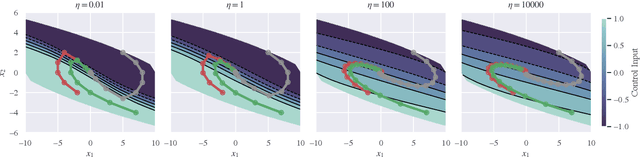

Recent work in imitation learning has shown that having an expert controller that is both suitably smooth and stable enables stronger guarantees on the performance of the learned controller. However, constructing such smoothed expert controllers for arbitrary systems remains challenging, especially in the presence of input and state constraints. As our primary contribution, we show how such a smoothed expert can be designed for a general class of systems using a log-barrier-based relaxation of a standard Model Predictive Control (MPC) optimization problem. Improving upon our previous work, we show that barrier MPC achieves theoretically optimal error-to-smoothness tradeoff along some direction. At the core of this theoretical guarantee on smoothness is an improved lower bound we prove on the optimality gap of the analytic center associated with a convex Lipschitz function, which we believe could be of independent interest. We validate our theoretical findings via experiments, demonstrating the merits of our smoothing approach over randomized smoothing.
Sample- and Oracle-Efficient Reinforcement Learning for MDPs with Linearly-Realizable Value Functions
Sep 07, 2024Designing sample-efficient and computationally feasible reinforcement learning (RL) algorithms is particularly challenging in environments with large or infinite state and action spaces. In this paper, we advance this effort by presenting an efficient algorithm for Markov Decision Processes (MDPs) where the state-action value function of any policy is linear in a given feature map. This challenging setting can model environments with infinite states and actions, strictly generalizes classic linear MDPs, and currently lacks a computationally efficient algorithm under online access to the MDP. Specifically, we introduce a new RL algorithm that efficiently finds a near-optimal policy in this setting, using a number of episodes and calls to a cost-sensitive classification (CSC) oracle that are both polynomial in the problem parameters. Notably, our CSC oracle can be efficiently implemented when the feature dimension is constant, representing a clear improvement over state-of-the-art methods, which require solving non-convex problems with horizon-many variables and can incur computational costs that are \emph{exponential} in the horizon.
Fully Unconstrained Online Learning
May 30, 2024We provide an online learning algorithm that obtains regret $G\|w_\star\|\sqrt{T\log(\|w_\star\|G\sqrt{T})} + \|w_\star\|^2 + G^2$ on $G$-Lipschitz convex losses for any comparison point $w_\star$ without knowing either $G$ or $\|w_\star\|$. Importantly, this matches the optimal bound $G\|w_\star\|\sqrt{T}$ available with such knowledge (up to logarithmic factors), unless either $\|w_\star\|$ or $G$ is so large that even $G\|w_\star\|\sqrt{T}$ is roughly linear in $T$. Thus, it matches the optimal bound in all cases in which one can achieve sublinear regret, which arguably most "interesting" scenarios.