 Add to Chrome
 Add to Firefox
 Add to Edge
Non-Asymptotic Convergence of Stochastic Iterative Algorithms: A Lyapunov Framework
May 29, 2026
We survey Lyapunov-based techniques for the finite-time analysis of stochastic iterative algorithms, also known as stochastic approximation (SA) algorithms, for solving fixed-point equations $\bar{F}(x)=x$, where the operator $\bar{F}(\cdot)$ can only be accessed through a noisy oracle. We first focus on the standard setting in which $\bar{F}(\cdot)$ is contractive with respect to some norm and the noise is i.i.d., and explain how generalized Moreau envelopes serve as universal Lyapunov functions, regardless of the underlying norm. We then show how this framework yields mean-square convergence guarantees and applies to stochastic gradient descent, linear SA, and value-based reinforcement learning algorithms such as Q-learning and temporal-difference learning. Finally, we discuss extensions to Markovian noise, seminorm-contractive operators, dissipative operators, and high-probability bounds, and conclude with open problems. The goal is to present a unified and self-contained roadmap for the finite-time analysis of SA and its applications, especially in reinforcement learning.

Achieving $ε^{-2}$ Sample Complexity for Single-Loop Actor-Critic under Minimal Assumptions
May 13, 2026In this paper, we establish last-iterate convergence rates for off-policy actor--critic methods in reinforcement learning. In particular, under a single-loop, single-timescale implementation and a broad class of policy updates, including approximate policy iteration and natural policy gradient methods, we prove the first $\tilde{\mathcal{O}}(ε^{-2})$ sample complexity guarantee for finding an $ε$-optimal policy under minimal assumptions, namely, the existence of a policy that induces an irreducible Markov chain. This stands in stark contrast to the existing literature, where an $\tilde{\mathcal{O}}(ε^{-2})$ sample complexity is achieved only through nested-loop updates and/or under strong, algorithm-dependent assumptions on the policies, such as uniform mixing and uniform exploration. Technically, to address the challenges posed by the coupled update equations arising from the single-loop implementation, as well as the potentially unbounded iterates induced by off-policy learning, our analysis is based on a coupled Lyapunov drift framework. Specifically, we establish a geometric convergence rate for the actor and an $\tilde{\mathcal{O}}(1/T)$ convergence rate for the critic, and combine the two Lyapunov drift inequalities through a cross-domination property. We believe this analytical framework is of independent interest and may be applicable to other coupled iterative algorithms with unbounded
Natural Policy Gradient as Doubly Smoothed Policy Iteration: A Bellman-Operator Framework
May 11, 2026In this work, we show that natural policy gradient, a core algorithm in reinforcement learning, admits an exact formulation as a smoothed and averaged form of policy iteration. Specifically, we introduce doubly smoothed policy iteration (DSPI), a Bellman-operator framework in which each policy is obtained by applying a regularized greedy step to a weighted average of past $Q$-functions. DSPI includes policy iteration, dual-averaged policy iteration, natural policy gradient, and more general policy dual averaging methods as special cases. Using only monotonicity and contraction of smoothed Bellman operators, we prove distribution-free global geometric convergence of DSPI. Consequently, standard natural policy gradient and policy dual averaging achieve an iteration complexity of $\mathcal{O}((1-γ)^{-1}\log((1-γ)^{-1}ε^{-1}))$ for computing an $ε$-optimal policy, without modifying the MDP, adding regularization beyond the mirror map inherent in the update, or using adaptive, trajectory-dependent stepsizes. For the unregularized greedy case, corresponding to dual-averaged policy iteration, we also prove finite termination. The same Bellman-operator framework further extends to discounted MDPs with linear function approximation and stochastic shortest path problems.
Bridging the Gap Between Average and Discounted TD Learning
May 03, 2026The analysis of Temporal Difference (TD) learning in the average-reward setting faces notable theoretical difficulties because the Bellman operator is not contractive with respect to any norm. This complicates standard analyses of stochastic updates that are effective in discounted settings. Although a considerable body of literature addresses these challenges, existing theoretical approaches come with limitations. We introduce a novel algorithm designed explicitly for policy evaluation in the average-reward setting, utilizing sampling from two Markovian trajectories. Our proposed method overcomes previous limitations by guaranteeing convergence to the unique solution of a properly defined projected Bellman equation. Notably, and in contrast to earlier work, our convergence analysis is uniformly applicable to both linear function approximation and tabular settings and does not involve explicit dimension-dependent terms in its convergence bounds. These results align with what is known to hold in the discounted setting. Furthermore, our algorithm achieves improved dependence on the problem's condition number, reducing the sample complexity from quartic, as in prior literature, to quadratic scaling, and thus matching the efficiency seen in the discounted setting.
Natural Hypergradient Descent: Algorithm Design, Convergence Analysis, and Parallel Implementation
Feb 11, 2026In this work, we propose Natural Hypergradient Descent (NHGD), a new method for solving bilevel optimization problems. To address the computational bottleneck in hypergradient estimation--namely, the need to compute or approximate Hessian inverse--we exploit the statistical structure of the inner optimization problem and use the empirical Fisher information matrix as an asymptotically consistent surrogate for the Hessian. This design enables a parallel optimize-and-approximate framework in which the Hessian-inverse approximation is updated synchronously with the stochastic inner optimization, reusing gradient information at negligible additional cost. Our main theoretical contribution establishes high-probability error bounds and sample complexity guarantees for NHGD that match those of state-of-the-art optimize-then-approximate methods, while significantly reducing computational time overhead. Empirical evaluations on representative bilevel learning tasks further demonstrate the practical advantages of NHGD, highlighting its scalability and effectiveness in large-scale machine learning settings.
Achieving $\varepsilon^{-2}$ Dependence for Average-Reward Q-Learning with a New Contraction Principle
Jan 29, 2026We present the convergence rates of synchronous and asynchronous Q-learning for average-reward Markov decision processes, where the absence of contraction poses a fundamental challenge. Existing non-asymptotic results overcome this challenge by either imposing strong assumptions to enforce seminorm contraction or relying on discounted or episodic Markov decision processes as successive approximations, which either require unknown parameters or result in suboptimal sample complexity. In this work, under a reachability assumption, we establish optimal $\widetilde{O}(\varepsilon^{-2})$ sample complexity guarantees (up to logarithmic factors) for a simple variant of synchronous and asynchronous Q-learning that samples from the lazified dynamics, where the system remains in the current state with some fixed probability. At the core of our analysis is the construction of an instance-dependent seminorm and showing that, after a lazy transformation of the Markov decision process, the Bellman operator becomes one-step contractive under this seminorm.
Non-Asymptotic Guarantees for Average-Reward Q-Learning with Adaptive Stepsizes
Apr 25, 2025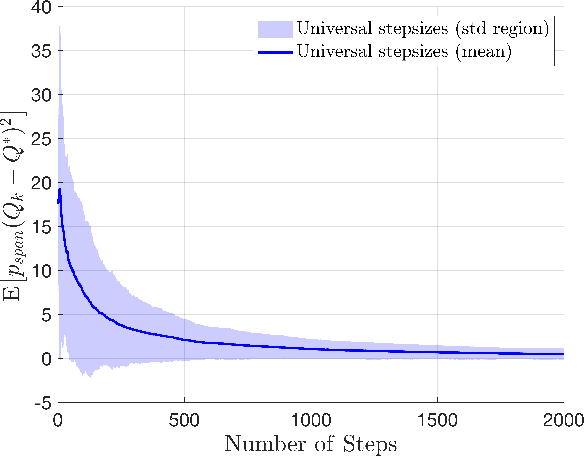
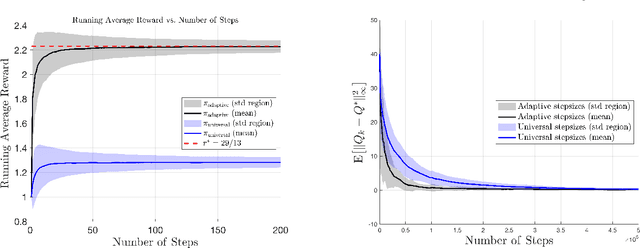
This work presents the first finite-time analysis for the last-iterate convergence of average-reward Q-learning with an asynchronous implementation. A key feature of the algorithm we study is the use of adaptive stepsizes, which serve as local clocks for each state-action pair. We show that the iterates generated by this Q-learning algorithm converge at a rate of $O(1/k)$ (in the mean-square sense) to the optimal relative Q-function in the span seminorm. Moreover, by adding a centering step to the algorithm, we further establish pointwise mean-square convergence to a centered optimal relative Q-function, also at a rate of $O(1/k)$. To prove these results, we show that adaptive stepsizes are necessary, as without them, the algorithm fails to converge to the correct target. In addition, adaptive stepsizes can be interpreted as a form of implicit importance sampling that counteracts the effects of asynchronous updates. Technically, the use of adaptive stepsizes makes each Q-learning update depend on the entire sample history, introducing strong correlations and making the algorithm a non-Markovian stochastic approximation (SA) scheme. Our approach to overcoming this challenge involves (1) a time-inhomogeneous Markovian reformulation of non-Markovian SA, and (2) a combination of almost-sure time-varying bounds, conditioning arguments, and Markov chain concentration inequalities to break the strong correlations between the adaptive stepsizes and the iterates. The tools developed in this work are likely to be broadly applicable to the analysis of general SA algorithms with adaptive stepsizes.
A Non-Asymptotic Theory of Seminorm Lyapunov Stability: From Deterministic to Stochastic Iterative Algorithms
Feb 20, 2025We study the problem of solving fixed-point equations for seminorm-contractive operators and establish foundational results on the non-asymptotic behavior of iterative algorithms in both deterministic and stochastic settings. Specifically, in the deterministic setting, we prove a fixed-point theorem for seminorm-contractive operators, showing that iterates converge geometrically to the kernel of the seminorm. In the stochastic setting, we analyze the corresponding stochastic approximation (SA) algorithm under seminorm-contractive operators and Markovian noise, providing a finite-sample analysis for various stepsize choices. A benchmark for equation solving is linear systems of equations, where the convergence behavior of fixed-point iteration is closely tied to the stability of linear dynamical systems. In this special case, our results provide a complete characterization of system stability with respect to a seminorm, linking it to the solution of a Lyapunov equation in terms of positive semi-definite matrices. In the stochastic setting, we establish a finite-sample analysis for linear Markovian SA without requiring the Hurwitzness assumption. Our theoretical results offer a unified framework for deriving finite-sample bounds for various reinforcement learning algorithms in the average reward setting, including TD($\lambda$) for policy evaluation (which is a special case of solving a Poisson equation) and Q-learning for control.
Last-Iterate Convergence of Payoff-Based Independent Learning in Zero-Sum Stochastic Games
Sep 02, 2024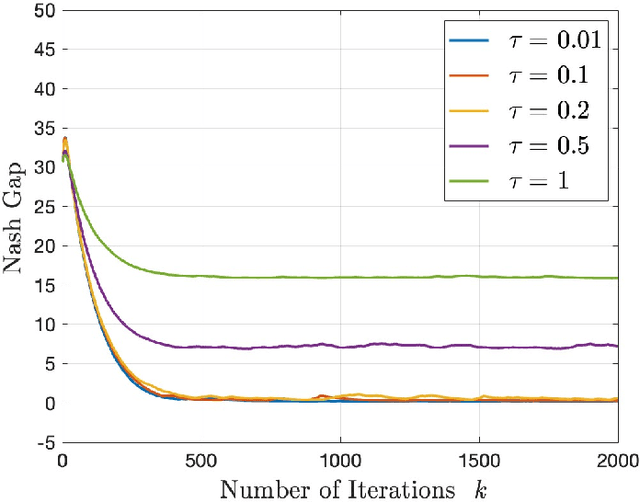
In this paper, we consider two-player zero-sum matrix and stochastic games and develop learning dynamics that are payoff-based, convergent, rational, and symmetric between the two players. Specifically, the learning dynamics for matrix games are based on the smoothed best-response dynamics, while the learning dynamics for stochastic games build upon those for matrix games, with additional incorporation of the minimax value iteration. To our knowledge, our theoretical results present the first finite-sample analysis of such learning dynamics with last-iterate guarantees. In the matrix game setting, the results imply a sample complexity of $O(\epsilon^{-1})$ to find the Nash distribution and a sample complexity of $O(\epsilon^{-8})$ to find a Nash equilibrium. In the stochastic game setting, the results also imply a sample complexity of $O(\epsilon^{-8})$ to find a Nash equilibrium. To establish these results, the main challenge is to handle stochastic approximation algorithms with multiple sets of coupled and stochastic iterates that evolve on (possibly) different time scales. To overcome this challenge, we developed a coupled Lyapunov-based approach, which may be of independent interest to the broader community studying the convergence behavior of stochastic approximation algorithms.
Approximate Global Convergence of Independent Learning in Multi-Agent Systems
May 30, 2024Independent learning (IL), despite being a popular approach in practice to achieve scalability in large-scale multi-agent systems, usually lacks global convergence guarantees. In this paper, we study two representative algorithms, independent $Q$-learning and independent natural actor-critic, within value-based and policy-based frameworks, and provide the first finite-sample analysis for approximate global convergence. The results imply a sample complexity of $\tilde{\mathcal{O}}(\epsilon^{-2})$ up to an error term that captures the dependence among agents and characterizes the fundamental limit of IL in achieving global convergence. To establish the result, we develop a novel approach for analyzing IL by constructing a separable Markov decision process (MDP) for convergence analysis and then bounding the gap due to model difference between the separable MDP and the original one. Moreover, we conduct numerical experiments using a synthetic MDP and an electric vehicle charging example to verify our theoretical findings and to demonstrate the practical applicability of IL.