 Add to Chrome
 Add to Firefox
 Add to Edge
Cell-Free Massive MIMO for Joint Communication and Proactive Monitoring
Apr 05, 2026
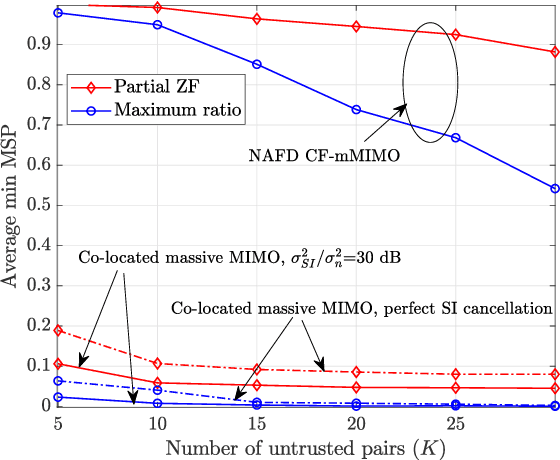
This paper introduces a novel joint communication and proactive monitoring (JCAM) system that simultaneously monitors multiple untrusted links and serves multiple legitimate users. The system leverages a cell-free massive multiple-input multiple-output (CF-mMIMO) architecture, where one subset of access points (APs) is dedicated to receiving signals from untrusted links, while another subset transmits data to legitimate users and jamming signals into the untrusted links. This dual functionality not only ensures reliable communication for legitimate users but also degrades the performance of untrusted links, thereby enhancing monitoring effectiveness. Closed-form expressions for the spectral efficiency (SE) of legitimate users and the monitoring success probability (MSP) are derived under partial zero-forcing (PZF) precoding/combining schemes with imperfect channel state information. Leveraging these expressions, we develop a simple yet effective AP mode assignment strategy that determines which APs perform downlink transmission and jamming, and which APs are dedicated to receiving signals from untrusted links. The objective is to maximize the MSP while satisfying predefined quality-of-service (QoS) requirements for all legitimate users. Numerical results show that the proposed mode assignment strategy significantly outperforms the benchmark, achieving up to a $32\%$ improvement in monitoring performance, while maintaining low computational complexity. Moreover, our proposed JCAM framework provides nearly a six-fold improvement in the minimum MSP over the co-located massive MIMO baseline.

Anti-Malicious ISAC: How to Jointly Monitor and Disrupt Your Foes?
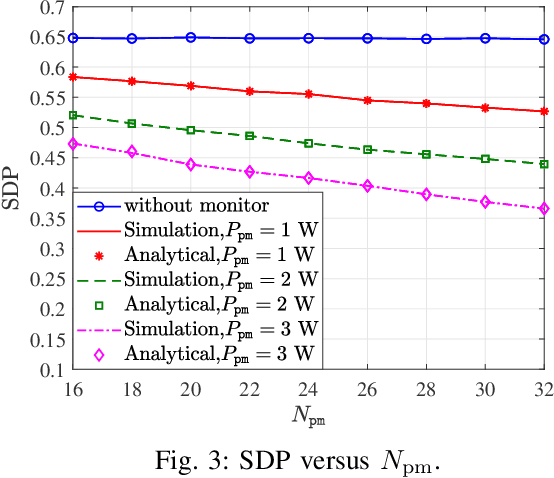
Dec 22, 2025Integrated sensing and communication (ISAC) systems are key enablers of future networks but raise significant security concerns. In this realm, the emergence of malicious ISAC systems has amplified the need for authorized parties to legitimately monitor suspicious communication links and protect legitimate targets from potential detection or exploitation by malicious foes. In this paper, we propose a new wireless proactive monitoring paradigm, where a legitimate monitor intercepts a suspicious communication link while performing cognitive jamming to enhance the monitoring success probability (MSP) and simultaneously safeguard the target. To this end, we derive closed-form expressions of the signal-to-interference-plus-noise-ratio (SINR) at the user (UE), sensing access points (S-APs), and an approximating expression of the SINR at the proactive monitor. Moreover, we propose an optimization technique under which the legitimate monitor minimizes the success detection probability (SDP) of the legitimate target, by optimizing the jamming power allocation over both communication and sensing channels subject to total power constraints and monitoring performance requirement. To enhance the monitor's longevity and reduce the risk of detection by malicious ISAC systems, we further propose an adaptive power allocation scheme aimed at minimizing the total transmit power at the monitor while meeting a pre-selected sensing SINR threshold and ensuring successful monitoring. Our numerical results show that the proposed algorithm significantly compromises the sensing and communication performance of malicious ISAC.
Robust Energy-Efficient Sleep-Mode Strategy for Multi-RIS-Aided Cell-Free Massive MIMO
Dec 13, 2025With the explosive growth of data traffic and the ubiquitous connectivity of wireless devices, the energy demands of wireless networks have inevitably escalated. Reconfigurable intelligent surface (RIS) has emerged as a promising solution for 6G networks due to its energy efficiency (EE) and low cost, while cell-free massive multiple-input multiple-output (CF-mMIMO) was proposed as an innovative network architecture without fixed cell boundaries to enhance these measures even further. However, existing studies often assume consistently high traffic loads, neglecting the dynamic nature of user demand. This can result in underutilized access points (APs) and unnecessary energy expenditure during low-demand periods. To tackle the challenge of EE in CF-mMIMO systems during low load periods, this paper proposes a novel energy-efficient transmission scheme that jointly coordinates active APs and multiple passive RISs. Specifically, a dynamic AP sleep-mode strategy is designed, where certain APs are selectively deactivated while nearby RISs assist in maintaining coverage. We formulate the EE maximization objective as a fractional programming problem and adopt the Dinkelbach method in conjunction with alternating optimization (AO) to iteratively solve the three coupled subproblems: (i) AP selection via a hybrid branch-and-bound (BnB) and greedy algorithm, (ii) transmit power optimization using a sequential convex approximation (SCA) method, initialized by a heuristic zero-forcing strategy, and (iii) RIS phase shift optimization using gradient projection. Simulation results show that the proposed scheme achieves significantly higher EE than existing methods in both low and moderate user scenarios.
Cell-Free Massive MIMO-Based Physical-Layer Authentication
Aug 27, 2025In this paper, we exploit the cell-free massive multiple-input multiple-output (CF-mMIMO) architecture to design a physical-layer authentication (PLA) framework that can simultaneously authenticate multiple distributed users across the coverage area. Our proposed scheme remains effective even in the presence of active adversaries attempting impersonation attacks to disrupt the authentication process. Specifically, we introduce a tag-based PLA CFmMIMO system, wherein the access points (APs) first estimate their channels with the legitimate users during an uplink training phase. Subsequently, a unique secret key is generated and securely shared between each user and the APs. We then formulate a hypothesis testing problem and derive a closed-form expression for the probability of detection for each user in the network. Numerical results validate the effectiveness of the proposed approach, demonstrating that it maintains a high detection probability even as the number of users in the system increases.
Fronthaul-Aware User-Centric Generalized Cell-Free Massive MIMO Systems
Jun 17, 2025We consider fronthaul-limited generalized zeroforcing-based cell-free massive multiple-input multiple-output (CF-mMIMO) systems with multiple-antenna users and multipleantenna access points (APs) relying on both cooperative beamforming (CB) and user-centric (UC) clustering. The proposed framework is very general and can be degenerated into different special cases, such as pure CB/pure UC clustering, or fully centralized CB/fully distributed beamforming. We comprehensively analyze the spectral efficiency (SE) performance of the system wherein the users use the minimum mean-squared errorbased successive interference cancellation (MMSE-SIC) scheme to detect the desired signals. Specifically, we formulate an optimization problem for the user association and power control for maximizing the sum SE. The formulated problem is under per-AP transmit power and fronthaul constraints, and is based on only long-term channel state information (CSI). The challenging formulated problem is transformed into tractable form and a novel algorithm is proposed to solve it using minorization maximization (MM) technique. We analyze the trade-offs provided by the CF-mMIMO system with different number of CB clusters, hence highlighting the importance of the appropriate choice of CB design for different system setups. Numerical results show that for the centralized CB, the proposed power optimization provides nearly 59% improvement in the average sum SE over the heuristic approach, and 312% improvement, when the distributed beamforming is employed.
Cell-Free Massive MIMO-Assisted SWIPT for IoT Networks
May 05, 2025This paper studies cell-free massive multiple-input multiple-output (CF-mMIMO) systems that underpin simultaneous wireless information and power transfer (SWIPT) for separate information users (IUs) and energy users (EUs) in Internet of Things (IoT) networks. We propose a joint access point (AP) operation mode selection and power control design, wherein certain APs are designated for energy transmission to EUs, while others are dedicated to information transmission to IUs. The performance of the system, from both a spectral efficiency (SE) and energy efficiency (EE) perspective, is comprehensively analyzed. Specifically, we formulate two mixed-integer nonconvex optimization problems for maximizing the average sum-SE and EE, under realistic power consumption models and constraints on the minimum individual SE requirements for individual IUs, minimum HE for individual EUs, and maximum transmit power at each AP. The challenging optimization problems are solved using successive convex approximation (SCA) techniques. The proposed framework design is further applied to the average sum-HE maximization and energy harvesting fairness problems. Our numerical results demonstrate that the proposed joint AP operation mode selection and power control algorithm can achieve EE performance gains of up to $4$-fold and $5$-fold over random AP operation mode selection, with and without power control respectively.
Anti-Malicious ISAC Using Proactive Monitoring
Oct 06, 2024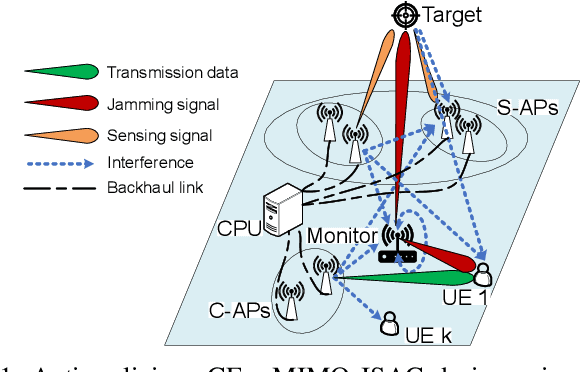

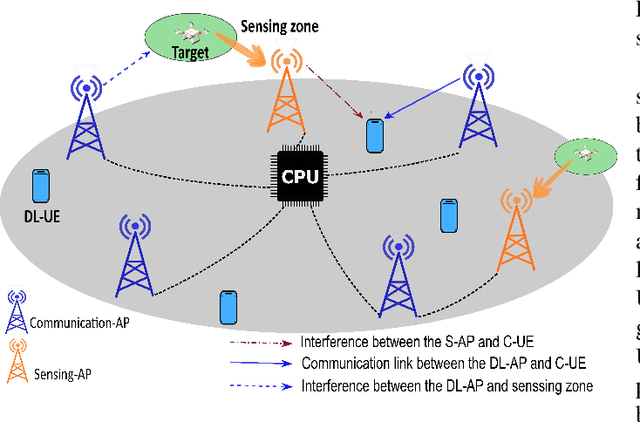
In this paper, we investigate proactive monitoring to mitigate malicious activities in integrated sensing and communication (ISAC) systems. Our focus is on a scenario where a cell-free massive multiple-input multiple-output (CF-mMIMO) architecture is exploited by malicious actors. Malicious actors use multiple access points (APs) to illegally sense a legitimate target while communicating with users (UEs), one of which is suspected of illegal activities. In our approach, a proactive monitor overhears the suspicious UE and simultaneously sends a jamming signal to degrade the communication links between the APs and suspicious UE. Simultaneously, the monitor sends a precoded jamming signal toward the legitimate target to hinder the malicious sensing attempts. We derive closed-form expressions for the sensing signal-to-interference-noise ratio (SINR), as well as the received SINR at the UEs and overheard SINR at the monitor. The simulation results show that our anti-malicious CF-mMIMO ISAC strategy can significantly reduce the sensing performance while offering excellent monitoring performance.
CSI Acquisition in Cell-Free Massive MIMO Surveillance Systems
Oct 04, 2024We consider a cell-free massive multiple-input multiple-output (CF-mMIMO) surveillance system, in which multiple multi-antenna monitoring nodes (MNs) are deployed in either observing or jamming mode to disrupt the communication between a multi-antenna untrusted pair. We propose a simple and effective channel state information (CSI) acquisition scheme at the MNs. Specifically, our approach leverages pilot signals in both the uplink and downlink phases of the untrusted link, coupled with minimum mean-squared error (MMSE) estimation. This enables the MNs to accurately estimate the effective channels to both the untrusted transmitter (UT) and untrusted receiver (UR), thereby yielding robust monitoring performance. We analyze the spectral efficiency (SE) performance of the untrusted links and of the monitoring system, taking into account the proposed CSI acquisition and successive MMSE cancellation schemes. The monitoring success probability (MSP) is then derived. Simulation results show that the CF-mMIMO surveillance system, relying on the proposed CSI acquisition scheme, can achieve monitoring performance close to that achieved by having perfect CSI knowledge of the untrusted link (theoretical upper bound), especially when the number of MNs is large.
Ten Years of Research Advances in Full-Duplex Massive MIMO
Sep 15, 2024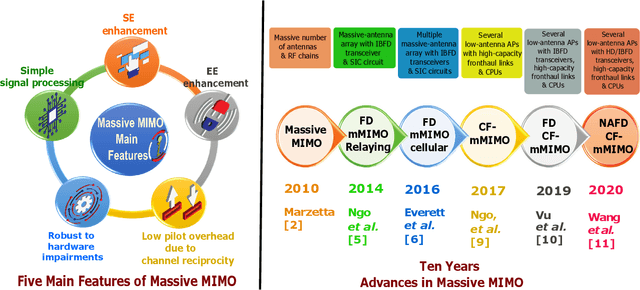
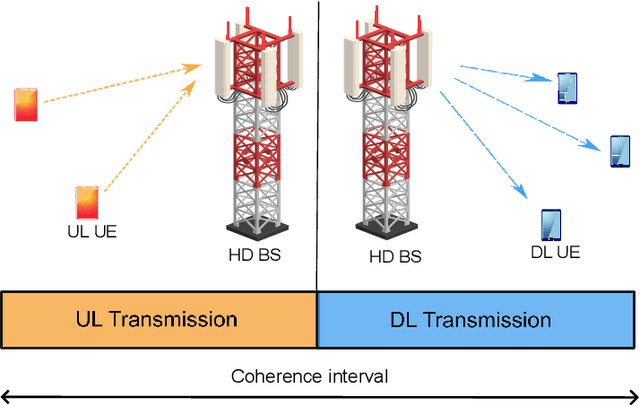
We present an overview of ongoing research endeavors focused on in-band full-duplex (IBFD) massive multiple-input multiple-output (MIMO) systems and their applications. In response to the unprecedented demands for mobile traffic in concurrent and upcoming wireless networks, a paradigm shift from conventional cellular networks to distributed communication systems becomes imperative. Cell-free massive MIMO (CF-mMIMO) emerges as a practical and scalable implementation of distributed/network MIMO systems, serving as a crucial physical layer technology for the advancement of next-generation wireless networks. This architecture inherits benefits from co-located massive MIMO and distributed systems and provides the flexibility for integration with the IBFD technology. We delineate the evolutionary trajectory of cellular networks, transitioning from conventional half-duplex multi-user MIMO networks to IBFD CF-mMIMO. The discussion extends further to the emerging paradigm of network-assisted IBFD CF-mMIMO (NAFD CF-mMIMO), serving as an energy-efficient prototype for asymmetric uplink and downlink communication services. This novel approach finds applications in dual-functionality scenarios, including simultaneous wireless power and information transmission, wireless surveillance, and integrated sensing and communications. We highlight various current use case applications, discuss open challenges, and outline future research directions aimed at fully realizing the potential of NAFD CF-mMIMO systems to meet the evolving demands of future wireless networks.
Next Generation Multiple Access with Cell-Free Massive MIMO
Aug 26, 2024To meet the unprecedented mobile traffic demands of future wireless networks, a paradigm shift from conventional cellular networks to distributed communication systems is imperative. Cell-free massive multiple-input multiple-output (CF-mMIMO) represents a practical and scalable embodiment of distributed/network MIMO systems. It inherits not only the key benefits of co-located massive MIMO systems but also the macro-diversity gains from distributed systems. This innovative architecture has demonstrated significant potential in enhancing network performance from various perspectives, outperforming co-located mMIMO and conventional small-cell systems. Moreover, CF-mMIMO offers flexibility in integration with emerging wireless technologies such as full-duplex (FD), non-orthogonal transmission schemes, millimeter-wave (mmWave) communications, ultra-reliable low-latency communication (URLLC), unmanned aerial vehicle (UAV)-aided communication, and reconfigurable intelligent surfaces (RISs). In this paper, we provide an overview of current research efforts on CF-mMIMO systems and their promising future application scenarios. We then elaborate on new requirements for CF-mMIMO networks in the context of these technological breakthroughs. We also present several current open challenges and outline future research directions aimed at fully realizing the potential of CF mMIMO systems in meeting the evolving demands of future wireless networks.