 Add to Chrome
 Add to Firefox
 Add to Edge
Anti-Malicious ISAC: How to Jointly Monitor and Disrupt Your Foes?
Dec 22, 2025
Integrated sensing and communication (ISAC) systems are key enablers of future networks but raise significant security concerns. In this realm, the emergence of malicious ISAC systems has amplified the need for authorized parties to legitimately monitor suspicious communication links and protect legitimate targets from potential detection or exploitation by malicious foes. In this paper, we propose a new wireless proactive monitoring paradigm, where a legitimate monitor intercepts a suspicious communication link while performing cognitive jamming to enhance the monitoring success probability (MSP) and simultaneously safeguard the target. To this end, we derive closed-form expressions of the signal-to-interference-plus-noise-ratio (SINR) at the user (UE), sensing access points (S-APs), and an approximating expression of the SINR at the proactive monitor. Moreover, we propose an optimization technique under which the legitimate monitor minimizes the success detection probability (SDP) of the legitimate target, by optimizing the jamming power allocation over both communication and sensing channels subject to total power constraints and monitoring performance requirement. To enhance the monitor's longevity and reduce the risk of detection by malicious ISAC systems, we further propose an adaptive power allocation scheme aimed at minimizing the total transmit power at the monitor while meeting a pre-selected sensing SINR threshold and ensuring successful monitoring. Our numerical results show that the proposed algorithm significantly compromises the sensing and communication performance of malicious ISAC.

Anti-Malicious ISAC Using Proactive Monitoring
Oct 06, 2024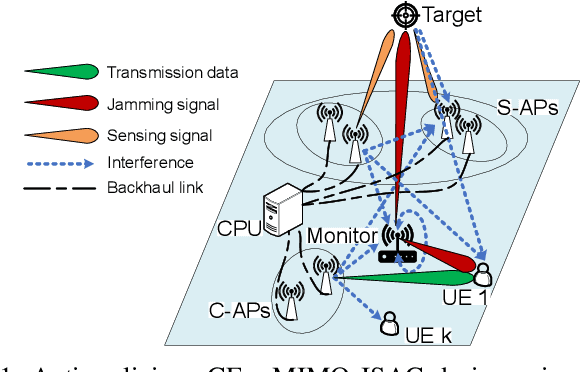

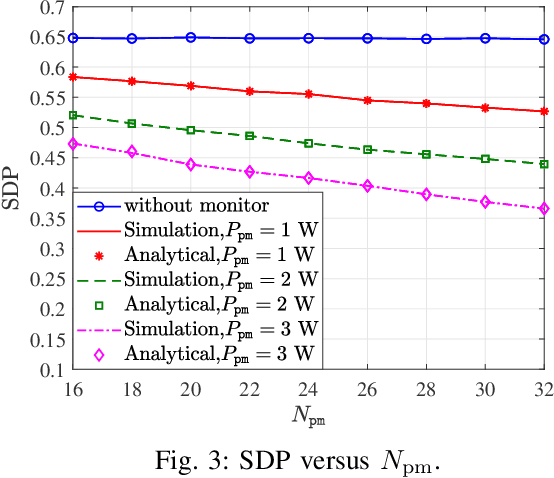
In this paper, we investigate proactive monitoring to mitigate malicious activities in integrated sensing and communication (ISAC) systems. Our focus is on a scenario where a cell-free massive multiple-input multiple-output (CF-mMIMO) architecture is exploited by malicious actors. Malicious actors use multiple access points (APs) to illegally sense a legitimate target while communicating with users (UEs), one of which is suspected of illegal activities. In our approach, a proactive monitor overhears the suspicious UE and simultaneously sends a jamming signal to degrade the communication links between the APs and suspicious UE. Simultaneously, the monitor sends a precoded jamming signal toward the legitimate target to hinder the malicious sensing attempts. We derive closed-form expressions for the sensing signal-to-interference-noise ratio (SINR), as well as the received SINR at the UEs and overheard SINR at the monitor. The simulation results show that our anti-malicious CF-mMIMO ISAC strategy can significantly reduce the sensing performance while offering excellent monitoring performance.