 Add to Chrome
 Add to Firefox
 Add to Edge
FilmBench: A Film-Grade Benchmark for Cinematic Video Generation
Jul 27, 2026
Progress in video generation keeps narrowing the visual gap between AI-generated and professionally produced footage, yet most benchmarks still draw prompts from web sources or LLM templates and score them with untrained, generic multimodal models. More fundamentally, their evaluation taxonomies remain rudimentary (overall visual quality, coarse text alignment and temporal smoothness) rather than the professional Cinematic Language criteria by which films are actually made and judged, so they assess basic video plausibility rather than film-grade craft. We introduce FilmBench, a text-to-video (T2V) and reference-to-video (R2V) benchmark grounded in the professional Cinematic Language of the film- academy tradition and co-developed with directors and faculty from the Beijing Film Academy and the Hujing Digital Media & Entertainment Group film studio. It rests on three choices. First, prompts are reverse-engineered from clips of award-winning films spanning 20 cinematic genres and chosen by professional directors, so every prompt is anchored to a verified live-action reference; the prompts follow real shot lists, and most script multiple shots (1,056 of the 1,169 prompts are multi-shot), unlike prior single-clip benchmarks. Second, evaluation follows a three-level Cinematic taxonomy of 3 axes, 12 components and 35 (T2V) +3 (R2V-only) sub-metrics. Third, we develop an in-house expert-grade automatic evaluation agent and open-source its core suite of Cinematic Language operators (FilmOps). Benchmarking leading video generation models (9 for T2V, 7 for R2V), the evaluator reproduces the human model ranking at model-level Spearman \r{ho} = 0.95 (T2V) and 0.96 (R2V). Scores fall well below prior web-style benchmarks, with two consistent gaps in dynamic aesthetics and a marked single- to multi-shot performance drop that widens for weaker models.

Vision-G1: Towards General Vision Language Reasoning with Multi-Domain Data Curation
Aug 18, 2025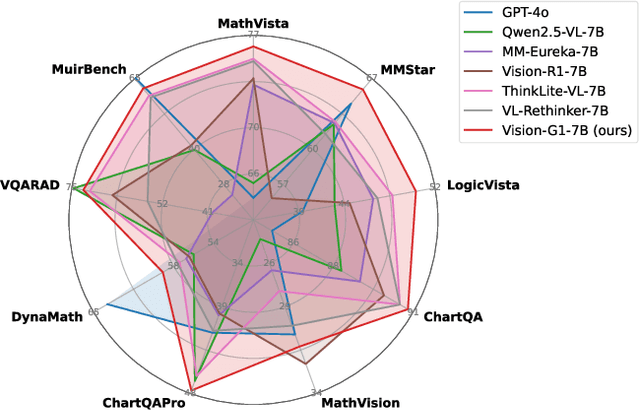
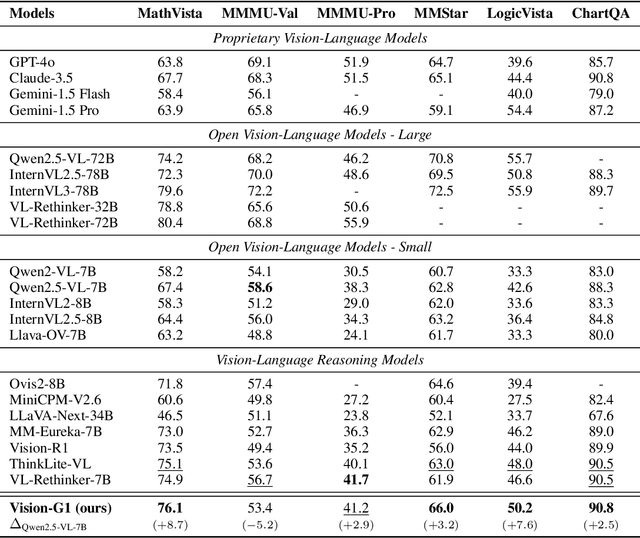
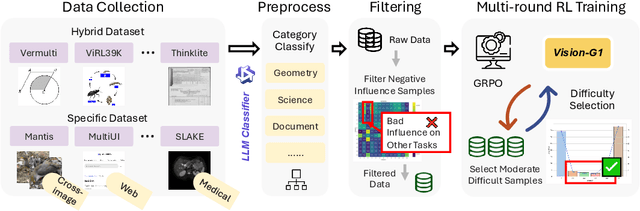
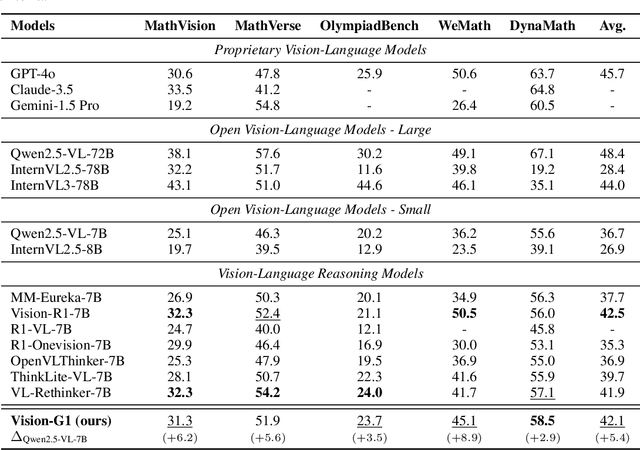
Despite their success, current training pipelines for reasoning VLMs focus on a limited range of tasks, such as mathematical and logical reasoning. As a result, these models face difficulties in generalizing their reasoning capabilities to a wide range of domains, primarily due to the scarcity of readily available and verifiable reward data beyond these narrowly defined areas. Moreover, integrating data from multiple domains is challenging, as the compatibility between domain-specific datasets remains uncertain. To address these limitations, we build a comprehensive RL-ready visual reasoning dataset from 46 data sources across 8 dimensions, covering a wide range of tasks such as infographic, mathematical, spatial, cross-image, graphic user interface, medical, common sense and general science. We propose an influence function based data selection and difficulty based filtering strategy to identify high-quality training samples from this dataset. Subsequently, we train the VLM, referred to as Vision-G1, using multi-round RL with a data curriculum to iteratively improve its visual reasoning capabilities. Our model achieves state-of-the-art performance across various visual reasoning benchmarks, outperforming similar-sized VLMs and even proprietary models like GPT-4o and Gemini-1.5 Flash. The model, code and dataset are publicly available at https://github.com/yuh-zha/Vision-G1.