 Add to Chrome
 Add to Firefox
 Add to Edge
NeuralActuator: Neural Actuation Modeling for Robot Dynamics and External Force Perception
Jul 13, 2026
Differentiable simulators have advanced policy learning and model-based control, yet actuator dynamics remain an important source of sim-to-real error. This is particularly acute on low-cost platforms, where the linear current-to-torque relation $τ= K_tI$ becomes unreliable during commanded-target tracking because of friction, hysteresis, backlash, and thermal effects. We present NeuralActuator, a neural actuator model that jointly predicts (i) a simulator-equivalent generalized-effort surrogate for trajectory propagation on low-cost servo platforms, (ii) external force with a contact-probability gate for sensorless force perception, and (iii) a motor-condition score for the supervised joint. We also introduce the Neural Actuation Dataset (NAD), collected with a twin-arm teleoperation system that records robot states and actuator telemetry together with external-force labels. The torque-surrogate head is trained through differentiable simulation from pose trajectories without direct generalized-effort labels, while the force, gate, and motor-condition heads receive direct supervision. A Transformer captures temporal dependencies while supporting real-time inference. We evaluate NeuralActuator on a 5-DoF OpenManipulator-X, a 6-DoF SO-101, and a 7-DoF Franka Emika Panda, spanning three actuator families and platforms costing approximately USD 500 to over USD 30,000. The low-cost platforms support dynamics and force evaluation, while the offline Franka experiment provides an additional payload-force-estimation benchmark. Experiments further demonstrate its application for motor condition estimation on OpenManipulator-X and improved behavior-cloning performance when NeuralActuator is used as a pretrained module.

Huddle: Parallel Shape Assembly using Decentralized, Minimalistic Robots
Mar 18, 2026We propose a novel algorithm for forming arbitrarily shaped assemblies using decentralized robots. By relying on local interactions, the algorithm ensures there are no unreachable states or gaps in the assembly, which are global properties. The in-assembly robots attract passing-by robots into expanding the assembly via a simple implementation of signaling and alignment. Our approach is minimalistic, requiring only communication between attached, immediate neighbors. It is motion-agnostic and requires no pose localization, enabling asynchronous and order-independent assembly. We prove the algorithm's correctness and demonstrate its effectiveness in forming a 107-robot assembly.
Learning Object Properties Using Robot Proprioception via Differentiable Robot-Object Interaction
Oct 04, 2024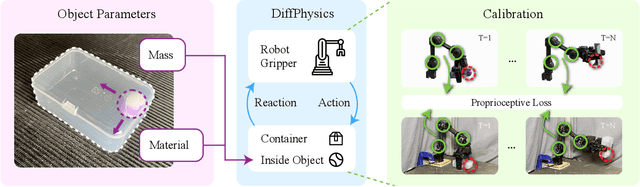
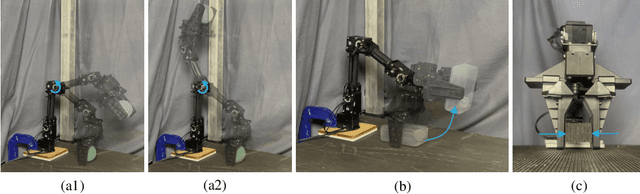
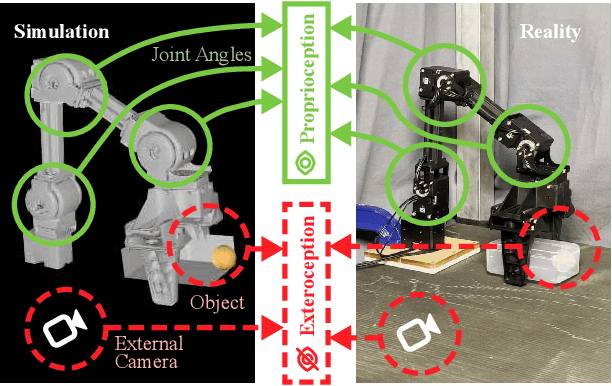
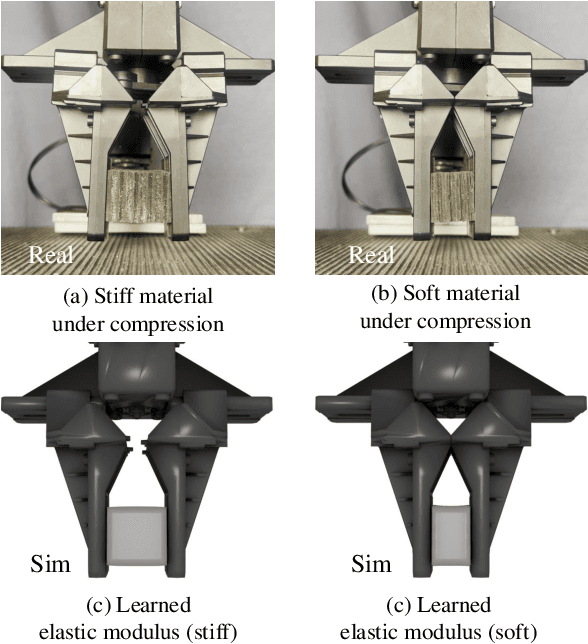
Differentiable simulation has become a powerful tool for system identification. While prior work has focused on identifying robot properties using robot-specific data or object properties using object-specific data, our approach calibrates object properties by using information from the robot, without relying on data from the object itself. Specifically, we utilize robot joint encoder information, which is commonly available in standard robotic systems. Our key observation is that by analyzing the robot's reactions to manipulated objects, we can infer properties of those objects, such as inertia and softness. Leveraging this insight, we develop differentiable simulations of robot-object interactions to inversely identify the properties of the manipulated objects. Our approach relies solely on proprioception -- the robot's internal sensing capabilities -- and does not require external measurement tools or vision-based tracking systems. This general method is applicable to any articulated robot and requires only joint position information. We demonstrate the effectiveness of our method on a low-cost robotic platform, achieving accurate mass and elastic modulus estimations of manipulated objects with just a few seconds of computation on a laptop.