 Add to Chrome
 Add to Firefox
 Add to Edge
Confidence-Orchestrated Self-Evolution against Uncertain LLM Feedback
May 27, 2026
Self-evolving large language models (LLMs) learn by generating their own training tasks and solutions, reducing reliance on human-curated supervision. However, in many reasoning domains, the model must also validate generated tasks and judge generated answers to obtain training signals. This creates a training-signal challenge: erroneous self-judgments become erroneous gradient updates. Existing approaches either rely on external verifiers, which limits generality, or treat noisy self-generated feedback as supervision. We propose COSE (Confidence-Orchestrated Self-Evolution), which uses the LLM's intrinsic confidence as a lightweight uncertainty signal to modulate learning. COSE introduces confidence-weighted PPO updates and confidence-prioritized replay. Across 19 held-out benchmarks and four Qwen/Llama backbones (0.6B--4B), COSE consistently improves over base models and achieves the best average performance in general reasoning and mathematics, while remaining competitive on code. Code and data are available at https://anonymous.4open.science/r/COSE_-B5C2.

Residual Attention Physics-Informed Neural Networks for Robust Multiphysics Simulation of Steady-State Electrothermal Energy Systems
Mar 24, 2026Efficient thermal management and precise field prediction are critical for the design of advanced energy systems, including electrohydrodynamic transport, microfluidic energy harvesters, and electrically driven thermal regulators. However, the steady-state simulation of these electrothermal coupled multiphysics systems remains challenging for physics-informed neural computation due to strong nonlinear field coupling, temperature-dependent coefficient variability, and complex interface dynamics. This study proposes a Residual Attention Physics-Informed Neural Network (RA-PINN) framework for the unified solution of coupled velocity, pressure, electric-potential, and temperature fields. By integrating a unified five-field operator formulation with residual-connected feature propagation and attention-guided channel modulation, the proposed architecture effectively captures localized coupling structures and steep gradients. We evaluate RA-PINN across four representative energy-relevant benchmarks: constant-coefficient coupling, indirect pressure-gauge constraints, temperature-dependent transport, and oblique-interface consistency. Comparative analysis against Pure-MLP, LSTM-PINN, and pLSTM-PINN demonstrates that RA-PINN achieves superior accuracy, yielding the lowest MSE, RMSE, and relative $L_2$ errors across all scenarios. Notably, RA-PINN maintains high structural fidelity in interface-dominated and variable-coefficient settings where conventional PINN backbones often fail. These results establish RA-PINN as a robust and accurate computational framework for the high-fidelity modeling and optimization of complex electrothermal multiphysics in sustainable energy applications.
WISE-Flow: Workflow-Induced Structured Experience for Self-Evolving Conversational Service Agents
Jan 13, 2026Large language model (LLM)-based agents are widely deployed in user-facing services but remain error-prone in new tasks, tend to repeat the same failure patterns, and show substantial run-to-run variability. Fixing failures via environment-specific training or manual patching is costly and hard to scale. To enable self-evolving agents in user-facing service environments, we propose WISE-Flow, a workflow-centric framework that converts historical service interactions into reusable procedural experience by inducing workflows with prerequisite-augmented action blocks. At deployment, WISE-Flow aligns the agent's execution trajectory to retrieved workflows and performs prerequisite-aware feasibility reasoning to achieve state-grounded next actions. Experiments on ToolSandbox and $τ^2$-bench show consistent improvement across base models.
A fine-grained look at causal effects in causal spaces
Dec 16, 2025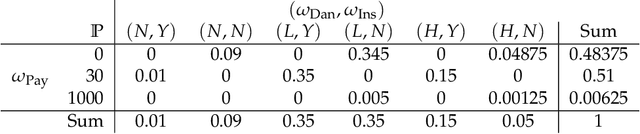
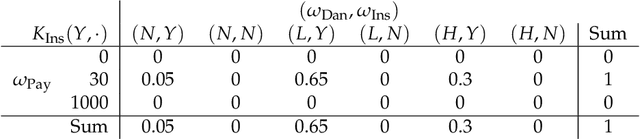
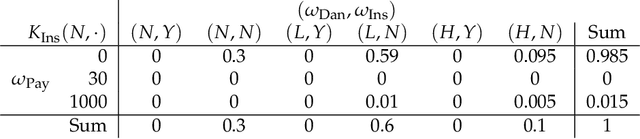
The notion of causal effect is fundamental across many scientific disciplines. Traditionally, quantitative researchers have studied causal effects at the level of variables; for example, how a certain drug dose (W) causally affects a patient's blood pressure (Y). However, in many modern data domains, the raw variables-such as pixels in an image or tokens in a language model-do not have the semantic structure needed to formulate meaningful causal questions. In this paper, we offer a more fine-grained perspective by studying causal effects at the level of events, drawing inspiration from probability theory, where core notions such as independence are first given for events and sigma-algebras, before random variables enter the picture. Within the measure-theoretic framework of causal spaces, a recently introduced axiomatisation of causality, we first introduce several binary definitions that determine whether a causal effect is present, as well as proving some properties of them linking causal effect to (in)dependence under an intervention measure. Further, we provide quantifying measures that capture the strength and nature of causal effects on events, and show that we can recover the common measures of treatment effect as special cases.
Towards Robust Text Classification: Mitigating Spurious Correlations with Causal Learning
Nov 01, 2024
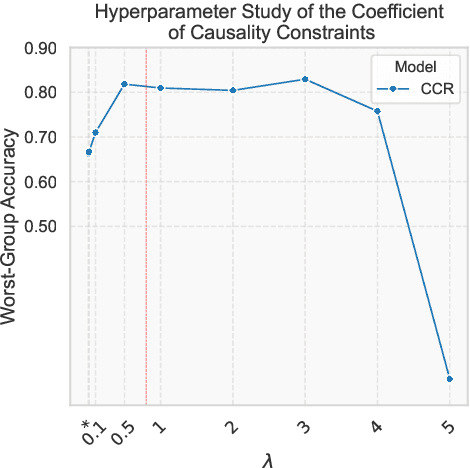
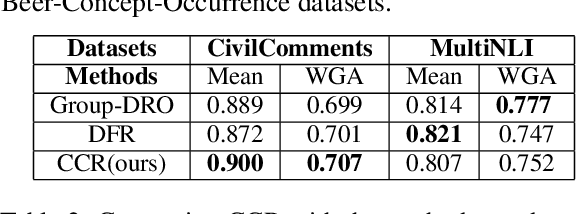
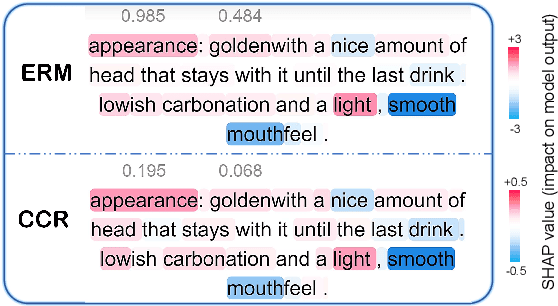
In text classification tasks, models often rely on spurious correlations for predictions, incorrectly associating irrelevant features with the target labels. This issue limits the robustness and generalization of models, especially when faced with out-of-distribution data where such spurious correlations no longer hold. To address this challenge, we propose the Causally Calibrated Robust Classifier (CCR), which aims to reduce models' reliance on spurious correlations and improve model robustness. Our approach integrates a causal feature selection method based on counterfactual reasoning, along with an unbiased inverse propensity weighting (IPW) loss function. By focusing on selecting causal features, we ensure that the model relies less on spurious features during prediction. We theoretically justify our approach and empirically show that CCR achieves state-of-the-art performance among methods without group labels, and in some cases, it can compete with the models that utilize group labels.
Navigating the Shortcut Maze: A Comprehensive Analysis of Shortcut Learning in Text Classification by Language Models
Sep 26, 2024Language models (LMs), despite their advances, often depend on spurious correlations, undermining their accuracy and generalizability. This study addresses the overlooked impact of subtler, more complex shortcuts that compromise model reliability beyond oversimplified shortcuts. We introduce a comprehensive benchmark that categorizes shortcuts into occurrence, style, and concept, aiming to explore the nuanced ways in which these shortcuts influence the performance of LMs. Through extensive experiments across traditional LMs, large language models, and state-of-the-art robust models, our research systematically investigates models' resilience and susceptibilities to sophisticated shortcuts. Our benchmark and code can be found at: https://github.com/yuqing-zhou/shortcut-learning-in-text-classification.