 Add to Chrome
 Add to Firefox
 Add to Edge
Gemini Embedding 2: A Native Multimodal Embedding Model from Gemini
May 26, 2026
We introduce Gemini Embedding 2, a native multimodal embedding model that allows embedding video, audio, image, and text modalities in a unified representation space. We leverage the multimodal capabilities of Gemini to produce embeddings for arbitrary combinations of interleaved inputs across all these modalities that generalize well across a wide variety of tasks. Applying large-scale contrastive learning in a multi-task multi-stage training setup, we achieve state-of-the-art performance on key embedding benchmarks including unimodal, cross-modal, and multimodal retrieval spanning a diverse set of tasks. We show that our embedding model demonstrates strong performance (with a score of 62.9 R@1 on MSCOCO, 68.8 NDCG@10 on Vatex, 69.9 on MTEB multilingual and 84.0 on MTEB Code) across a variety of tasks surpassing the performance of specialized models. These unified capabilities make Gemini Embedding 2 a promising candidate for downstream use cases such as RAG, recommendation and search. Furthermore, its robust zero-shot performance across distinct fields - from astronomy and bioscience to fine arts and the culinary arts - establishes it as a highly reliable, out-of-the-box representation even for specialized domains.

Gemini Embedding: Generalizable Embeddings from Gemini
Mar 10, 2025In this report, we introduce Gemini Embedding, a state-of-the-art embedding model leveraging the power of Gemini, Google's most capable large language model. Capitalizing on Gemini's inherent multilingual and code understanding capabilities, Gemini Embedding produces highly generalizable embeddings for text spanning numerous languages and textual modalities. The representations generated by Gemini Embedding can be precomputed and applied to a variety of downstream tasks including classification, similarity, clustering, ranking, and retrieval. Evaluated on the Massive Multilingual Text Embedding Benchmark (MMTEB), which includes over one hundred tasks across 250+ languages, Gemini Embedding substantially outperforms prior state-of-the-art models, demonstrating considerable improvements in embedding quality. Achieving state-of-the-art performance across MMTEB's multilingual, English, and code benchmarks, our unified model demonstrates strong capabilities across a broad selection of tasks and surpasses specialized domain-specific models.
Characterizing Attribution and Fluency Tradeoffs for Retrieval-Augmented Large Language Models
Feb 14, 2023Despite recent progress, it has been difficult to prevent semantic hallucinations in generative Large Language Models. One common solution to this is augmenting LLMs with a retrieval system and making sure that the generated output is attributable to the retrieved information. Given this new added constraint, it is plausible to expect that the overall quality of the output will be affected, for example, in terms of fluency. Can scaling language models help? Here we examine the relationship between fluency and attribution in LLMs prompted with retrieved evidence in knowledge-heavy dialog settings. Our experiments were implemented with a set of auto-metrics that are aligned with human preferences. They were used to evaluate a large set of generations, produced under varying parameters of LLMs and supplied context. We show that larger models tend to do much better in both fluency and attribution, and that (naively) using top-k retrieval versus top-1 retrieval improves attribution but hurts fluency. We next propose a recipe that could allow smaller models to both close the gap with larger models and preserve the benefits of top-k retrieval while avoiding its drawbacks.
Scaling Up Visual and Vision-Language Representation Learning With Noisy Text Supervision
Feb 11, 2021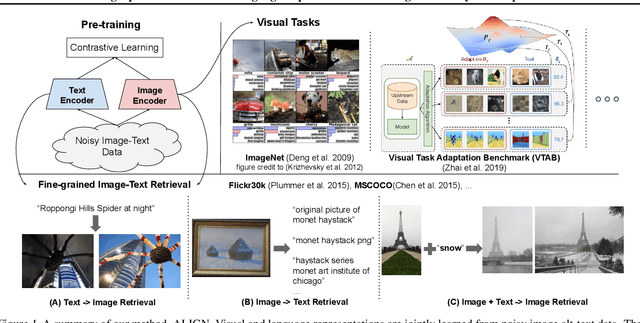
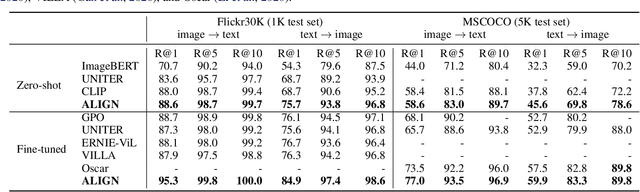
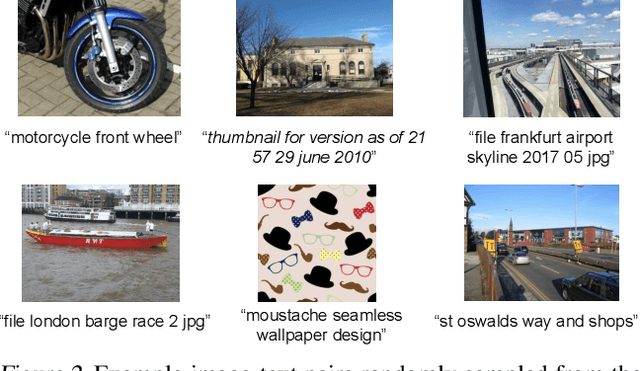

Pre-trained representations are becoming crucial for many NLP and perception tasks. While representation learning in NLP has transitioned to training on raw text without human annotations, visual and vision-language representations still rely heavily on curated training datasets that are expensive or require expert knowledge. For vision applications, representations are mostly learned using datasets with explicit class labels such as ImageNet or OpenImages. For vision-language, popular datasets like Conceptual Captions, MSCOCO, or CLIP all involve a non-trivial data collection (and cleaning) process. This costly curation process limits the size of datasets and hence hinders the scaling of trained models. In this paper, we leverage a noisy dataset of over one billion image alt-text pairs, obtained without expensive filtering or post-processing steps in the Conceptual Captions dataset. A simple dual-encoder architecture learns to align visual and language representations of the image and text pairs using a contrastive loss. We show that the scale of our corpus can make up for its noise and leads to state-of-the-art representations even with such a simple learning scheme. Our visual representation achieves strong performance when transferred to classification tasks such as ImageNet and VTAB. The aligned visual and language representations also set new state-of-the-art results on Flickr30K and MSCOCO benchmarks, even when compared with more sophisticated cross-attention models. The representations also enable cross-modality search with complex text and text + image queries.